Cargo Drones
Cargo Drones Market Research Report 2036
Cargo Drones Market Report is Segmented By Payload Capacity (Below 50 Kg, 50–100 Kg, 100–150 Kg, 150–200 Kg, Above 200 Kg), By Range (Below 15 Km, 15–30 Km, 30–45 Km, Above 45 Km), By Drone Type (Commercial, Military & Defense), By End Use Industry (Logistics, Healthcare & Pharmaceuticals, Food & Beverages, e-Commerce & Retail, Consumer Electronics, Defense, Construction and Mining, Others), By Propulsion Type (Electric Powered, Hybrid Powered, Fuel Powered), By Region (North America, Europe, Asia Pacific, Latin America, Middle East & Africa), and Geography (North America, Europe, Asia-Pacific, South America, and the Middle East and Africa). The Market Forecasts are Provided in Terms of Value (USD)
Cargo Drones Market Outlook
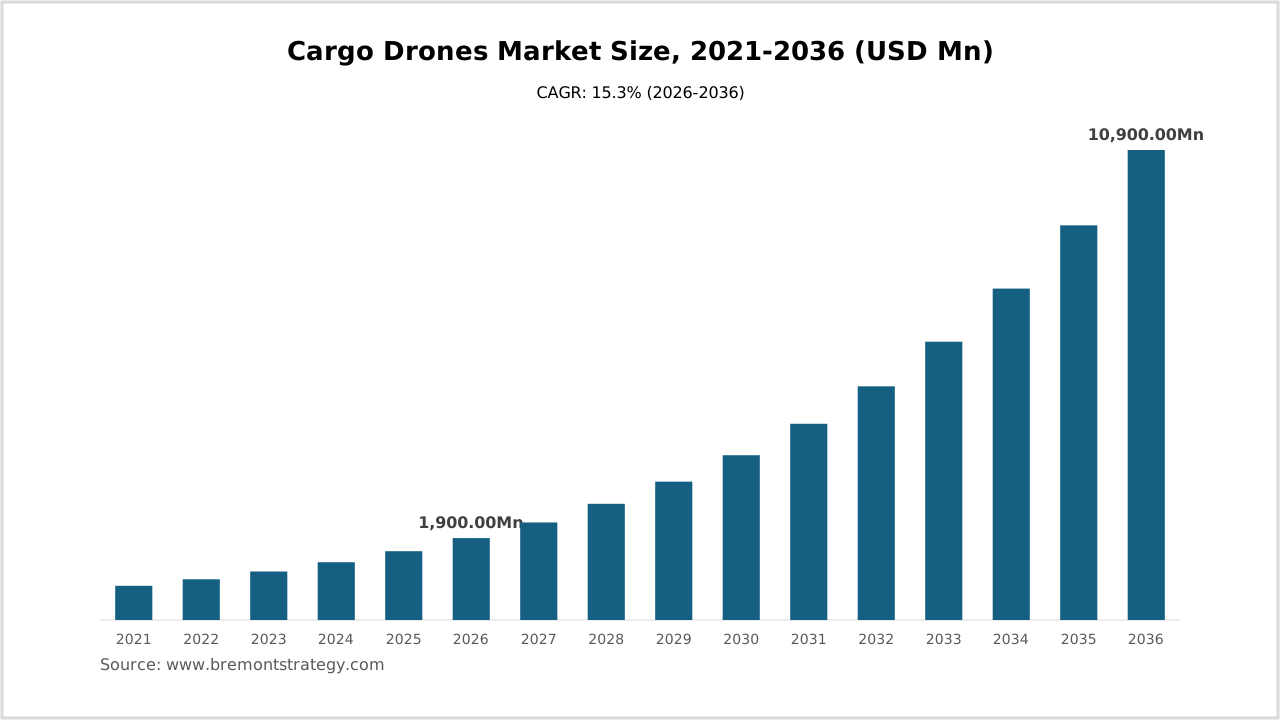
The Cargo Drones market was valued at USD 1,900 million in 2026 and is projected to reach USD 10,900 million by 2036, growing at a CAGR of 15.3% during the forecast period 2026-2036. This significant growth is driven by the increasing demand for efficient and rapid delivery solutions across various industries, including logistics, healthcare, and e-commerce. The ability of cargo drones to bypass traditional transportation challenges such as traffic congestion and geographical barriers is a key factor contributing to their rising adoption.
Cargo drones are unmanned aerial vehicles designed specifically for transporting goods. They operate autonomously or semi-autonomously, using advanced navigation systems and sensors to ensure safe and efficient delivery. Unlike conventional delivery methods, cargo drones offer the advantage of reduced delivery times and operational costs, making them an attractive option for businesses looking to optimize their supply chain operations. The integration of AI and IoT technologies further enhances their capabilities, allowing for real-time tracking and data analytics.
The demand for cargo drones is structurally driven by the need for faster delivery times and the expansion of e-commerce. Infrastructure development, such as drone-friendly logistics hubs and regulatory frameworks, is crucial for market growth. Technological advancements, including improvements in battery life, payload capacity, and range, are also pivotal. The focus on sustainability and reducing carbon footprints is encouraging the adoption of electric and hybrid-powered drones, aligning with global environmental goals.
Competitive dynamics in the cargo drones market are shaped by factors such as product performance, pricing strategies, and technological innovation. Companies are investing in R&D to enhance drone capabilities and expand their product portfolios. Strategic partnerships and collaborations are common as firms seek to strengthen their market presence and distribution networks. Brand reputation and reliability are critical for gaining customer trust, while compliance with safety and regulatory standards remains a priority for market participants.
Cargo Drones Market Key Takeaways
- The Cargo Drones market is expected to grow from USD 1,900 million in 2026 to USD 10,900 million by 2036, at a CAGR of 15.3%.
- Technological advancements in AI and IoT are enhancing the operational efficiency and capabilities of cargo drones.
- Electric and hybrid-powered drones are gaining traction due to their alignment with sustainability goals and reduced carbon emissions.
- Regulatory frameworks and infrastructure development are critical for the widespread adoption of cargo drones.
- Key industries driving demand include logistics, healthcare, and e-commerce, with a focus on reducing delivery times and costs.
Cargo Drones Market Key Drivers
| Drivers | Impact |
|---|---|
| Technological Advancements | Enhance drone capabilities and operational efficiency, driving market growth. |
| Rising E-commerce Demand | Increases the need for efficient delivery solutions, boosting drone adoption. |
| Regulatory Support | Facilitates market expansion through favorable policies and infrastructure. |
Technological Advancements
Technological advancements are a primary driver of the cargo drones market, significantly enhancing the capabilities and efficiency of these unmanned aerial vehicles. Innovations in AI and IoT have enabled drones to perform complex tasks autonomously, improving navigation, obstacle avoidance, and delivery precision. Additionally, advancements in battery technology have extended flight times and increased payload capacities, making drones more viable for a broader range of applications. These technological improvements not only enhance operational efficiency but also reduce costs, making cargo drones an attractive option for businesses seeking to optimize their logistics operations.
Rising E-commerce Demand
The rapid growth of e-commerce is a significant driver for the cargo drones market. As online shopping becomes increasingly popular, the demand for efficient and timely delivery solutions has surged. Cargo drones offer a compelling solution by providing faster delivery times and reducing logistical bottlenecks associated with traditional transportation methods. This demand is particularly pronounced in urban areas where traffic congestion can delay deliveries. By leveraging drones, e-commerce companies can enhance customer satisfaction through quicker delivery times, thereby gaining a competitive edge in the market.
Regulatory Support
Regulatory support plays a crucial role in the expansion of the cargo drones market. Governments worldwide are recognizing the potential of drones to revolutionize logistics and are implementing favorable policies to facilitate their adoption. This includes developing regulatory frameworks that ensure safety and compliance while promoting innovation. Infrastructure development, such as the establishment of drone-friendly logistics hubs and air corridors, is also being prioritized. These initiatives not only provide a conducive environment for market growth but also encourage investment in drone technology, further driving the market forward.
Cargo Drones Market Opportunities and Challenges
| Opportunity | Challenges |
|---|---|
| Urban Delivery Solutions | Regulatory Compliance |
| Healthcare Logistics | Technological Limitations |
| Infrastructure Development | Cost Constraints |
The cargo drones market presents several opportunities, particularly in urban delivery solutions. As cities become more congested, the need for efficient delivery systems that can bypass traffic is growing. Cargo drones offer a viable solution by providing rapid and direct delivery routes. Additionally, the healthcare sector presents significant opportunities, as drones can be used to transport medical supplies and samples quickly and efficiently, especially in remote or hard-to-reach areas. Infrastructure development, including the creation of drone-friendly logistics hubs, further enhances the potential for market growth.
Despite the opportunities, the cargo drones market faces several challenges. Regulatory compliance remains a significant hurdle, as companies must navigate complex and varying regulations across different regions. Technological limitations, such as battery life and payload capacity, also pose challenges to widespread adoption. Furthermore, cost constraints, including the high initial investment and maintenance costs, can deter smaller companies from entering the market. Addressing these challenges will be crucial for the sustained growth and success of the cargo drones market.
Cargo Drones Market Report Scope
| Attributes | Details |
|---|---|
| Report Title: | Cargo Drones Market Research Report 2036 |
| By Payload Capacity | Below 50 Kg, 50–100 Kg, 100–150 Kg, 150–200 Kg, Above 200 Kg |
| By Range | Below 15 Km, 15–30 Km, 30–45 Km, Above 45 Km |
| By Drone Type | Commercial, Military & Defense |
| By End Use Industry | Logistics, Healthcare & Pharmaceuticals, Food & Beverages, e-Commerce & Retail, Consumer Electronics, Defense, Construction and Mining, Others |
| By Propulsion Type | Electric Powered, Hybrid Powered, Fuel Powered |
| By Region | North America, Europe, Asia Pacific, Latin America, Middle East & Africa |
| Countries Covered: | North America (United States, Canada), Europe (Germany, France, UK, Italy, Spain, Rest of Europe), Asia Pacific (China, Japan, India, South Korea, Australia, Rest of Asia Pacific), Latin America (Brazil, Mexico, Rest of Latin America), Middle East & Africa (Saudi Arabia, UAE, South Africa, Rest of Middle East & Africa) |
| Base Year: | 2026 |
| Historic Data: | 2021-2025 |
| Forecast Period: | 2026-2036 |
| Number of Pages: | 289 |
| Number of Tables & Figures: | 347 |
| Customization Available: | Yes, the report can be customized by segment, region, country, or company upon request. |
Cargo Drones Market Segment Analysis
The Cargo Drones market is segmented based on payload capacity, range, drone type, end use industry, propulsion type, and region. Each segment plays a crucial role in defining the market dynamics and addressing specific industry needs.
By Payload Capacity Analysis
| Segment | Market Share | Growth Rate | Key Insight |
|---|---|---|---|
| Below 50 Kg | - | - | Ideal for small parcel deliveries in urban areas. |
| 50–100 Kg | - | - | Suitable for medium-sized packages and medical supplies. |
| 100–150 Kg | - | - | Balances payload capacity with range for diverse applications. |
| 150–200 Kg | - | - | Targets industrial and commercial logistics needs. |
| Above 200 Kg | - | - | Supports heavy-duty logistics and defense applications. |
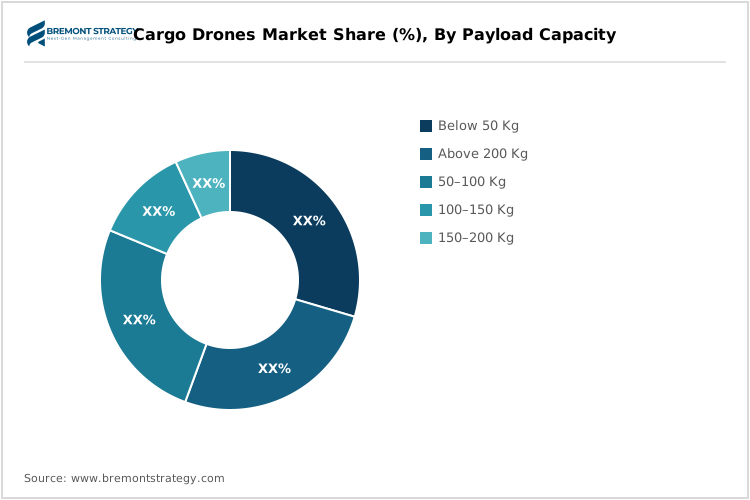
The payload capacity segment is crucial in determining the operational scope of cargo drones. Drones with a capacity below 50 Kg are primarily used for small parcel deliveries, especially in urban settings where quick and efficient delivery is essential. The 50–100 Kg segment caters to medium-sized packages, including medical supplies, which require timely delivery. Drones with a capacity of 100–150 Kg offer a balance between payload and range, making them versatile for various applications. The 150–200 Kg segment is designed for industrial and commercial logistics, where larger payloads are common. Drones with a capacity above 200 Kg are used for heavy-duty logistics and defense applications, where substantial payloads are necessary.
Demand across these sub-segments is influenced by technological advancements, regulatory frameworks, and industry-specific requirements. For instance, the healthcare sector's need for rapid delivery of medical supplies drives demand for drones in the 50–100 Kg range. Similarly, the logistics industry's focus on efficiency and cost reduction supports the adoption of drones with higher payload capacities. Regulatory developments, such as the establishment of drone-friendly air corridors, further facilitate the growth of these segments. Technological innovations, including improvements in battery life and navigation systems, enhance the operational capabilities of drones across all payload capacities.
Opportunities for growth in the payload capacity segments are driven by ongoing research and development efforts aimed at increasing payload limits and extending flight ranges. However, challenges such as regulatory compliance and cost constraints may hinder adoption. The need for specialized infrastructure and trained personnel to operate larger drones also presents barriers. Despite these challenges, the market is poised for growth as companies continue to innovate and adapt to changing industry needs. The development of hybrid and electric propulsion systems is expected to further enhance the capabilities of drones across all payload capacities, supporting their adoption in new and existing markets.
By Range Analysis
| Segment | Market Share | Growth Rate | Key Insight |
|---|---|---|---|
| Below 15 Km | - | - | Optimal for short-distance urban deliveries. |
| 15–30 Km | - | - | Balances range with payload for suburban areas. |
| 30–45 Km | - | - | Suitable for intercity logistics and healthcare. |
| Above 45 Km | - | - | Targets long-distance and rural deliveries. |
The range of cargo drones is a critical factor in determining their application and effectiveness. Drones with a range below 15 Km are primarily used for short-distance urban deliveries, where quick turnaround times are essential. The 15–30 Km range segment offers a balance between range and payload capacity, making it suitable for suburban deliveries. Drones with a range of 30–45 Km are ideal for intercity logistics and healthcare applications, where timely delivery is crucial. The above 45 Km range segment targets long-distance and rural deliveries, where traditional transportation methods may be less efficient.
Factors influencing demand across these range segments include technological advancements, regulatory developments, and industry-specific needs. For example, the healthcare sector's requirement for rapid delivery of medical supplies drives demand for drones with longer ranges. Similarly, the logistics industry's focus on efficiency and cost reduction supports the adoption of drones with extended ranges. Regulatory frameworks, such as the establishment of drone-friendly air corridors, further facilitate the growth of these segments. Technological innovations, including improvements in battery life and navigation systems, enhance the operational capabilities of drones across all range segments.
Opportunities for growth in the range segments are driven by ongoing research and development efforts aimed at extending flight ranges and increasing payload capacities. However, challenges such as regulatory compliance and cost constraints may hinder adoption. The need for specialized infrastructure and trained personnel to operate drones with longer ranges also presents barriers. Despite these challenges, the market is poised for growth as companies continue to innovate and adapt to changing industry needs. The development of hybrid and electric propulsion systems is expected to further enhance the capabilities of drones across all range segments, supporting their adoption in new and existing markets.
By Drone Type Analysis
| Segment | Market Share | Growth Rate | Key Insight |
|---|---|---|---|
| Commercial | - | - | Widely used in logistics and e-commerce sectors. |
| Military & Defense | - | - | Essential for tactical and strategic operations. |
The drone type segment is divided into commercial and military & defense applications. Commercial drones are widely used in logistics and e-commerce sectors, where they provide efficient delivery solutions and reduce operational costs. These drones are designed to handle a variety of payloads and ranges, making them versatile for different applications. Military & defense drones, on the other hand, are essential for tactical and strategic operations, where they provide critical support in surveillance, reconnaissance, and logistics.
Demand for commercial drones is driven by the growing need for efficient delivery solutions in the logistics and e-commerce sectors. These industries require drones that can handle a variety of payloads and ranges, making commercial drones an attractive option. Military & defense drones are driven by the need for advanced surveillance and reconnaissance capabilities, as well as logistical support in tactical operations. Regulatory frameworks and technological advancements play a crucial role in shaping demand across these segments, as they influence the operational capabilities and adoption of drones.
Opportunities for growth in the drone type segments are driven by ongoing research and development efforts aimed at enhancing drone capabilities and expanding their applications. However, challenges such as regulatory compliance and cost constraints may hinder adoption. The need for specialized infrastructure and trained personnel to operate drones also presents barriers. Despite these challenges, the market is poised for growth as companies continue to innovate and adapt to changing industry needs. The development of hybrid and electric propulsion systems is expected to further enhance the capabilities of drones across all drone types, supporting their adoption in new and existing markets.
By End Use Industry Analysis
| Segment | Market Share | Growth Rate | Key Insight |
|---|---|---|---|
| Logistics | - | - | Key driver for drone adoption due to efficiency needs. |
| Healthcare & Pharmaceuticals | - | - | Critical for rapid delivery of medical supplies. |
| Food & Beverages | - | - | Emerging use in quick service and delivery. |
| e-Commerce & Retail | - | - | Boosted by demand for fast delivery services. |
| Consumer Electronics | - | - | Supports efficient distribution of high-value items. |
| Defense | - | - | Utilized for strategic and tactical logistics. |
| Construction and Mining | - | - | Facilitates transport of equipment and materials. |
| Others | - | - | Includes niche applications across various sectors. |
The end use industry segment is diverse, with logistics, healthcare & pharmaceuticals, food & beverages, e-commerce & retail, consumer electronics, defense, construction and mining, and others. Each industry has unique requirements and applications for cargo drones. Logistics is a key driver for drone adoption, as companies seek to improve efficiency and reduce delivery times. Healthcare & pharmaceuticals rely on drones for the rapid delivery of medical supplies, especially in remote areas. The food & beverages industry is exploring drones for quick service and delivery, while e-commerce & retail benefit from the demand for fast delivery services. Consumer electronics use drones for the efficient distribution of high-value items, while defense applications focus on strategic and tactical logistics. Construction and mining industries utilize drones for the transport of equipment and materials, while other sectors explore niche applications.
Demand across these industries is influenced by technological advancements, regulatory frameworks, and industry-specific needs. For example, the logistics industry's focus on efficiency and cost reduction supports the adoption of drones, while the healthcare sector's need for rapid delivery drives demand for drones in that industry. Regulatory developments, such as the establishment of drone-friendly air corridors, further facilitate the growth of these segments. Technological innovations, including improvements in battery life and navigation systems, enhance the operational capabilities of drones across all end use industries.
Opportunities for growth in the end use industry segments are driven by ongoing research and development efforts aimed at expanding drone applications and enhancing their capabilities. However, challenges such as regulatory compliance and cost constraints may hinder adoption. The need for specialized infrastructure and trained personnel to operate drones also presents barriers. Despite these challenges, the market is poised for growth as companies continue to innovate and adapt to changing industry needs. The development of hybrid and electric propulsion systems is expected to further enhance the capabilities of drones across all end use industries, supporting their adoption in new and existing markets.
By Propulsion Type Analysis
| Segment | Market Share | Growth Rate | Key Insight |
|---|---|---|---|
| Electric Powered | - | - | Favored for sustainability and lower emissions. |
| Hybrid Powered | - | - | Offers balance between range and efficiency. |
| Fuel Powered | - | - | Suitable for long-range and heavy payloads. |
The propulsion type segment is divided into electric powered, hybrid powered, and fuel powered drones. Electric powered drones are favored for their sustainability and lower emissions, aligning with global environmental goals. Hybrid powered drones offer a balance between range and efficiency, making them suitable for a variety of applications. Fuel powered drones are suitable for long-range and heavy payloads, where extended flight times and higher capacities are required.
Demand for electric powered drones is driven by the growing focus on sustainability and reducing carbon footprints. These drones are ideal for urban deliveries, where emissions regulations are stringent. Hybrid powered drones are popular for their versatility, offering a balance between range and efficiency. Fuel powered drones are essential for applications requiring long-range capabilities and heavy payloads, such as defense and industrial logistics. Technological advancements, regulatory frameworks, and industry-specific needs influence demand across these propulsion types.
Opportunities for growth in the propulsion type segments are driven by ongoing research and development efforts aimed at enhancing drone capabilities and expanding their applications. However, challenges such as regulatory compliance and cost constraints may hinder adoption. The need for specialized infrastructure and trained personnel to operate drones also presents barriers. Despite these challenges, the market is poised for growth as companies continue to innovate and adapt to changing industry needs. The development of hybrid and electric propulsion systems is expected to further enhance the capabilities of drones across all propulsion types, supporting their adoption in new and existing markets.
By Region Analysis
| Segment | Market Share | Growth Rate | Key Insight |
|---|---|---|---|
| North America | - | - | Strong infrastructure and regulatory support. |
| Europe | - | - | Focus on sustainability and innovation. |
| Asia Pacific | - | - | Rapid industrialization and e-commerce growth. |
| Latin America | - | - | Emerging market with growing logistics needs. |
| Middle East & Africa | - | - | Infrastructure development and strategic investments. |
The regional analysis of the cargo drones market highlights the unique characteristics and growth drivers in each region. North America benefits from strong infrastructure and regulatory support, making it a key market for cargo drones. The region's focus on technological innovation and efficiency drives demand for drones across various industries. Europe is characterized by its focus on sustainability and innovation, with regulatory frameworks supporting the adoption of drones. The region's emphasis on reducing carbon emissions aligns with the growing demand for electric and hybrid powered drones.
Asia Pacific is experiencing rapid industrialization and e-commerce growth, driving demand for efficient delivery solutions. The region's large population and expanding middle class contribute to the growth of the cargo drones market. Latin America is an emerging market with growing logistics needs, driven by increasing trade and infrastructure development. The region's focus on improving supply chain efficiency supports the adoption of drones. The Middle East & Africa region is characterized by infrastructure development and strategic investments, with governments recognizing the potential of drones to enhance logistics and transportation.
Opportunities for growth in each region are driven by ongoing research and development efforts, regulatory support, and industry-specific needs. However, challenges such as regulatory compliance and cost constraints may hinder adoption. The need for specialized infrastructure and trained personnel to operate drones also presents barriers. Despite these challenges, the market is poised for growth as companies continue to innovate and adapt to changing industry needs. The development of hybrid and electric propulsion systems is expected to further enhance the capabilities of drones across all regions, supporting their adoption in new and existing markets.
Cargo Drones Market Regional Outlook
| Regional Outlook | |
|---|---|
| Largest Market | North America |
| Fastest Growing Market | Asia Pacific |
| Emerging Countries | India, Brazil, UAE |
| Future Outlook | The cargo drones market is expected to witness significant growth across all regions, driven by technological advancements and regulatory support. |
North America is currently the largest market for cargo drones, benefiting from strong infrastructure and regulatory support. The region's focus on technological innovation and efficiency drives demand for drones across various industries. The presence of key companies and a well-established logistics network further supports market growth. In contrast, Asia Pacific is the fastest growing market, driven by rapid industrialization and e-commerce growth. The region's large population and expanding middle class contribute to the increasing demand for efficient delivery solutions.
Emerging countries such as India, Brazil, and the UAE present significant opportunities for the cargo drones market. These countries are experiencing rapid economic growth and infrastructure development, creating a conducive environment for the adoption of drones. Government initiatives and strategic investments in technology and logistics further support market expansion. The focus on improving supply chain efficiency and reducing delivery times aligns with the growing demand for cargo drones in these regions.
The future outlook for the cargo drones market is positive, with significant growth expected across all regions. Technological advancements, regulatory support, and industry-specific needs will continue to drive demand for drones. The development of hybrid and electric propulsion systems is expected to further enhance the capabilities of drones, supporting their adoption in new and existing markets. As companies continue to innovate and adapt to changing industry needs, the cargo drones market is poised for sustained growth and success.
Cargo Drones Market Competitor Outlook
| Competitor Outlook | |
|---|---|
| Market Leader | DJI |
| Key Players |
|
| Key Competitive Factors |
|
The cargo drones market is characterized by intense competition, with several key players vying for market share. DJI is recognized as a market leader, known for its technological innovation and extensive product portfolio. The company's strong brand reputation and customer trust have contributed to its leadership position in the market. Other key players include AeroVironment, Israel Aerospace Industries, and AgEagle Aerial Systems, each with unique strengths and capabilities.
Technological innovation and R&D capabilities are critical competitive factors in the cargo drones market. Companies are investing heavily in research and development to enhance drone capabilities and expand their product offerings. Product performance and reliability are also crucial, as customers seek drones that can deliver consistent and efficient performance. Regulatory compliance and safety standards are essential for gaining customer trust and ensuring market success.
Strategic partnerships and collaborations are common in the cargo drones market, as companies seek to strengthen their market presence and distribution networks. Brand reputation and customer trust are critical for gaining a competitive edge, as customers prioritize reliability and performance when selecting drones. As the market continues to evolve, companies will need to focus on innovation and customer satisfaction to maintain their competitive positions.
Cargo Drones Pricing Analysis
The pricing structure of cargo drones is influenced by several factors, including raw-material and component costs, manufacturing expenses, and technology investments. The cost of advanced sensors, navigation systems, and propulsion technologies can significantly impact the overall price of drones. Additionally, compliance with regulatory standards and certification requirements can add to the cost, as companies must ensure their products meet safety and performance criteria.
Supply-chain considerations, such as distribution and logistics, also play a role in determining pricing. Companies must balance the need for competitive pricing with the costs associated with customization, service, and support. Buyer price sensitivity varies across industries, with some sectors prioritizing cost-effectiveness while others focus on performance and reliability. As the market matures, companies may explore strategies to optimize pricing and enhance value for customers.
Cargo Drones Consumer Buying Behaviour / Preference Analysis
Key Purchase Criteria
| Buying Factor | Relative Importance | Reason |
|---|---|---|
| Performance and Reliability | High | Ensures efficient and consistent delivery operations. |
| Cost-effectiveness | Medium | Balances budget constraints with operational needs. |
| Regulatory Compliance | High | Essential for safety and legal operation of drones. |
Typical buyers of cargo drones include logistics companies, e-commerce retailers, healthcare providers, and defense organizations. These buyers prioritize performance and reliability, as efficient and consistent delivery operations are critical to their success. Regulatory compliance is also a top priority, as companies must ensure their drones meet safety and legal standards. Cost-effectiveness is important, but buyers are often willing to invest in higher-quality drones that offer superior performance and reliability.
Procurement behavior varies across industries, with some buyers focusing on technical evaluation and others prioritizing price sensitivity. Quality expectations are high, as buyers seek drones that can deliver consistent performance and reliability. Supplier relationships and after-sales service are also important, as buyers value support and maintenance services. Customization requirements may vary, with some buyers seeking tailored solutions to meet specific operational needs.
TABLE OF CONTENTS
1. Research Methodology
2. Market Structure
3. Executive Summary
4. Cargo Drones Market Overview
- 4.1 Introduction
- Market Snapshot
- Assumptions, Inclusion & Exclusions
- Technological Advancements & Patent Analysis
- Case Studies
- Market Entry & Launch Strategies
- Macro-Economic Factors Impacting the Market Growth
- 4.2 Cargo Drones Market Dynamics
- Market Drivers
- Market Restraints
- Market Opportunity
- 4.3 Cargo Drones Market - Supply Chain Analysis
- Key Raw Material/Components Provider
- Key Manufacturers
- Key Distributors
- Key Consumers
- 4.4 Key Forces Shaping the Cargo Drones Market
- Bargaining Power of Suppliers
- Bargaining Power of Buyers
- Threat of Substitution
- Threat of New Entrants
- Competitive Rivalry
- 4.1 Introduction
5. Global Cargo Drones Market, By Payload Capacity
- 5.1 Market Size, Value (USD Mn) & Volume (Units)
- Below 50 Kg
- 50–100 Kg
- 100–150 Kg
- 150–200 Kg
- Above 200 Kg
- 5.2 Key Market Trends & Growth Opportunities
- 5.3 Market Share (%) Analysis, 2021-2036
- 5.4 Year-on-Year (YoY) Growth Rate
- 5.5 Market Attractiveness
- 5.6 Global Investment & Trade Risks
- 5.7 Pricing Analysis, 2021-2036
- 5.8 Operating Margin/Profits, 2021-2036
- 5.1 Market Size, Value (USD Mn) & Volume (Units)
6. Global Cargo Drones Market, By Range
- 6.1 Market Size, Value (USD Mn) & Volume (Units)
- Below 15 Km
- 15–30 Km
- 30–45 Km
- Above 45 Km
- 6.2 Key Market Trends & Growth Opportunities
- 6.3 Market Share (%) Analysis, 2021-2036
- 6.4 Year-on-Year (YoY) Growth Rate
- 6.5 Market Attractiveness
- 6.6 Global Investment & Trade Risks
- 6.7 Pricing Analysis, 2021-2036
- 6.8 Operating Margin/Profits, 2021-2036
- 6.1 Market Size, Value (USD Mn) & Volume (Units)
7. Global Cargo Drones Market, By Drone Type
- 7.1 Market Size, Value (USD Mn) & Volume (Units)
- Commercial
- Military & Defense
- 7.2 Key Market Trends & Growth Opportunities
- 7.3 Market Share (%) Analysis, 2021-2036
- 7.4 Year-on-Year (YoY) Growth Rate
- 7.5 Market Attractiveness
- 7.6 Global Investment & Trade Risks
- 7.7 Pricing Analysis, 2021-2036
- 7.8 Operating Margin/Profits, 2021-2036
- 7.1 Market Size, Value (USD Mn) & Volume (Units)
8. Global Cargo Drones Market, By End Use Industry
- 8.1 Market Size, Value (USD Mn) & Volume (Units)
- Logistics
- Healthcare & Pharmaceuticals
- Food & Beverages
- e-Commerce & Retail
- Consumer Electronics
- Defense
- Construction and Mining
- Others
- 8.2 Key Market Trends & Growth Opportunities
- 8.3 Market Share (%) Analysis, 2021-2036
- 8.4 Year-on-Year (YoY) Growth Rate
- 8.5 Market Attractiveness
- 8.6 Global Investment & Trade Risks
- 8.7 Pricing Analysis, 2021-2036
- 8.8 Operating Margin/Profits, 2021-2036
- 8.1 Market Size, Value (USD Mn) & Volume (Units)
9. Global Cargo Drones Market, By Propulsion Type
- 9.1 Market Size, Value (USD Mn) & Volume (Units)
- Electric Powered
- Hybrid Powered
- Fuel Powered
- 9.2 Key Market Trends & Growth Opportunities
- 9.3 Market Share (%) Analysis, 2021-2036
- 9.4 Year-on-Year (YoY) Growth Rate
- 9.5 Market Attractiveness
- 9.6 Global Investment & Trade Risks
- 9.7 Pricing Analysis, 2021-2036
- 9.8 Operating Margin/Profits, 2021-2036
- 9.1 Market Size, Value (USD Mn) & Volume (Units)
10. Global Cargo Drones Market, By Region
- 10.1 Market Size, Value (USD Mn) & Volume (Units)
- North America
- Europe
- Asia Pacific
- Latin America
- Middle East & Africa
- 10.2 Key Market Trends & Growth Opportunities
- 10.3 Market Share (%) Analysis, 2021-2036
- 10.4 Year-on-Year (YoY) Growth Rate
- 10.5 Market Attractiveness
- 10.6 Global Investment & Trade Risks
- 10.7 Pricing Analysis, 2021-2036
- 10.8 Operating Margin/Profits, 2021-2036
- 10.1 Market Size, Value (USD Mn) & Volume (Units)
11. Global Cargo Drones Market, By North America
- 11.1 Market Size, Value (USD Mn) & Volume (Units)
- US
- Canada
- 11.2 Key Market Trends & Growth Opportunities
- 11.3 Market Share (%) Analysis, 2021-2036
- 11.4 Year-on-Year (YoY) Growth Rate
- 11.5 Market Attractiveness
- 11.6 Global Investment & Trade Risks
- 11.7 Pricing Analysis, 2021-2036
- 11.8 Operating Margin/Profits, 2021-2036
- 11.1 Market Size, Value (USD Mn) & Volume (Units)
12. Global Cargo Drones Market, By Europe
- 12.1 Market Size, Value (USD Mn) & Volume (Units)
- Germany
- France
- UK
- Spain
- Italy
- Switzerland
- Russia
- Poland
- Rest of Europe
- 12.2 Key Market Trends & Growth Opportunities
- 12.3 Market Share (%) Analysis, 2021-2036
- 12.4 Year-on-Year (YoY) Growth Rate
- 12.5 Market Attractiveness
- 12.6 Global Investment & Trade Risks
- 12.7 Pricing Analysis, 2021-2036
- 12.8 Operating Margin/Profits, 2021-2036
- 12.1 Market Size, Value (USD Mn) & Volume (Units)
13. Global Cargo Drones Market, By Asia Pacific
- 13.1 Market Size, Value (USD Mn) & Volume (Units)
- China
- Japan
- South Korea
- India
- Australia
- South East Asia
- Rest of APAC
- 13.2 Key Market Trends & Growth Opportunities
- 13.3 Market Share (%) Analysis, 2021-2036
- 13.4 Year-on-Year (YoY) Growth Rate
- 13.5 Market Attractiveness
- 13.6 Global Investment & Trade Risks
- 13.7 Pricing Analysis, 2021-2036
- 13.8 Operating Margin/Profits, 2021-2036
- 13.1 Market Size, Value (USD Mn) & Volume (Units)
14. Global Cargo Drones Market, By Latin America
- 14.1 Market Size, Value (USD Mn) & Volume (Units)
- Brazil
- Mexico
- Argentina
- Rest of LATAM
- 14.2 Key Market Trends & Growth Opportunities
- 14.3 Market Share (%) Analysis, 2021-2036
- 14.4 Year-on-Year (YoY) Growth Rate
- 14.5 Market Attractiveness
- 14.6 Global Investment & Trade Risks
- 14.7 Pricing Analysis, 2021-2036
- 14.8 Operating Margin/Profits, 2021-2036
- 14.1 Market Size, Value (USD Mn) & Volume (Units)
15. Global Cargo Drones Market, By Middle East & Africa
- 15.1 Market Size, Value (USD Mn) & Volume (Units)
- Saudi Arabia
- UAE
- South Africa
- Rest of MEA
- 15.2 Key Market Trends & Growth Opportunities
- 15.3 Market Share (%) Analysis, 2021-2036
- 15.4 Year-on-Year (YoY) Growth Rate
- 15.5 Market Attractiveness
- 15.6 Global Investment & Trade Risks
- 15.7 Pricing Analysis, 2021-2036
- 15.8 Operating Margin/Profits, 2021-2036
- 15.1 Market Size, Value (USD Mn) & Volume (Units)
16. Competitive Analysis
- 16.1 Competition Landscape, Key Players
- Global Market Share (%) Analysis of Key Players in Cargo Drones, in Value (USD Mn) & Volume (Units)
- Company Overview
- Company Financials
- News & Developments
- Strategic Initiatives
- 16.2 Company Profiles
- DJI
- AeroVironment
- Israel Aerospace Industries
- AgEagle Aerial Systems
- Elroy Air
- American Robotics
- Microdrones
- Zipline
- Wing Aviation
- Matternet
- EHang
- Amazon Prime Air
- Drone Delivery Canada
- Dronamics
- Sabrewing Aircraft Company
- Natilus
- Silent Arrow
- Wingcopter
- Flytrex
- UPS Flight Forward
- Airbus
- 16.1 Competition Landscape, Key Players
METHODOLOGY
To provide you with a comprehensive understanding of how we quantify your market opportunity, we utilize a multi-phased methodology designed to minimize risk and maximize strategic clarity. We begin the process by establishing a clear conceptual framework, often referred to as the TAM-SAM-SOM model. By starting with the Total Addressable Market, we look at the absolute global demand for your category. We then refine this into the Serviceable Addressable Market to account for your specific geographic and technological reach, and finally, we pinpoint the Serviceable Obtainable Market. This ensures that the final figures we present are not just theoretical "vanity metrics," but represent a realistic, capture-able revenue target for your business.
Our data collection process relies on a rigorous principle called triangulation, where we cross-reference multiple independent data streams to ensure accuracy. We initiate this with deep-dive secondary research, synthesizing high-value intelligence from audited financial filings, government trade databases, and specialized industry journals. This "desk research" phase provides a macro-economic baseline and identifies historical growth trajectories. However, because secondary data can sometimes lag behind real-time shifts, we supplement this with targeted primary research. This involves direct engagement with Key Opinion Leaders (KOLs) and structured quantitative surveys to capture the current pulse of the market and emerging buyer intent.
To ensure the integrity of our estimates, we employ a dual-modeling approach, calculating the market size from both the "Top-Down" and "Bottom-Up." The Top-Down analysis provides a valuable sanity check against broader economic trends, but we place the most weight on our Bottom-Up modeling. By taking granular data, such as the average transaction value and the actual number of potential customer touchpoints, and scaling them upward, we build a highly defensible model grounded in operational reality. This dual-verification method allows us to identify any discrepancies early, ensuring that the resulting data is robust enough to withstand the scrutiny of stakeholders or investors.
Finally, we recognize that a static market size figure is only a snapshot in time. To provide you with a roadmap for the future, we integrate trend analysis and Compound Annual Growth Rate (CAGR) forecasting into our final reporting. We analyze the underlying drivers, such as regulatory shifts, technological disruptions, or changing consumer behaviors, to predict how the market will evolve over the next three to five years. This ongoing tracking mechanism transforms a simple number into a dynamic strategic tool, allowing you to monitor your market share in real-time and pivot your resources as new opportunities emerge.
Frequently Asked Questions
What is the current market size of the Cargo Drones market?
The Cargo Drones market was valued at USD 1,900 million in 2026.
What is the projected market size by 2036?
The market is projected to reach USD 10,900 million by 2036.
What is the CAGR for the Cargo Drones market?
The market is expected to grow at a CAGR of 15.3% during the forecast period 2026-2036.
Which region is leading in the Cargo Drones market?
North America is currently the largest market for cargo drones.
Who are the key companies in the Cargo Drones market?
Key companies include DJI, AeroVironment, Israel Aerospace Industries, AgEagle Aerial Systems, and Elroy Air, among others.
What are the key growth drivers for the Cargo Drones market?
Key growth drivers include technological advancements, rising e-commerce demand, and regulatory support.
Is customization available for the Cargo Drones market report?
Yes, the report can be customized by segment, region, country, or company upon request.