Piezoelectric Roads
Piezoelectric Roads Market Research Report 2036
Piezoelectric Roads Market Report is Segmented By Material Type (Ceramics, Polymers, Composites, Others), By Application (Energy Harvesting, Traffic Monitoring, Structural Health Monitoring, Others), By Installation Type (New Construction, Retrofit), By End User (Highways, Urban Roads, Bridges, Others), By Region (Asia Pacific, North America, Latin America, Europe, Middle East & Africa), and Geography (North America, Europe, Asia-Pacific, South America, and the Middle East and Africa). The Market Forecasts are Provided in Terms of Value (USD)
Piezoelectric Roads Market Outlook
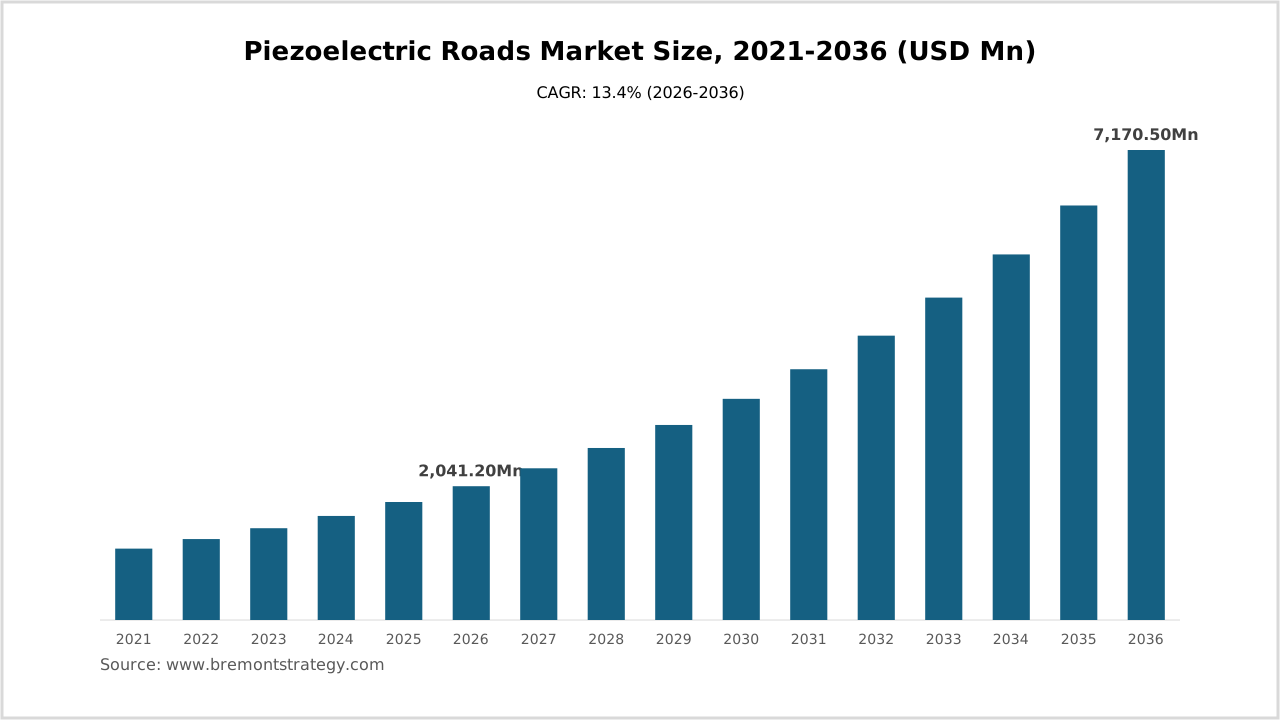
The Piezoelectric Roads market was valued at USD 2,041.2 million in 2026 and is projected to reach USD 7,170.5 million by 2036, growing at a CAGR of 13.4% during the forecast period 2026-2036. This growth is driven by increasing investments in sustainable infrastructure and the rising demand for renewable energy sources. The ability of piezoelectric roads to convert mechanical stress from vehicular movement into electrical energy presents a significant opportunity for energy harvesting, particularly in urban areas with high traffic density.
Piezoelectric roads utilize piezoelectric materials embedded within road surfaces to generate electricity from the pressure exerted by moving vehicles. This technology differentiates itself from conventional energy sources by offering a renewable and sustainable method of energy generation without the need for additional land or significant infrastructure changes. The core technology involves piezoelectric sensors that convert mechanical stress into electrical energy, which can be stored or fed into the grid.
Structural demand drivers include the global push towards sustainable energy solutions and smart city initiatives. Governments and municipalities are increasingly investing in infrastructure that supports energy efficiency and reduces carbon footprints. Technological advancements in piezoelectric materials, such as improved efficiency and durability, are also propelling market growth. Research and development efforts are focused on enhancing the energy conversion efficiency and lifespan of piezoelectric materials, making them more viable for large-scale applications.
Competitive dynamics in the piezoelectric roads market are influenced by factors such as product performance, cost-effectiveness, and technological innovation. Companies are focusing on strategic partnerships and collaborations to enhance their market presence and technological capabilities. The market is characterized by a mix of established players and innovative startups, each contributing to the development of more efficient and cost-effective piezoelectric solutions. Brand reputation, reliability, and the ability to offer customized solutions are critical factors influencing adoption in this market.
Piezoelectric Roads Market Key Takeaways
- The Piezoelectric Roads market is projected to grow from USD 2,041.2 million in 2026 to USD 7,170.5 million by 2036, at a CAGR of 13.4%.
- Energy harvesting is a key application, driven by the need for sustainable and renewable energy solutions in urban infrastructure.
- Technological advancements in piezoelectric materials are enhancing efficiency and durability, supporting market growth.
- Strategic partnerships and collaborations are crucial for companies to expand their technological capabilities and market reach.
- Asia Pacific and North America are expected to be significant regions for market growth due to infrastructure development and smart city initiatives.
Piezoelectric Roads Market Key Drivers
| Drivers | Impact |
|---|---|
| Sustainable Energy Demand | Increasing focus on renewable energy sources is driving the adoption of piezoelectric roads. |
| Smart City Initiatives | Governments are investing in smart infrastructure, boosting demand for piezoelectric roads. |
| Technological Advancements | Innovations in piezoelectric materials are enhancing efficiency and application scope. |
Sustainable Energy Demand
The global emphasis on reducing carbon emissions and transitioning to renewable energy sources is a significant driver for the piezoelectric roads market. As countries strive to meet international climate agreements and reduce reliance on fossil fuels, piezoelectric roads offer a viable solution for energy harvesting. This technology not only supports sustainable energy goals but also provides a decentralized energy generation method that can be integrated into existing infrastructure, making it an attractive option for urban planners and policymakers.
Smart City Initiatives
Smart city initiatives are gaining momentum worldwide, with governments investing in technologies that enhance urban living and infrastructure efficiency. Piezoelectric roads align with these initiatives by offering a dual benefit of energy generation and traffic monitoring. The integration of piezoelectric sensors into roadways can provide real-time data on traffic patterns, contributing to smarter traffic management systems. This dual functionality makes piezoelectric roads a valuable component of smart city infrastructure.
Technological Advancements
Continuous advancements in piezoelectric materials are crucial for the market's growth. Innovations aimed at improving the energy conversion efficiency and durability of piezoelectric sensors are expanding their application potential. Research and development efforts are focused on creating materials that can withstand the rigors of road traffic while maintaining high energy output. These technological improvements are essential for the widespread adoption of piezoelectric roads, as they directly impact the cost-effectiveness and reliability of the technology.
Piezoelectric Roads Market Opportunities and Challenges
| Opportunity | Challenges |
|---|---|
| Infrastructure Modernization | High Initial Costs |
| Government Incentives | Technical Limitations |
| Emerging Markets | Regulatory Hurdles |
Infrastructure modernization presents a significant opportunity for the piezoelectric roads market. As countries invest in upgrading their transportation networks, there is a growing demand for innovative solutions that enhance energy efficiency and sustainability. Government incentives and funding for renewable energy projects further support the adoption of piezoelectric roads. Additionally, emerging markets offer untapped potential for growth, as they seek to implement modern infrastructure solutions to support urbanization and economic development.
Despite the opportunities, the piezoelectric roads market faces several challenges. High initial costs associated with the installation and maintenance of piezoelectric systems can be a barrier to adoption. Technical limitations, such as the efficiency of energy conversion and the durability of piezoelectric materials under heavy traffic conditions, also pose challenges. Furthermore, regulatory hurdles related to infrastructure projects and energy policies can impact the deployment of piezoelectric roads, requiring companies to navigate complex regulatory environments.
Piezoelectric Roads Market Report Scope
| Attributes | Details |
|---|---|
| Report Title: | Piezoelectric Roads Market Research Report 2036 |
| By Material Type | Ceramics, Polymers, Composites, Others |
| By Application | Energy Harvesting, Traffic Monitoring, Structural Health Monitoring, Others |
| By Installation Type | New Construction, Retrofit |
| By End User | Highways, Urban Roads, Bridges, Others |
| By Region | Asia Pacific, North America, Latin America, Europe, Middle East & Africa |
| Countries Covered | North America (United States, Canada), Europe (Germany, France, UK, Italy, Spain, Rest of Europe), Asia Pacific (China, Japan, India, South Korea, Australia, Rest of Asia Pacific), Latin America (Brazil, Mexico, Rest of Latin America), Middle East & Africa (Saudi Arabia, UAE, South Africa, Rest of Middle East & Africa) |
| Base Year | 2026 |
| Historic Data | 2021-2025 |
| Forecast Period | 2026-2036 |
| Number of Pages | 289 |
| Number of Tables & Figures | 357 |
| Customization Available | Yes, the report can be customized by segment, region, country, or company upon request. |
Piezoelectric Roads Market Segment Analysis
The Piezoelectric Roads market is segmented by material type, application, installation type, and end user. Each segment plays a crucial role in the market's overall dynamics, offering unique opportunities and challenges.
By Material Type Analysis
| Segment | Market Share | Growth Rate | Key Insight |
|---|---|---|---|
| Ceramics | - | - | Ceramics are widely used due to their high piezoelectric efficiency and durability. |
| Polymers | - | - | Polymers offer flexibility and are increasingly used in retrofit applications. |
| Composites | - | - | Composites combine the benefits of ceramics and polymers, enhancing performance. |
| Others | - | - | Includes emerging materials with potential for innovation in piezoelectric applications. |
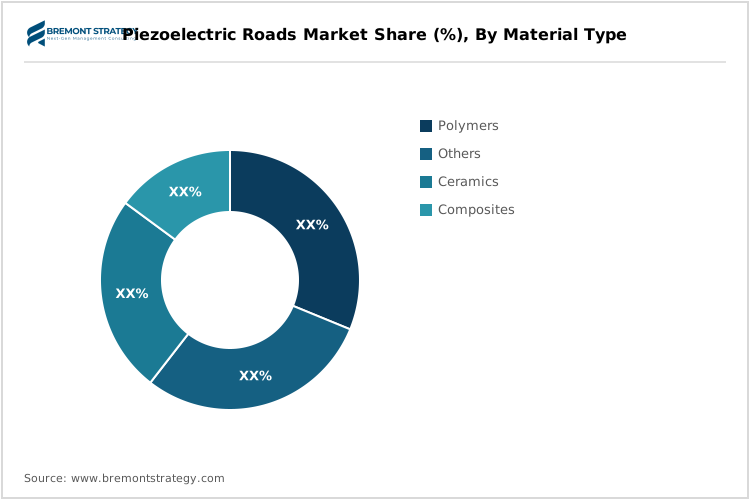
Ceramics are a dominant material type in the piezoelectric roads market due to their high efficiency in energy conversion and durability under heavy traffic conditions. They are preferred for new construction projects where long-term performance is critical. Polymers, on the other hand, offer flexibility and are increasingly used in retrofit applications where existing infrastructure needs to be upgraded without significant alterations. Composites, which combine the benefits of ceramics and polymers, are gaining traction for their enhanced performance characteristics.
The use of ceramics in piezoelectric roads is driven by their ability to withstand high pressure and temperature variations, making them suitable for diverse climatic conditions. Polymers are favored for their lightweight and adaptable nature, which allows for easy integration into existing road surfaces. Composites are emerging as a promising material type, offering a balance between performance and cost-effectiveness, which is crucial for large-scale deployments.
Opportunities in the material type segment are centered around the development of new materials that offer improved energy conversion efficiency and durability. Research and development efforts are focused on creating materials that can enhance the lifespan of piezoelectric systems while reducing costs. Emerging materials, categorized under 'Others', present potential for innovation and could lead to breakthroughs in piezoelectric technology.
By Application Analysis
| Segment | Market Share | Growth Rate | Key Insight |
|---|---|---|---|
| Energy Harvesting | - | - | Energy harvesting is the primary application, driving market growth. |
| Traffic Monitoring | - | - | Traffic monitoring applications are gaining traction in smart city projects. |
| Structural Health Monitoring | - | - | Structural health monitoring ensures infrastructure safety and longevity. |
| Others | - | - | Includes emerging applications with potential for future growth. |
Energy harvesting is the primary application of piezoelectric roads, leveraging the technology's ability to convert mechanical energy from vehicular movement into electrical energy. This application is crucial for sustainable energy initiatives and is a significant driver of market growth. Traffic monitoring is another key application, where piezoelectric sensors provide real-time data on traffic flow and density, aiding in the development of smart traffic management systems.
Structural health monitoring is an emerging application that utilizes piezoelectric sensors to assess the condition of infrastructure, ensuring safety and longevity. This application is particularly relevant for bridges and highways, where regular monitoring can prevent catastrophic failures. The 'Others' category includes emerging applications that are still in the developmental stage but hold potential for future growth as technology advances.
Opportunities in the application segment are driven by the increasing demand for smart city solutions and the integration of piezoelectric technology into urban infrastructure. As cities strive to become more sustainable and efficient, the role of piezoelectric roads in energy harvesting and traffic monitoring is expected to expand. Research and development efforts are focused on enhancing the capabilities of piezoelectric sensors to support a wider range of applications.
By Installation Type Analysis
| Segment | Market Share | Growth Rate | Key Insight |
|---|---|---|---|
| New Construction | - | - | New construction projects are key for integrating piezoelectric technology from the ground up. |
| Retrofit | - | - | Retrofit installations are crucial for upgrading existing infrastructure. |
New construction projects offer significant opportunities for the integration of piezoelectric technology, allowing for the design and implementation of systems that maximize energy harvesting potential. These projects are often part of larger infrastructure development initiatives, where sustainability and energy efficiency are key considerations. Retrofit installations, on the other hand, are essential for upgrading existing infrastructure to incorporate piezoelectric technology without the need for complete reconstruction.
The choice between new construction and retrofit installations depends on factors such as budget, project scope, and existing infrastructure conditions. New construction projects provide the advantage of designing piezoelectric systems from the ground up, ensuring optimal performance and integration. Retrofit installations, however, offer a cost-effective solution for enhancing the energy efficiency of existing roadways, making them an attractive option for municipalities with budget constraints.
Future trends in installation types are likely to focus on the development of modular piezoelectric systems that can be easily integrated into both new and existing infrastructure. These systems will offer flexibility and scalability, allowing for gradual implementation and expansion as needed. Research and development efforts are aimed at reducing installation costs and improving the ease of integration, which will be crucial for widespread adoption.
By End User Analysis
| Segment | Market Share | Growth Rate | Key Insight |
|---|---|---|---|
| Highways | - | - | Highways are a major end user due to high traffic volumes and energy harvesting potential. |
| Urban Roads | - | - | Urban roads benefit from energy harvesting and traffic monitoring applications. |
| Bridges | - | - | Bridges utilize piezoelectric technology for structural health monitoring. |
| Others | - | - | Includes specialized applications in various infrastructure projects. |
Highways are a major end user of piezoelectric roads, benefiting from the high traffic volumes that enhance energy harvesting potential. The integration of piezoelectric technology into highways supports sustainable energy initiatives and provides a reliable source of renewable energy. Urban roads also benefit from piezoelectric applications, particularly in energy harvesting and traffic monitoring, which are essential for smart city development.
Bridges are another critical end user, utilizing piezoelectric technology for structural health monitoring. This application ensures the safety and longevity of bridge infrastructure by providing real-time data on structural integrity. The 'Others' category includes specialized applications in various infrastructure projects, where piezoelectric technology can be tailored to meet specific needs.
Opportunities in the end user segment are driven by the increasing demand for sustainable infrastructure solutions and the integration of piezoelectric technology into urban planning. As cities and countries invest in modernizing their transportation networks, the role of piezoelectric roads in supporting energy efficiency and infrastructure safety is expected to grow. Research and development efforts are focused on expanding the application scope of piezoelectric technology to meet the diverse needs of different end users.
Piezoelectric Roads Market Regional Outlook
| Regional Outlook | |
|---|---|
| Largest Market | Asia Pacific |
| Fastest Growing Market | North America |
| Emerging Countries | India, Brazil, South Africa |
| Future Outlook | Regions are focusing on integrating piezoelectric technology into smart city infrastructure to enhance energy efficiency and sustainability. |
In North America, the piezoelectric roads market is driven by the increasing focus on sustainable infrastructure and smart city initiatives. The United States and Canada are investing in modernizing their transportation networks, with piezoelectric technology playing a key role in energy harvesting and traffic management. The region's strong emphasis on reducing carbon emissions and enhancing energy efficiency supports the adoption of piezoelectric roads.
Europe is witnessing significant growth in the piezoelectric roads market, driven by stringent environmental regulations and the push for renewable energy solutions. Countries such as Germany, France, and the UK are leading the way in integrating piezoelectric technology into their infrastructure projects. The European Union's commitment to reducing carbon emissions and promoting sustainable energy sources is a major driver for market growth in the region.
Asia-Pacific is the largest market for piezoelectric roads, with countries like China, Japan, and India investing heavily in smart city projects and sustainable infrastructure. The region's rapid urbanization and economic development are creating opportunities for the adoption of piezoelectric technology. Emerging markets such as India, Brazil, and South Africa are also showing potential for growth, as they seek to modernize their infrastructure and enhance energy efficiency.
Piezoelectric Roads Market Competitor Outlook
| Competitor Outlook | |
|---|---|
| Market Leader | Pavegen |
| Key Players |
|
| Key Competitive Factors |
|
Pavegen is recognized as a market leader in the piezoelectric roads market, known for its innovative solutions and strong market presence. The company has established itself as a pioneer in the field, with a focus on developing efficient and scalable piezoelectric systems. Pavegen's strategic partnerships and collaborations have further strengthened its position in the market, allowing it to expand its technological capabilities and reach.
The competitive landscape of the piezoelectric roads market is characterized by a mix of established players and innovative startups. Companies are focusing on technological innovation and efficiency to differentiate themselves in the market. Strategic partnerships and collaborations are crucial for expanding market reach and enhancing technological capabilities. Cost-effectiveness and scalability are key factors influencing the adoption of piezoelectric solutions, as they directly impact the feasibility of large-scale deployments.
Brand reputation and reliability are also important competitive factors, as customers seek trusted partners for their infrastructure projects. Companies that can offer customized solutions and demonstrate a strong track record of successful implementations are likely to gain a competitive edge in the market. The focus on sustainability and energy efficiency is driving demand for piezoelectric roads, creating opportunities for companies to innovate and expand their market presence.
Piezoelectric Roads Pricing Analysis
The pricing structure of piezoelectric roads is influenced by several factors, including the cost of raw materials, manufacturing processes, and technology development. Piezoelectric materials, such as ceramics and polymers, are key components that impact the overall cost of the system. Manufacturing costs are also significant, as they involve the integration of piezoelectric sensors into road surfaces, which requires specialized equipment and expertise.
Supply chain considerations, such as the availability of raw materials and the efficiency of distribution networks, play a crucial role in determining the final price of piezoelectric roads. Customization and certification costs can also impact pricing, as projects may require tailored solutions to meet specific regulatory and performance standards. Buyer price sensitivity varies depending on the scale of the project and the availability of funding, with larger projects often benefiting from economies of scale.
Piezoelectric Roads Consumer Buying Behaviour / Preference Analysis
Key Purchase Criteria
| Buying Factor | Relative Importance | Reason |
|---|---|---|
| Cost-effectiveness | High | Buyers prioritize solutions that offer long-term savings and efficiency. |
| Technological Innovation | Medium | Innovative solutions are valued for their enhanced performance and capabilities. |
| Reliability | High | Reliability is crucial for infrastructure projects to ensure safety and longevity. |
Typical buyers in the piezoelectric roads market include government agencies, municipalities, and private infrastructure developers. These buyers prioritize cost-effectiveness, seeking solutions that offer long-term savings and efficiency. Procurement behavior is influenced by the availability of funding and the need to meet regulatory and performance standards. Technical evaluation is a critical step in the procurement process, as buyers assess the capabilities and performance of piezoelectric systems.
Price sensitivity varies among buyers, with larger projects often benefiting from economies of scale. Quality expectations are high, as piezoelectric roads must withstand heavy traffic and environmental conditions. Reliability is a key purchase criterion, as infrastructure projects require solutions that ensure safety and longevity. Buyers also value supplier relationships and the ability to customize solutions to meet specific project needs. After-sales service and support are important considerations, as they impact the long-term performance and maintenance of piezoelectric systems.
TABLE OF CONTENTS
1. Research Methodology
2. Market Structure
3. Executive Summary
4. Piezoelectric Roads Market Overview
- 4.1 Introduction
- Market Snapshot
- Assumptions, Inclusion & Exclusions
- Technological Advancements & Patent Analysis
- Case Studies
- Market Entry & Launch Strategies
- Macro-Economic Factors Impacting the Market Growth
- 4.2 Piezoelectric Roads Market Dynamics
- Market Drivers
- Market Restraints
- Market Opportunity
- 4.3 Piezoelectric Roads Market - Supply Chain Analysis
- Key Raw Material/Components Provider
- Key Manufacturers
- Key Distributors
- Key Consumers
- 4.4 Key Forces Shaping the Piezoelectric Roads Market
- Bargaining Power of Suppliers
- Bargaining Power of Buyers
- Threat of Substitution
- Threat of New Entrants
- Competitive Rivalry
- 4.1 Introduction
5. Global Piezoelectric Roads Market, By Material Type
- 5.1 Market Size, Value (USD Mn) & Volume (Units)
- Ceramics
- Polymers
- Composites
- Others
- 5.2 Key Market Trends & Growth Opportunities
- 5.3 Market Share (%) Analysis, 2021-2036
- 5.4 Year-on-Year (YoY) Growth Rate
- 5.5 Market Attractiveness
- 5.6 Global Investment & Trade Risks
- 5.7 Pricing Analysis, 2021-2036
- 5.8 Operating Margin/Profits, 2021-2036
- 5.1 Market Size, Value (USD Mn) & Volume (Units)
6. Global Piezoelectric Roads Market, By Application
- 6.1 Market Size, Value (USD Mn) & Volume (Units)
- Energy Harvesting
- Traffic Monitoring
- Structural Health Monitoring
- Others
- 6.2 Key Market Trends & Growth Opportunities
- 6.3 Market Share (%) Analysis, 2021-2036
- 6.4 Year-on-Year (YoY) Growth Rate
- 6.5 Market Attractiveness
- 6.6 Global Investment & Trade Risks
- 6.7 Pricing Analysis, 2021-2036
- 6.8 Operating Margin/Profits, 2021-2036
- 6.1 Market Size, Value (USD Mn) & Volume (Units)
7. Global Piezoelectric Roads Market, By Installation Type
- 7.1 Market Size, Value (USD Mn) & Volume (Units)
- New Construction
- Retrofit
- 7.2 Key Market Trends & Growth Opportunities
- 7.3 Market Share (%) Analysis, 2021-2036
- 7.4 Year-on-Year (YoY) Growth Rate
- 7.5 Market Attractiveness
- 7.6 Global Investment & Trade Risks
- 7.7 Pricing Analysis, 2021-2036
- 7.8 Operating Margin/Profits, 2021-2036
- 7.1 Market Size, Value (USD Mn) & Volume (Units)
8. Global Piezoelectric Roads Market, By End User
- 8.1 Market Size, Value (USD Mn) & Volume (Units)
- Highways
- Urban Roads
- Bridges
- Others
- 8.2 Key Market Trends & Growth Opportunities
- 8.3 Market Share (%) Analysis, 2021-2036
- 8.4 Year-on-Year (YoY) Growth Rate
- 8.5 Market Attractiveness
- 8.6 Global Investment & Trade Risks
- 8.7 Pricing Analysis, 2021-2036
- 8.8 Operating Margin/Profits, 2021-2036
- 8.1 Market Size, Value (USD Mn) & Volume (Units)
9. Global Piezoelectric Roads Market, By Region
- 9.1 Market Size, Value (USD Mn) & Volume (Units)
- North America
- Europe
- Asia Pacific
- Latin America
- Middle East & Africa
- 9.2 Key Market Trends & Growth Opportunities
- 9.3 Market Share (%) Analysis, 2021-2036
- 9.4 Year-on-Year (YoY) Growth Rate
- 9.5 Market Attractiveness
- 9.6 Global Investment & Trade Risks
- 9.7 Pricing Analysis, 2021-2036
- 9.8 Operating Margin/Profits, 2021-2036
- 9.1 Market Size, Value (USD Mn) & Volume (Units)
10. Global Piezoelectric Roads Market, By North America
- 10.1 Market Size, Value (USD Mn) & Volume (Units)
- US
- Canada
- 10.2 Key Market Trends & Growth Opportunities
- 10.3 Market Share (%) Analysis, 2021-2036
- 10.4 Year-on-Year (YoY) Growth Rate
- 10.5 Market Attractiveness
- 10.6 Global Investment & Trade Risks
- 10.7 Pricing Analysis, 2021-2036
- 10.8 Operating Margin/Profits, 2021-2036
- 10.1 Market Size, Value (USD Mn) & Volume (Units)
11. Global Piezoelectric Roads Market, By Europe
- 11.1 Market Size, Value (USD Mn) & Volume (Units)
- Germany
- France
- UK
- Spain
- Italy
- Switzerland
- Russia
- Poland
- Rest of Europe
- 11.2 Key Market Trends & Growth Opportunities
- 11.3 Market Share (%) Analysis, 2021-2036
- 11.4 Year-on-Year (YoY) Growth Rate
- 11.5 Market Attractiveness
- 11.6 Global Investment & Trade Risks
- 11.7 Pricing Analysis, 2021-2036
- 11.8 Operating Margin/Profits, 2021-2036
- 11.1 Market Size, Value (USD Mn) & Volume (Units)
12. Global Piezoelectric Roads Market, By Asia Pacific
- 12.1 Market Size, Value (USD Mn) & Volume (Units)
- China
- Japan
- South Korea
- India
- Australia
- South East Asia
- Rest of APAC
- 12.2 Key Market Trends & Growth Opportunities
- 12.3 Market Share (%) Analysis, 2021-2036
- 12.4 Year-on-Year (YoY) Growth Rate
- 12.5 Market Attractiveness
- 12.6 Global Investment & Trade Risks
- 12.7 Pricing Analysis, 2021-2036
- 12.8 Operating Margin/Profits, 2021-2036
- 12.1 Market Size, Value (USD Mn) & Volume (Units)
13. Global Piezoelectric Roads Market, By Latin America
- 13.1 Market Size, Value (USD Mn) & Volume (Units)
- Brazil
- Mexico
- Argentina
- Rest of LATAM
- 13.2 Key Market Trends & Growth Opportunities
- 13.3 Market Share (%) Analysis, 2021-2036
- 13.4 Year-on-Year (YoY) Growth Rate
- 13.5 Market Attractiveness
- 13.6 Global Investment & Trade Risks
- 13.7 Pricing Analysis, 2021-2036
- 13.8 Operating Margin/Profits, 2021-2036
- 13.1 Market Size, Value (USD Mn) & Volume (Units)
14. Global Piezoelectric Roads Market, By Middle East & Africa
- 14.1 Market Size, Value (USD Mn) & Volume (Units)
- Saudi Arabia
- UAE
- South Africa
- Rest of MEA
- 14.2 Key Market Trends & Growth Opportunities
- 14.3 Market Share (%) Analysis, 2021-2036
- 14.4 Year-on-Year (YoY) Growth Rate
- 14.5 Market Attractiveness
- 14.6 Global Investment & Trade Risks
- 14.7 Pricing Analysis, 2021-2036
- 14.8 Operating Margin/Profits, 2021-2036
- 14.1 Market Size, Value (USD Mn) & Volume (Units)
15. Competitive Analysis
- 15.1 Competition Landscape, Key Players
- Global Market Share (%) Analysis of Key Players in Piezoelectric Roads, in Value (USD Mn) & Volume (Units)
- Company Overview
- Company Financials
- News & Developments
- Strategic Initiatives
- 15.2 Company Profiles
- Pavegen
- Piezo Systems
- Enel Green Power
- Kinetic Energy Solutions
- VibraTek
- Powerleap
- Innowattech
- TNO
- Murata Manufacturing
- Kistler Group
- APC International
- CeramTec
- PI Ceramic
- CTS Corporation
- Morgan Advanced Materials
- SparkFun Electronics
- Meggitt Sensing Systems
- Johnson Matthey Piezo Products
- Noliac
- 15.1 Competition Landscape, Key Players
METHODOLOGY
To provide you with a comprehensive understanding of how we quantify your market opportunity, we utilize a multi-phased methodology designed to minimize risk and maximize strategic clarity. We begin the process by establishing a clear conceptual framework, often referred to as the TAM-SAM-SOM model. By starting with the Total Addressable Market, we look at the absolute global demand for your category. We then refine this into the Serviceable Addressable Market to account for your specific geographic and technological reach, and finally, we pinpoint the Serviceable Obtainable Market. This ensures that the final figures we present are not just theoretical "vanity metrics," but represent a realistic, capture-able revenue target for your business.
Our data collection process relies on a rigorous principle called triangulation, where we cross-reference multiple independent data streams to ensure accuracy. We initiate this with deep-dive secondary research, synthesizing high-value intelligence from audited financial filings, government trade databases, and specialized industry journals. This "desk research" phase provides a macro-economic baseline and identifies historical growth trajectories. However, because secondary data can sometimes lag behind real-time shifts, we supplement this with targeted primary research. This involves direct engagement with Key Opinion Leaders (KOLs) and structured quantitative surveys to capture the current pulse of the market and emerging buyer intent.
To ensure the integrity of our estimates, we employ a dual-modeling approach, calculating the market size from both the "Top-Down" and "Bottom-Up." The Top-Down analysis provides a valuable sanity check against broader economic trends, but we place the most weight on our Bottom-Up modeling. By taking granular data, such as the average transaction value and the actual number of potential customer touchpoints, and scaling them upward, we build a highly defensible model grounded in operational reality. This dual-verification method allows us to identify any discrepancies early, ensuring that the resulting data is robust enough to withstand the scrutiny of stakeholders or investors.
Finally, we recognize that a static market size figure is only a snapshot in time. To provide you with a roadmap for the future, we integrate trend analysis and Compound Annual Growth Rate (CAGR) forecasting into our final reporting. We analyze the underlying drivers, such as regulatory shifts, technological disruptions, or changing consumer behaviors, to predict how the market will evolve over the next three to five years. This ongoing tracking mechanism transforms a simple number into a dynamic strategic tool, allowing you to monitor your market share in real-time and pivot your resources as new opportunities emerge.
Frequently Asked Questions
What is the current market size of the Piezoelectric Roads market?
The Piezoelectric Roads market was valued at USD 2,041.2 million in 2026.
What is the projected market size by 2036?
The market is projected to reach USD 7,170.5 million by 2036.
What is the CAGR for the Piezoelectric Roads market?
The market is expected to grow at a CAGR of 13.4% during the forecast period 2026-2036.
Which region is leading in the Piezoelectric Roads market?
Asia Pacific is the largest market for piezoelectric roads.
Who are the key companies in the Piezoelectric Roads market?
Key companies include Pavegen, Piezo Systems, Enel Green Power, Kinetic Energy Solutions, and VibraTek, among others.
What are the key growth drivers for the Piezoelectric Roads market?
Key growth drivers include sustainable energy demand, smart city initiatives, and technological advancements in piezoelectric materials.
Is customization available for the Piezoelectric Roads market report?
Yes, the report can be customized by segment, region, country, or company upon request.