Front-of-the-Meter Battery
Front-of-the-Meter Battery Market Research Report 2036
Front-of-the-Meter Battery Market Report is Segmented Segments ([object Object]), and Geography (North America, Europe, Asia-Pacific, South America, and the Middle East and Africa). The Market Forecasts are Provided in Terms of Value (USD)
Front-of-the-Meter Battery Market Outlook
The Front-of-the-Meter Battery market was valued at 11.1 in 2026 and is projected to reach 60.2 by 2036, growing at a CAGR of 18.5% during the forecast period 2026-2036. This significant growth is driven by increasing demand for energy storage solutions that support grid stability and renewable energy integration, as well as advancements in battery technology that enhance efficiency and reduce costs.
The Front-of-the-Meter Battery market focuses on large-scale energy storage systems that are installed at the utility level, often at substations or other grid-connected locations. These systems are designed to store energy for later use, helping to balance supply and demand, integrate renewable energy sources, and provide ancillary services such as frequency regulation. Unlike behind-the-meter systems, which are installed at the consumer level, front-of-the-meter batteries are typically larger and serve broader grid applications.
Key demand drivers include the global shift towards renewable energy sources, which necessitates reliable energy storage solutions to manage intermittent supply. Additionally, regulatory frameworks promoting energy storage adoption, coupled with declining battery costs, are encouraging utilities and independent power producers to invest in front-of-the-meter solutions. Infrastructure development and grid modernization efforts further bolster market growth.
Technological advancements in battery chemistry, particularly in lithium-ion and flow batteries, are pivotal to market expansion. Innovations aimed at increasing energy density, cycle life, and safety are critical R&D priorities. Moreover, the integration of digital technologies for enhanced monitoring and control of battery systems is becoming increasingly important, enabling more efficient grid management.
Competitive dynamics in the market are shaped by factors such as product performance, cost-effectiveness, and the ability to offer comprehensive solutions that include installation, maintenance, and technical support. Companies are also focusing on strategic partnerships and collaborations to enhance their market presence and leverage complementary strengths.
Overall, the Front-of-the-Meter Battery market is poised for robust growth, driven by the need for sustainable energy solutions and the ongoing transformation of the global energy landscape. As the market evolves, stakeholders will need to navigate challenges related to technology integration, regulatory compliance, and competitive pressures.
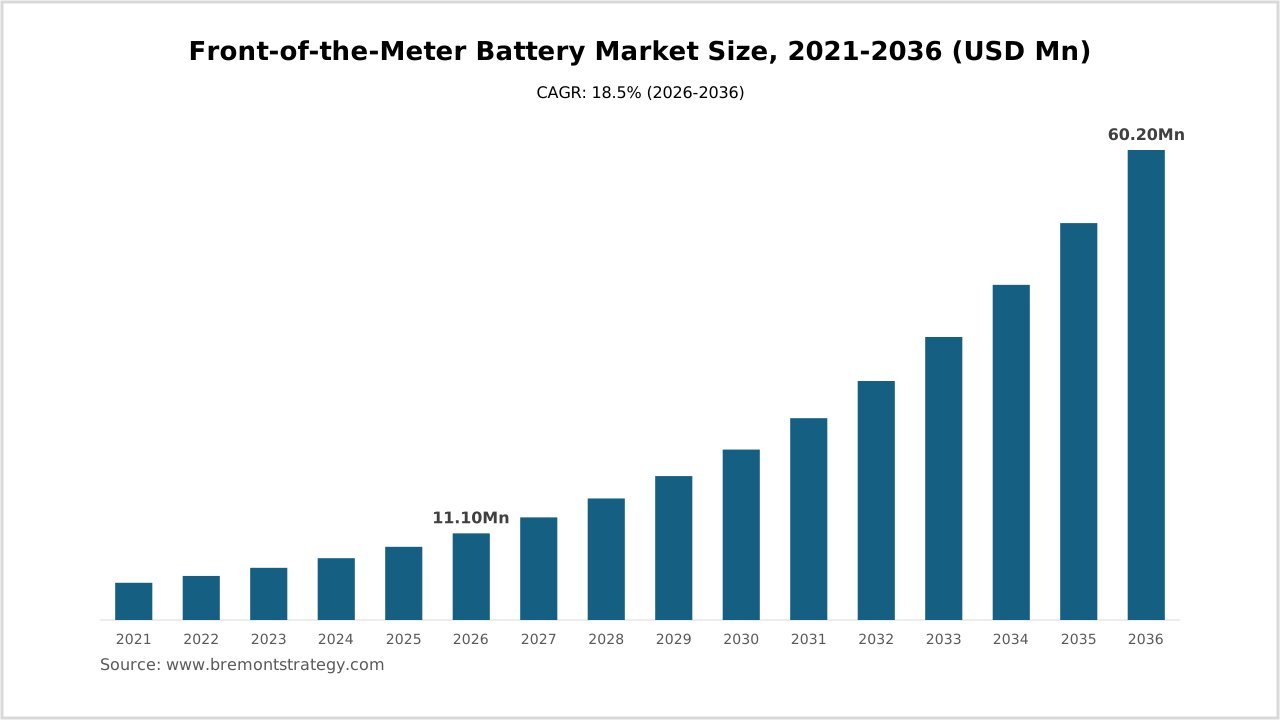
Front-of-the-Meter Battery Market Key Takeaways
- The Front-of-the-Meter Battery market is projected to grow from 11.1 in 2026 to 60.2 by 2036, at a CAGR of 18.5%.
- Key segments include Lithium-Ion, Lead-Acid, Flow Batteries, Nickel-Based, and Other Batteries, each offering unique advantages for grid applications.
- Utility Owned, Third Party Owned, and Customer Owned models provide diverse ownership options, influencing market dynamics.
- Applications such as Grid Services, Renewable Integration, and Peak Shaving drive demand for front-of-the-meter solutions.
- North America, Europe, and Asia Pacific are key regions, with varying regulatory and market conditions impacting growth.
Front-of-the-Meter Battery Market Key Drivers
| Drivers | Impact |
|---|---|
| Renewable Energy Integration | Increases demand for energy storage to manage intermittent supply. |
| Grid Modernization | Drives investment in advanced energy storage solutions. |
| Declining Battery Costs | Makes large-scale storage projects more economically viable. |
| Regulatory Support | Encourages adoption through incentives and mandates. |
| Technological Advancements | Enhances efficiency and safety of battery systems. |
Renewable Energy Integration
The integration of renewable energy sources such as solar and wind into the power grid is a major driver for the Front-of-the-Meter Battery market. These energy sources are inherently variable, producing power only when the sun is shining or the wind is blowing. As a result, there is a growing need for energy storage solutions that can store excess energy generated during peak production times and release it when demand is high or production is low. Front-of-the-meter batteries provide the necessary flexibility and reliability to manage this variability, ensuring a stable and continuous power supply.
Grid Modernization
Grid modernization efforts are focused on upgrading the existing power infrastructure to improve reliability, efficiency, and resilience. As part of these efforts, utilities are increasingly investing in advanced energy storage solutions, including front-of-the-meter batteries. These systems help to stabilize the grid by providing services such as frequency regulation, voltage support, and peak shaving. By enhancing grid performance and reducing the need for costly infrastructure upgrades, front-of-the-meter batteries play a crucial role in modernizing the power grid.
Declining Battery Costs
The cost of battery technology, particularly lithium-ion batteries, has been declining steadily over the past decade. This trend is making large-scale energy storage projects more economically viable, encouraging utilities and independent power producers to invest in front-of-the-meter solutions. As battery costs continue to decrease, the financial barriers to deploying these systems are reduced, leading to increased adoption and market growth.
Regulatory Support
Government policies and regulatory frameworks play a significant role in promoting the adoption of energy storage solutions. Many countries have implemented incentives, subsidies, and mandates to encourage the deployment of front-of-the-meter batteries. These regulatory measures help to create a favorable environment for market growth by reducing financial risks and providing clear guidelines for implementation.
Technological Advancements
Ongoing technological advancements in battery chemistry and system design are enhancing the performance, safety, and efficiency of front-of-the-meter batteries. Innovations such as improved energy density, longer cycle life, and enhanced safety features are critical to meeting the demands of modern grid applications. Additionally, the integration of digital technologies for real-time monitoring and control is enabling more efficient and reliable operation of these systems.
Front-of-the-Meter Battery Market Opportunities and Challenges
| Opportunity | Challenges |
|---|---|
| Renewable Energy Expansion | High Initial Investment |
| Technological Innovation | Regulatory Hurdles |
| Grid Resilience Needs | Supply Chain Constraints |
The expansion of renewable energy sources presents significant opportunities for the Front-of-the-Meter Battery market. As countries strive to meet their renewable energy targets, the demand for energy storage solutions that can manage the variability of renewable power generation is expected to rise. Technological innovation also offers opportunities for market growth, as advancements in battery chemistry and system design can lead to more efficient and cost-effective solutions. Additionally, the increasing need for grid resilience in the face of climate change and extreme weather events is driving demand for robust energy storage systems.
Despite these opportunities, the market faces several challenges. High initial investment costs can be a barrier to entry for some stakeholders, particularly in regions with limited financial resources. Regulatory hurdles, such as complex permitting processes and lack of standardized policies, can also impede market growth. Furthermore, supply chain constraints, including the availability of raw materials and components, can affect the timely deployment of front-of-the-meter battery systems. Addressing these challenges will be crucial for the sustained growth of the market.
Front-of-the-Meter Battery Market Report Scope
| Attributes | Details |
|---|---|
| Report Title: | Front-of-the-Meter Battery Market Research Report 2036 |
| By Battery Type | Lithium-Ion, Lead-Acid, Flow Batteries, Nickel-Based, Other Batteries |
| By Ownership Model | Utility Owned, Third Party Owned, Customer Owned |
| By Application | Grid Services, Renewable Integration, Peak Shaving, Frequency Regulation, Other Applications |
| By End User | Utilities, Independent Power Producers, Commercial and Industrial, Other End Users |
| By Region | North America, Europe, Asia Pacific, South America, Middle East, Africa |
| Countries Covered: | North America (United States, Canada), Europe (Germany, France, UK, Italy, Spain, Rest of Europe), Asia Pacific (China, Japan, India, South Korea, Australia, Rest of Asia Pacific), Latin America (Brazil, Mexico, Rest of Latin America), Middle East & Africa (Saudi Arabia, UAE, South Africa, Rest of Middle East & Africa) |
| Base Year: | 2026 |
| Historic Data: | 2021-2025 |
| Forecast Period: | 2026-2036 |
| Number of Pages: | 300 |
| Number of Tables & Figures: | 350 |
| Customization Available: | Yes, the report can be customized by segment, region, country, or company upon request. |
Front-of-the-Meter Battery Market Segment Analysis
The Front-of-the-Meter Battery market is segmented by battery type, ownership model, application, end user, and region. Each segment offers unique insights into market dynamics and growth opportunities.
By Battery Type Analysis
| Segment | Market Share | Growth Rate | Key Insight |
|---|---|---|---|
| Lithium-Ion | - | - | Dominates due to high energy density and efficiency. |
| Lead-Acid | - | - | Cost-effective but limited by lower energy density. |
| Flow Batteries | - | - | Offers long cycle life and scalability for large projects. |
| Nickel-Based | - | - | Used in niche applications requiring high discharge rates. |
| Other Batteries | - | - | Includes emerging technologies with potential for growth. |
Lithium-Ion batteries are the most widely used in the Front-of-the-Meter Battery market due to their high energy density, efficiency, and declining costs. These batteries are ideal for applications requiring rapid response and high power output, making them suitable for grid services and renewable integration. Lead-Acid batteries, while more cost-effective, are limited by their lower energy density and shorter cycle life, making them less suitable for large-scale applications.
Flow batteries offer unique advantages such as long cycle life and scalability, making them ideal for large projects that require consistent energy output over extended periods. Nickel-Based batteries are used in niche applications where high discharge rates are necessary, although their market share is limited compared to other battery types. Other Batteries include emerging technologies that are still in the development phase but hold potential for future growth as they mature and become commercially viable.
By Ownership Model Analysis
| Segment | Market Share | Growth Rate | Key Insight |
|---|---|---|---|
| Utility Owned | - | - | Favored for direct control over grid operations. |
| Third Party Owned | - | - | Offers flexibility and reduces capital expenditure for utilities. |
| Customer Owned | - | - | Less common, typically for specific industrial applications. |
Utility Owned models are prevalent in the Front-of-the-Meter Battery market as they allow utilities to maintain direct control over grid operations and ensure reliability. This model is particularly advantageous for utilities looking to integrate energy storage into their existing infrastructure without relying on external parties.
Third Party Owned models provide flexibility and reduce capital expenditure for utilities by allowing external companies to own and operate the battery systems. This model is attractive for utilities that prefer to outsource the management of energy storage assets while still benefiting from their services. Customer Owned models are less common and typically found in specific industrial applications where end users have unique energy storage needs and the capability to manage their own systems.
By Application Analysis
| Segment | Market Share | Growth Rate | Key Insight |
|---|---|---|---|
| Grid Services | - | - | Essential for maintaining grid stability and reliability. |
| Renewable Integration | - | - | Facilitates the integration of variable renewable energy sources. |
| Peak Shaving | - | - | Reduces demand charges and optimizes energy use. |
| Frequency Regulation | - | - | Provides rapid response to maintain grid frequency. |
| Other Applications | - | - | Includes emerging uses such as microgrids and backup power. |
Grid Services are a critical application for front-of-the-meter batteries, as they help maintain grid stability and reliability by providing services such as voltage support and load balancing. Renewable Integration is another key application, as these batteries enable the seamless integration of variable renewable energy sources like solar and wind into the power grid.
Peak Shaving applications help reduce demand charges and optimize energy use by storing energy during off-peak times and discharging it during peak demand periods. Frequency Regulation is essential for maintaining grid frequency within acceptable limits, and front-of-the-meter batteries provide the rapid response needed for this application. Other Applications include emerging uses such as microgrids and backup power, which are gaining traction as the market evolves.
By End User Analysis
| Segment | Market Share | Growth Rate | Key Insight |
|---|---|---|---|
| Utilities | - | - | Primary adopters due to grid management needs. |
| Independent Power Producers | - | - | Invest in storage to enhance renewable projects. |
| Commercial and Industrial | - | - | Adopt for cost savings and energy independence. |
| Other End Users | - | - | Includes government and institutional users. |
Utilities are the primary adopters of front-of-the-meter batteries, as they require reliable energy storage solutions to manage grid operations and integrate renewable energy sources. These systems help utilities maintain grid stability and meet regulatory requirements for renewable energy integration.
Independent Power Producers (IPPs) invest in energy storage to enhance the performance and reliability of their renewable energy projects. By incorporating front-of-the-meter batteries, IPPs can store excess energy generated during peak production times and release it when demand is high, improving the overall efficiency of their projects. Commercial and Industrial users adopt these systems for cost savings and energy independence, as they can reduce demand charges and optimize energy use. Other End Users include government and institutional users who require energy storage solutions for specific applications.
By Region Analysis
| Segment | Market Share | Growth Rate | Key Insight |
|---|---|---|---|
| North America | - | - | Strong regulatory support and investment in grid modernization. |
| Europe | - | - | Focus on renewable integration and energy transition. |
| Asia Pacific | - | - | Rapid industrialization and growing energy demand. |
| South America | - | - | Emerging market with potential for renewable projects. |
| Middle East | - | - | Investments in solar energy and grid infrastructure. |
| Africa | - | - | Opportunities in off-grid and rural electrification. |
North America is a key region for the Front-of-the-Meter Battery market, driven by strong regulatory support and significant investment in grid modernization efforts. The region's focus on renewable energy integration and the need for reliable energy storage solutions to manage grid operations are key factors contributing to market growth.
Europe is focused on renewable integration and energy transition, with countries implementing policies to reduce carbon emissions and increase the share of renewable energy in their energy mix. This has led to increased demand for front-of-the-meter batteries, which play a crucial role in managing the variability of renewable energy sources and ensuring grid stability.
Asia Pacific is experiencing rapid industrialization and growing energy demand, making it a significant market for front-of-the-meter batteries. The region's focus on expanding renewable energy capacity and improving grid infrastructure is driving demand for energy storage solutions that can support these efforts.
South America is an emerging market with potential for renewable energy projects, particularly in countries with abundant solar and wind resources. The adoption of front-of-the-meter batteries in the region is driven by the need to integrate these renewable energy sources into the grid and improve energy access in remote areas.
The Middle East and Africa present opportunities for front-of-the-meter batteries, with investments in solar energy and grid infrastructure driving demand. In Africa, there is a growing focus on off-grid and rural electrification projects, where energy storage solutions can play a critical role in providing reliable power to underserved communities.
Front-of-the-Meter Battery Market Regional Outlook
| Regional Outlook | |
|---|---|
| Largest Market | North America |
| Fastest Growing Market | Asia Pacific |
| Emerging Countries | Brazil, India, South Africa |
| Future Outlook | Continued growth driven by renewable energy expansion and grid modernization efforts. |
North America is a leading region in the Front-of-the-Meter Battery market, driven by strong regulatory support and significant investment in grid modernization. The region's focus on renewable energy integration and the need for reliable energy storage solutions to manage grid operations are key factors contributing to market growth.
Europe is focused on renewable integration and energy transition, with countries implementing policies to reduce carbon emissions and increase the share of renewable energy in their energy mix. This has led to increased demand for front-of-the-meter batteries, which play a crucial role in managing the variability of renewable energy sources and ensuring grid stability.
Asia Pacific is experiencing rapid industrialization and growing energy demand, making it a significant market for front-of-the-meter batteries. The region's focus on expanding renewable energy capacity and improving grid infrastructure is driving demand for energy storage solutions that can support these efforts.
South America is an emerging market with potential for renewable energy projects, particularly in countries with abundant solar and wind resources. The adoption of front-of-the-meter batteries in the region is driven by the need to integrate these renewable energy sources into the grid and improve energy access in remote areas.
The Middle East and Africa present opportunities for front-of-the-meter batteries, with investments in solar energy and grid infrastructure driving demand. In Africa, there is a growing focus on off-grid and rural electrification projects, where energy storage solutions can play a critical role in providing reliable power to underserved communities.
Front-of-the-Meter Battery Market Competitor Outlook
| Competitor Outlook | |
|---|---|
| Market Leader | Tesla Inc. |
| Key Players |
|
| Key Competitive Factors |
|
The Front-of-the-Meter Battery market is characterized by intense competition among key players, each striving to enhance their market position through innovation and strategic initiatives. Tesla Inc. is recognized as a market leader, leveraging its advanced battery technology and strong brand reputation to capture significant market share. The company's focus on continuous innovation and expansion of its product portfolio has solidified its leadership position.
Other key players, such as BYD Company Limited, Siemens AG, and Panasonic Corporation, are also making significant strides in the market. These companies are investing heavily in research and development to improve battery performance and efficiency, while also exploring new applications and markets. Strategic partnerships and collaborations are common strategies employed by these companies to enhance their competitive edge and expand their global footprint.
Key competitive factors in the market include product performance and efficiency, cost-effectiveness, and technological innovation. Companies that can offer comprehensive solutions, including installation, maintenance, and technical support, are well-positioned to succeed in this competitive landscape. Additionally, strategic partnerships and collaborations with other industry players can provide access to new markets and technologies, further enhancing a company's competitive position.
Front-of-the-Meter Battery Pricing Analysis
The pricing structure of front-of-the-meter batteries is influenced by several factors, including raw material costs, manufacturing expenses, and technology costs. Lithium-ion batteries, which dominate the market, have seen significant price reductions due to advancements in manufacturing processes and economies of scale. However, the cost of raw materials, such as lithium and cobalt, can impact overall pricing, as these materials are subject to market fluctuations.
Supply chain considerations, including transportation and logistics, also play a role in determining the final price of front-of-the-meter battery systems. Customization and compliance with industry standards and certifications can add to the overall cost, as these factors require additional resources and expertise. Buyers in this market are typically sensitive to price, but they also prioritize quality, reliability, and after-sales support when making purchasing decisions.
Front-of-the-Meter Battery Consumer Buying Behaviour / Preference Analysis
Key Purchase Criteria
| Buying Factor | Relative Importance | Reason |
|---|---|---|
| Cost | High | Significant investment required for large-scale systems. |
| Performance | High | Critical for ensuring grid stability and reliability. |
| Reliability | High | Essential for continuous operation and grid support. |
| Customization | Medium | Allows for tailored solutions to meet specific needs. |
| After-Sales Support | Medium | Important for maintenance and operational efficiency. |
Typical buyers in the Front-of-the-Meter Battery market include utilities, independent power producers, and commercial and industrial users. These buyers prioritize cost, performance, and reliability when evaluating potential solutions, as these factors are critical for ensuring the successful integration of energy storage systems into their operations. Price sensitivity is a key consideration, as the initial investment for large-scale systems can be substantial.
Procurement behavior often involves a thorough technical evaluation of potential solutions, with buyers seeking systems that offer the best balance of cost and performance. Quality expectations are high, as buyers require systems that can operate reliably over extended periods. Supplier relationships and after-sales support are also important considerations, as buyers seek partners who can provide ongoing maintenance and technical assistance to ensure optimal system performance.
TABLE OF CONTENTS
1. Research Methodology
2. Market Structure
3. Executive Summary
4. Front-of-the-Meter Battery Market Overview
- 4.1 Introduction
- Market Snapshot
- Assumptions, Inclusion & Exclusions
- Technological Advancements & Patent Analysis
- Case Studies
- Market Entry & Launch Strategies
- Macro-Economic Factors Impacting the Market Growth
- 4.2 Front-of-the-Meter Battery Market Dynamics
- Market Drivers
- Market Restraints
- Market Opportunity
- 4.3 Front-of-the-Meter Battery Market - Supply Chain Analysis
- Key Raw Material/Components Provider
- Key Manufacturers
- Key Distributors
- Key Consumers
- 4.4 Key Forces Shaping the Front-of-the-Meter Battery Market
- Bargaining Power of Suppliers
- Bargaining Power of Buyers
- Threat of Substitution
- Threat of New Entrants
- Competitive Rivalry
- 4.1 Introduction
5. Global Front-of-the-Meter Battery Market, By Segments
- 5.1 Market Size, Value (USD Mn) & Volume (Units)
- 5.2 Key Market Trends & Growth Opportunities
- 5.3 Market Share (%) Analysis, 2021-2036
- 5.4 Year-on-Year (YoY) Growth Rate
- 5.5 Market Attractiveness
- 5.6 Global Investment & Trade Risks
- 5.7 Pricing Analysis, 2021-2036
- 5.8 Operating Margin/Profits, 2021-2036
6. Global Front-of-the-Meter Battery Market, By Region
- 6.1 Market Size, Value (USD Mn) & Volume (Units)
- North America
- Europe
- Asia Pacific
- Latin America
- Middle East & Africa
- 6.2 Key Market Trends & Growth Opportunities
- 6.3 Market Share (%) Analysis, 2021-2036
- 6.4 Year-on-Year (YoY) Growth Rate
- 6.5 Market Attractiveness
- 6.6 Global Investment & Trade Risks
- 6.7 Pricing Analysis, 2021-2036
- 6.8 Operating Margin/Profits, 2021-2036
- 6.1 Market Size, Value (USD Mn) & Volume (Units)
7. Global Front-of-the-Meter Battery Market, By North America
- 7.1 Market Size, Value (USD Mn) & Volume (Units)
- US
- Canada
- 7.2 Key Market Trends & Growth Opportunities
- 7.3 Market Share (%) Analysis, 2021-2036
- 7.4 Year-on-Year (YoY) Growth Rate
- 7.5 Market Attractiveness
- 7.6 Global Investment & Trade Risks
- 7.7 Pricing Analysis, 2021-2036
- 7.8 Operating Margin/Profits, 2021-2036
- 7.1 Market Size, Value (USD Mn) & Volume (Units)
8. Global Front-of-the-Meter Battery Market, By Europe
- 8.1 Market Size, Value (USD Mn) & Volume (Units)
- Germany
- France
- UK
- Spain
- Italy
- Switzerland
- Russia
- Poland
- Rest of Europe
- 8.2 Key Market Trends & Growth Opportunities
- 8.3 Market Share (%) Analysis, 2021-2036
- 8.4 Year-on-Year (YoY) Growth Rate
- 8.5 Market Attractiveness
- 8.6 Global Investment & Trade Risks
- 8.7 Pricing Analysis, 2021-2036
- 8.8 Operating Margin/Profits, 2021-2036
- 8.1 Market Size, Value (USD Mn) & Volume (Units)
9. Global Front-of-the-Meter Battery Market, By Asia Pacific
- 9.1 Market Size, Value (USD Mn) & Volume (Units)
- China
- Japan
- South Korea
- India
- Australia
- South East Asia
- Rest of APAC
- 9.2 Key Market Trends & Growth Opportunities
- 9.3 Market Share (%) Analysis, 2021-2036
- 9.4 Year-on-Year (YoY) Growth Rate
- 9.5 Market Attractiveness
- 9.6 Global Investment & Trade Risks
- 9.7 Pricing Analysis, 2021-2036
- 9.8 Operating Margin/Profits, 2021-2036
- 9.1 Market Size, Value (USD Mn) & Volume (Units)
10. Global Front-of-the-Meter Battery Market, By Latin America
- 10.1 Market Size, Value (USD Mn) & Volume (Units)
- Brazil
- Mexico
- Argentina
- Rest of LATAM
- 10.2 Key Market Trends & Growth Opportunities
- 10.3 Market Share (%) Analysis, 2021-2036
- 10.4 Year-on-Year (YoY) Growth Rate
- 10.5 Market Attractiveness
- 10.6 Global Investment & Trade Risks
- 10.7 Pricing Analysis, 2021-2036
- 10.8 Operating Margin/Profits, 2021-2036
- 10.1 Market Size, Value (USD Mn) & Volume (Units)
11. Global Front-of-the-Meter Battery Market, By Middle East & Africa
- 11.1 Market Size, Value (USD Mn) & Volume (Units)
- Saudi Arabia
- UAE
- South Africa
- Rest of MEA
- 11.2 Key Market Trends & Growth Opportunities
- 11.3 Market Share (%) Analysis, 2021-2036
- 11.4 Year-on-Year (YoY) Growth Rate
- 11.5 Market Attractiveness
- 11.6 Global Investment & Trade Risks
- 11.7 Pricing Analysis, 2021-2036
- 11.8 Operating Margin/Profits, 2021-2036
- 11.1 Market Size, Value (USD Mn) & Volume (Units)
12. Competitive Analysis
- 12.1 Competition Landscape, Key Players
- Global Market Share (%) Analysis of Key Players in Front-of-the-Meter Battery, in Value (USD Mn) & Volume (Units)
- Company Overview
- Company Financials
- News & Developments
- Strategic Initiatives
- 12.2 Company Profiles
- Tesla Inc.
- BYD Company Limited
- Siemens AG
- Panasonic Corporation
- Contemporary Amperex Technology Co. Limited (CATL)
- General Electric (GE) Renewable Energy
- ABB Ltd.
- Mitsubishi Power
- LG Energy Solution
- Toshiba Corporation
- Leclanché SA
- Samsung SDI
- Nidec Corporation
- Sungrow Power Supply Co. Ltd.
- EVE Energy Co. Ltd.
- Wartsila Corporation
- GS Yuasa International
- EnerSys
- Fluence Energy
- ENGIE SA
- Exide Technologies
- Hitachi Energy
- Powin Energy
- 12.1 Competition Landscape, Key Players
METHODOLOGY
To provide you with a comprehensive understanding of how we quantify your market opportunity, we utilize a multi-phased methodology designed to minimize risk and maximize strategic clarity. We begin the process by establishing a clear conceptual framework, often referred to as the TAM-SAM-SOM model. By starting with the Total Addressable Market, we look at the absolute global demand for your category. We then refine this into the Serviceable Addressable Market to account for your specific geographic and technological reach, and finally, we pinpoint the Serviceable Obtainable Market. This ensures that the final figures we present are not just theoretical "vanity metrics," but represent a realistic, capture-able revenue target for your business.
Our data collection process relies on a rigorous principle called triangulation, where we cross-reference multiple independent data streams to ensure accuracy. We initiate this with deep-dive secondary research, synthesizing high-value intelligence from audited financial filings, government trade databases, and specialized industry journals. This "desk research" phase provides a macro-economic baseline and identifies historical growth trajectories. However, because secondary data can sometimes lag behind real-time shifts, we supplement this with targeted primary research. This involves direct engagement with Key Opinion Leaders (KOLs) and structured quantitative surveys to capture the current pulse of the market and emerging buyer intent.
To ensure the integrity of our estimates, we employ a dual-modeling approach, calculating the market size from both the "Top-Down" and "Bottom-Up." The Top-Down analysis provides a valuable sanity check against broader economic trends, but we place the most weight on our Bottom-Up modeling. By taking granular data, such as the average transaction value and the actual number of potential customer touchpoints, and scaling them upward, we build a highly defensible model grounded in operational reality. This dual-verification method allows us to identify any discrepancies early, ensuring that the resulting data is robust enough to withstand the scrutiny of stakeholders or investors.
Finally, we recognize that a static market size figure is only a snapshot in time. To provide you with a roadmap for the future, we integrate trend analysis and Compound Annual Growth Rate (CAGR) forecasting into our final reporting. We analyze the underlying drivers, such as regulatory shifts, technological disruptions, or changing consumer behaviors, to predict how the market will evolve over the next three to five years. This ongoing tracking mechanism transforms a simple number into a dynamic strategic tool, allowing you to monitor your market share in real-time and pivot your resources as new opportunities emerge.
Frequently Asked Questions
What is the current market size of the Front-of-the-Meter Battery market?
The Front-of-the-Meter Battery market was valued at 11.1 in 2026.
What is the projected market size by 2036?
The market is projected to reach 60.2 by 2036.
What is the CAGR for the Front-of-the-Meter Battery market?
The market is expected to grow at a CAGR of 18.5% during the forecast period 2026-2036.
Which region is leading in the Front-of-the-Meter Battery market?
North America is a leading region in the Front-of-the-Meter Battery market.
Who are the key companies in the Front-of-the-Meter Battery market?
Key companies include Tesla Inc., BYD Company Limited, Siemens AG, Panasonic Corporation, and Contemporary Amperex Technology Co. Limited (CATL).
What are the key growth drivers for the market?
Key growth drivers include renewable energy integration, grid modernization, declining battery costs, regulatory support, and technological advancements.
Is customization available for this market report?
Yes, the report can be customized by segment, region, country, or company upon request.