Sleep Drinks
Sleep Drinks Market Research Report 2036
Sleep Drinks Market Report is Segmented Segments ([object Object]), and Geography (North America, Europe, Asia-Pacific, South America, and the Middle East and Africa). The Market Forecasts are Provided in Terms of Value (USD)
Sleep Drinks Market Outlook
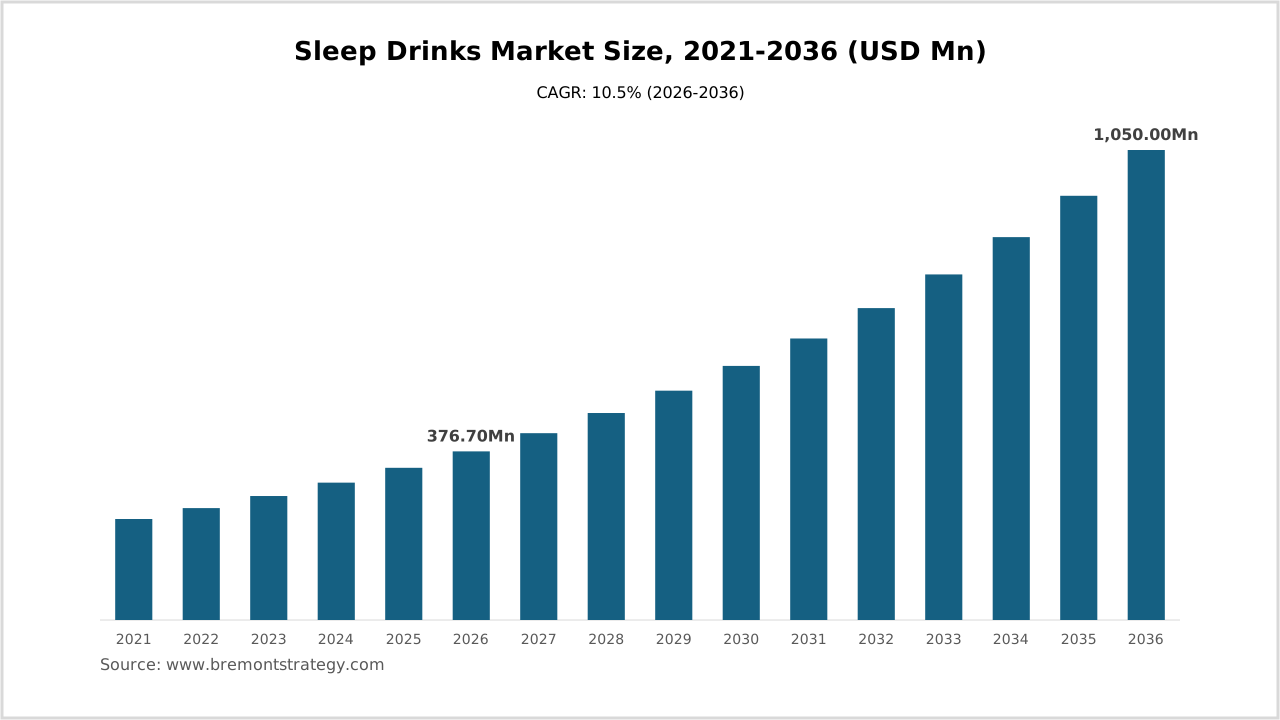
The Sleep Drinks market was valued at USD 376.7 million in 2026 and is projected to reach USD 1,050 million by 2036, growing at a CAGR of 10.5% during the forecast period 2026-2036. This growth is driven by increasing consumer awareness about sleep health and the rising prevalence of sleep disorders, which have led to a surge in demand for natural and effective sleep aids.
Sleep Drinks are beverages formulated to promote relaxation and improve sleep quality. They typically contain ingredients such as melatonin, magnesium, and herbal extracts like chamomile and valerian root. These drinks offer a convenient and non-pharmaceutical alternative to traditional sleep aids, appealing to consumers seeking natural solutions to enhance their sleep patterns.
Key demand drivers include the growing health and wellness trend, increased stress levels in modern lifestyles, and the rising incidence of insomnia and other sleep-related issues. Additionally, the expansion of distribution channels, including online retail and specialty stores, has made these products more accessible to a broader audience.
Technological advancements in formulation and ingredient extraction have led to the development of more effective and palatable sleep drinks. Innovations in packaging, such as ready-to-drink formats and liquid shots, have also contributed to market growth by enhancing convenience for consumers.
Competitive dynamics in the Sleep Drinks market are influenced by factors such as product efficacy, brand reputation, pricing strategies, and distribution networks. Companies are focusing on product differentiation through unique formulations and marketing strategies to capture consumer interest and loyalty.
Overall, the Sleep Drinks market is poised for significant growth, driven by increasing consumer demand for natural sleep solutions and ongoing product innovation. However, challenges such as regulatory compliance and consumer skepticism about efficacy remain.
Sleep Drinks Market Key Takeaways
- The Sleep Drinks market is projected to grow from USD 376.7 million in 2026 to USD 1,050 million by 2036, at a CAGR of 10.5%.
- Herbal Sleep Drinks and Melatonin-Based Sleep Drinks are popular product types due to their natural ingredients and perceived safety.
- Ready-to-Drink formulations are gaining traction for their convenience and ease of use.
- Online Retail and Direct-to-Consumer channels are expanding, offering greater accessibility to consumers.
- North America and Europe are key regions due to high consumer awareness and demand for wellness products.
Sleep Drinks Market Key Drivers
| Drivers | Impact |
|---|---|
| Health and Wellness Trend | Increasing consumer focus on health and wellness drives demand for natural sleep aids. |
| Rising Sleep Disorders | Growing prevalence of sleep disorders boosts the need for effective sleep solutions. |
| Product Innovation | Advancements in formulation and packaging enhance product appeal and convenience. |
| Expanding Distribution Channels | Wider availability through online and specialty stores increases market reach. |
| Consumer Awareness | Greater awareness of sleep health encourages adoption of sleep drinks. |
Health and Wellness Trend
The global shift towards health and wellness has significantly impacted consumer behavior, with individuals increasingly seeking products that support their overall well-being. Sleep drinks, formulated with natural ingredients, align with this trend by offering a non-pharmaceutical approach to improving sleep quality. As consumers become more health-conscious, the demand for products that promote relaxation and stress reduction, such as sleep drinks, is expected to rise.
Rising Sleep Disorders
The increasing prevalence of sleep disorders, including insomnia and sleep apnea, has heightened the demand for effective sleep aids. Sleep drinks provide a convenient and natural alternative to prescription medications, appealing to consumers looking for safer options. As awareness of sleep health grows, more individuals are likely to turn to sleep drinks to address their sleep-related issues.
Product Innovation
Continuous innovation in product formulation and packaging has played a crucial role in the growth of the Sleep Drinks market. Companies are investing in research and development to create more effective and palatable products, incorporating ingredients like melatonin, magnesium, and herbal extracts. Innovations such as ready-to-drink formats and liquid shots enhance convenience, making these products more attractive to consumers.
Expanding Distribution Channels
The expansion of distribution channels, particularly online retail and specialty stores, has increased the accessibility of sleep drinks to a broader audience. Consumers can now easily purchase these products from the comfort of their homes, driving market growth. Additionally, direct-to-consumer sales models allow companies to engage directly with customers, offering personalized experiences and fostering brand loyalty.
Consumer Awareness
As awareness of the importance of sleep health grows, more consumers are seeking solutions to improve their sleep quality. Educational campaigns and marketing efforts by companies have contributed to increased consumer awareness of sleep drinks and their benefits. This heightened awareness is expected to drive demand for these products as consumers prioritize sleep health as part of their overall wellness routines.
Sleep Drinks Market Opportunities and Challenges
| Opportunity | Challenges |
|---|---|
| Growing Consumer Base | Regulatory Compliance |
| Product Diversification | Consumer Skepticism |
| Technological Advancements | Market Competition |
The Sleep Drinks market presents several opportunities for growth. The expanding consumer base, driven by increasing awareness of sleep health, offers significant potential for market expansion. Companies can capitalize on this by diversifying their product offerings to cater to different consumer preferences and needs. Additionally, technological advancements in formulation and packaging provide opportunities for innovation, allowing companies to differentiate their products and capture a larger market share.
However, the market also faces challenges that could hinder growth. Regulatory compliance is a significant concern, as companies must navigate complex regulations governing the use of certain ingredients and health claims. Consumer skepticism about the efficacy of sleep drinks can also pose a challenge, as some consumers may be hesitant to try new products. Furthermore, the market is becoming increasingly competitive, with numerous players vying for market share, which could impact pricing and profitability.
Sleep Drinks Market Report Scope
| Attributes | Details |
|---|---|
| Report Title: | Sleep Drinks Market Research Report 2036 |
| By Product Type | Herbal Sleep Drinks, Melatonin-Based Sleep Drinks, Functional Non-Melatonin Beverages, Dairy-Based Sleep Drinks, Plant-Based Sleep Drinks, Relaxation Drinks |
| By Formulation Type | Ready-to-Drink, Powder Mix, Liquid Shots and Concentrates |
| By Ingredient | Melatonin, Magnesium, Valerian Root, Chamomile, L-Theanine, GABA, Adaptogens, Other Ingredients |
| By Distribution Channel | Supermarkets and Hypermarkets, Convenience Stores, Online Retail, Direct-to-Consumer, Pharmacies and Health Stores, Specialty Stores, Other Channels |
| By Consumer Type | Working Professionals, Young Adults, Adults, Geriatric Population, Athletes and Fitness Consumers |
| By Region | North America, Europe, Asia Pacific, Latin America, Middle East and Africa |
| Countries Covered: | North America (United States, Canada), Europe (Germany, France, UK, Italy, Spain, Rest of Europe), Asia Pacific (China, Japan, India, South Korea, Australia, Rest of Asia Pacific), Latin America (Brazil, Mexico, Rest of Latin America), Middle East & Africa (Saudi Arabia, UAE, South Africa, Rest of Middle East & Africa) |
| Base Year: | 2026 |
| Historic Data: | 2021-2025 |
| Forecast Period: | 2026-2036 |
| Number of Pages: | 280 |
| Number of Tables & Figures: | 350 |
| Customization Available: | Yes, the report can be customized by segment, region, country, or company upon request. |
Sleep Drinks Market Segment Analysis
The Sleep Drinks market is segmented into various categories, including product type, formulation type, ingredient, distribution channel, consumer type, and region. Each segment offers unique insights into consumer preferences and market dynamics.
By Product Type Analysis
| Segment | Market Share | Growth Rate | Key Insight |
|---|---|---|---|
| Herbal Sleep Drinks | - | - | Popular for their natural ingredients and perceived safety among consumers. |
| Melatonin-Based Sleep Drinks | - | - | Widely used due to their effectiveness in regulating sleep cycles. |
| Functional Non-Melatonin Beverages | - | - | Appeal to consumers seeking alternative sleep aids without melatonin. |
| Dairy-Based Sleep Drinks | - | - | Preferred by consumers looking for traditional and familiar beverage options. |
| Plant-Based Sleep Drinks | - | - | Gaining popularity among health-conscious and vegan consumers. |
| Relaxation Drinks | - | - | Target consumers looking for stress relief and relaxation benefits. |
Herbal Sleep Drinks are favored for their natural ingredients, such as chamomile and valerian root, which are perceived as safe and effective by consumers. These drinks cater to the growing demand for natural and holistic health solutions, making them a popular choice among health-conscious individuals.
Melatonin-Based Sleep Drinks are widely recognized for their ability to regulate sleep cycles and improve sleep quality. As a result, they are a preferred option for consumers experiencing sleep disturbances or jet lag. The effectiveness of melatonin in promoting restful sleep has contributed to the popularity of these products.
Functional Non-Melatonin Beverages offer an alternative for consumers who prefer sleep aids without melatonin. These drinks often contain ingredients like L-Theanine and GABA, which are known for their calming effects. The appeal of these beverages lies in their ability to provide relaxation without the use of hormones.
By Formulation Type Analysis
| Segment | Market Share | Growth Rate | Key Insight |
|---|---|---|---|
| Ready-to-Drink | - | - | Convenient option for on-the-go consumers seeking quick sleep solutions. |
| Powder Mix | - | - | Offers flexibility in dosage and preparation, appealing to DIY consumers. |
| Liquid Shots and Concentrates | - | - | Popular for their concentrated formulas and rapid effects. |
Ready-to-Drink formulations are gaining traction due to their convenience and ease of use. These products cater to busy consumers who seek quick and effective sleep solutions without the need for preparation. The portability of ready-to-drink options makes them ideal for travel and on-the-go consumption.
Powder Mix formulations offer consumers the flexibility to customize their dosage and preparation. This segment appeals to DIY consumers who prefer to control the strength and flavor of their sleep drinks. The versatility of powder mixes allows for easy incorporation into various beverages, enhancing their appeal.
Liquid Shots and Concentrates are favored for their concentrated formulas, which provide rapid effects. These products are popular among consumers seeking immediate relief from sleep disturbances. The compact size and potent formulations of liquid shots make them a convenient choice for those in need of quick sleep support.
By Ingredient Analysis
| Segment | Market Share | Growth Rate | Key Insight |
|---|---|---|---|
| Melatonin | - | - | Widely used for its effectiveness in regulating sleep-wake cycles. |
| Magnesium | - | - | Known for its calming properties and muscle relaxation benefits. |
| Valerian Root | - | - | Popular herbal ingredient for promoting relaxation and reducing anxiety. |
| Chamomile | - | - | Commonly used for its soothing effects and mild sedative properties. |
| L-Theanine | - | - | Recognized for its ability to promote relaxation without drowsiness. |
| GABA | - | - | Used for its calming effects and ability to reduce stress. |
| Adaptogens | - | - | Increasingly popular for their stress-reducing and balancing effects. |
| Other Ingredients | - | - | Includes a variety of natural extracts and compounds for sleep support. |
Melatonin is a key ingredient in many sleep drinks due to its proven effectiveness in regulating sleep-wake cycles. As a natural hormone, melatonin is widely accepted by consumers seeking non-pharmaceutical sleep aids. Its ability to improve sleep quality and reduce the time it takes to fall asleep makes it a popular choice.
Magnesium is known for its calming properties and ability to promote muscle relaxation. This mineral is often included in sleep drinks to enhance their overall effectiveness. Consumers appreciate magnesium's natural benefits, which contribute to a more restful sleep experience.
Valerian Root and Chamomile are popular herbal ingredients used in sleep drinks for their soothing effects. Valerian Root is known for its ability to reduce anxiety and promote relaxation, while Chamomile is valued for its mild sedative properties. These ingredients appeal to consumers seeking natural and gentle sleep solutions.
By Distribution Channel Analysis
| Segment | Market Share | Growth Rate | Key Insight |
|---|---|---|---|
| Supermarkets and Hypermarkets | - | - | Offer wide product availability and convenience for consumers. |
| Convenience Stores | - | - | Provide easy access to sleep drinks for on-the-go consumers. |
| Online Retail | - | - | Expanding rapidly due to increased consumer preference for online shopping. |
| Direct-to-Consumer | - | - | Allows brands to engage directly with consumers and offer personalized experiences. |
| Pharmacies and Health Stores | - | - | Trusted sources for health-conscious consumers seeking sleep aids. |
| Specialty Stores | - | - | Cater to niche markets with specialized sleep products. |
| Other Channels | - | - | Include various retail outlets offering diverse product selections. |
Supermarkets and Hypermarkets are key distribution channels for sleep drinks, offering wide product availability and convenience for consumers. These retail outlets provide a one-stop shopping experience, making it easy for consumers to purchase sleep drinks alongside their regular groceries.
Online Retail is expanding rapidly as more consumers prefer the convenience of shopping from home. The ability to compare products, read reviews, and access a wider range of options has contributed to the growth of online sales. This channel also allows brands to reach a global audience and offer exclusive online promotions.
Direct-to-Consumer sales models enable brands to engage directly with consumers, offering personalized experiences and fostering brand loyalty. This channel allows companies to gather valuable consumer insights and tailor their marketing strategies accordingly. The direct relationship with consumers also facilitates better customer service and support.
By Consumer Type Analysis
| Segment | Market Share | Growth Rate | Key Insight |
|---|---|---|---|
| Working Professionals | - | - | Seek sleep aids to manage stress and improve work-life balance. |
| Young Adults | - | - | Attracted to natural sleep solutions for lifestyle-related sleep issues. |
| Adults | - | - | Look for effective sleep aids to address age-related sleep disturbances. |
| Geriatric Population | - | - | Require gentle and safe sleep solutions for age-related sleep problems. |
| Athletes and Fitness Consumers | - | - | Use sleep drinks to enhance recovery and performance. |
Working Professionals are a significant consumer segment for sleep drinks, as they seek solutions to manage stress and improve work-life balance. The demands of modern work environments often lead to increased stress levels, making sleep aids an attractive option for professionals looking to enhance their sleep quality.
Young Adults are drawn to natural sleep solutions to address lifestyle-related sleep issues. This demographic is increasingly health-conscious and prefers products that align with their values of sustainability and wellness. Sleep drinks offer a convenient and natural way to improve sleep patterns without resorting to pharmaceuticals.
The Geriatric Population requires gentle and safe sleep solutions to address age-related sleep problems. As individuals age, they may experience changes in sleep patterns and increased difficulty in achieving restful sleep. Sleep drinks formulated with natural ingredients provide a non-invasive option for improving sleep quality in older adults.
Sleep Drinks Market Regional Outlook
| Regional Outlook | |
|---|---|
| Largest Market | North America |
| Fastest Growing Market | Asia Pacific |
| Emerging Countries | China, India, Brazil |
| Future Outlook | Continued growth driven by rising consumer awareness and product innovation. |
North America is the largest market for sleep drinks, driven by high consumer awareness and demand for wellness products. The region's well-established distribution networks and strong presence of key market players contribute to its dominance. The growing prevalence of sleep disorders and increasing focus on health and wellness further support market growth in North America.
Europe is a significant market for sleep drinks, with consumers increasingly seeking natural and effective sleep solutions. The region's stringent regulations on health claims and product safety ensure high-quality offerings, which appeal to health-conscious consumers. The presence of established brands and a growing trend towards holistic health contribute to market expansion in Europe.
Asia Pacific is the fastest-growing market for sleep drinks, driven by rising consumer awareness and increasing disposable incomes. Emerging economies like China and India present significant growth opportunities due to their large populations and growing middle class. The region's cultural emphasis on natural remedies and traditional medicine aligns well with the appeal of sleep drinks.
Sleep Drinks Market Competitor Outlook
| Competitor Outlook | |
|---|---|
| Market Leader | Unilever |
| Key Players |
|
| Key Competitive Factors |
|
The Sleep Drinks market is characterized by intense competition among key players, with Unilever emerging as a market leader due to its strong brand presence and extensive distribution network. The company's focus on product innovation and consumer trust has solidified its position in the market.
Other key players, such as Yakult, Kirin, and Meiji, are also significant contributors to the market, leveraging their expertise in functional beverages to expand their sleep drink offerings. These companies focus on product differentiation and strategic partnerships to enhance their market presence.
Competitive factors such as product efficacy, brand reputation, and pricing strategies play a crucial role in determining market success. Companies that prioritize regulatory compliance and certifications are better positioned to gain consumer trust and expand their market share. The ability to adapt to changing consumer preferences and invest in research and development is essential for maintaining a competitive edge.
Sleep Drinks Pricing Analysis
The pricing structure of sleep drinks is influenced by various factors, including raw material costs, manufacturing expenses, and distribution channels. Ingredients such as melatonin, magnesium, and herbal extracts contribute to the overall cost of production. Companies must balance ingredient quality with affordability to appeal to price-sensitive consumers.
Distribution and supply chain considerations also impact pricing, as companies must navigate logistics and transportation costs to ensure product availability. Customization and packaging innovations can add value but may also increase costs. Companies that effectively manage these factors while maintaining competitive pricing are likely to succeed in the market.
Sleep Drinks Consumer Buying Behaviour / Preference Analysis
Key Purchase Criteria
| Buying Factor | Relative Importance | Reason |
|---|---|---|
| Product Efficacy | High | Consumers prioritize effectiveness in improving sleep quality. |
| Natural Ingredients | Medium | Preference for natural and safe sleep solutions. |
| Price | Medium | Affordability is important for regular use and consumer loyalty. |
Typical buyers of sleep drinks include health-conscious individuals seeking natural solutions to improve their sleep quality. These consumers prioritize product efficacy and are willing to invest in products that deliver noticeable results. The preference for natural ingredients reflects a broader trend towards wellness and holistic health.
Price sensitivity varies among consumers, with affordability playing a crucial role in purchasing decisions. Consumers are more likely to remain loyal to brands that offer effective products at competitive prices. Supplier relationships and after-sales service also influence consumer preferences, as reliable customer support enhances the overall buying experience.
TABLE OF CONTENTS
1. Research Methodology
2. Market Structure
3. Executive Summary
4. Sleep Drinks Market Overview
- 4.1 Introduction
- Market Snapshot
- Assumptions, Inclusion & Exclusions
- Technological Advancements & Patent Analysis
- Case Studies
- Market Entry & Launch Strategies
- Macro-Economic Factors Impacting the Market Growth
- 4.2 Sleep Drinks Market Dynamics
- Market Drivers
- Market Restraints
- Market Opportunity
- 4.3 Sleep Drinks Market - Supply Chain Analysis
- Key Raw Material/Components Provider
- Key Manufacturers
- Key Distributors
- Key Consumers
- 4.4 Key Forces Shaping the Sleep Drinks Market
- Bargaining Power of Suppliers
- Bargaining Power of Buyers
- Threat of Substitution
- Threat of New Entrants
- Competitive Rivalry
- 4.1 Introduction
5. Global Sleep Drinks Market, By Segments
- 5.1 Market Size, Value (USD Mn) & Volume (Units)
- 5.2 Key Market Trends & Growth Opportunities
- 5.3 Market Share (%) Analysis, 2021-2036
- 5.4 Year-on-Year (YoY) Growth Rate
- 5.5 Market Attractiveness
- 5.6 Global Investment & Trade Risks
- 5.7 Pricing Analysis, 2021-2036
- 5.8 Operating Margin/Profits, 2021-2036
6. Global Sleep Drinks Market, By Region
- 6.1 Market Size, Value (USD Mn) & Volume (Units)
- North America
- Europe
- Asia Pacific
- Latin America
- Middle East & Africa
- 6.2 Key Market Trends & Growth Opportunities
- 6.3 Market Share (%) Analysis, 2021-2036
- 6.4 Year-on-Year (YoY) Growth Rate
- 6.5 Market Attractiveness
- 6.6 Global Investment & Trade Risks
- 6.7 Pricing Analysis, 2021-2036
- 6.8 Operating Margin/Profits, 2021-2036
- 6.1 Market Size, Value (USD Mn) & Volume (Units)
7. Global Sleep Drinks Market, By North America
- 7.1 Market Size, Value (USD Mn) & Volume (Units)
- US
- Canada
- 7.2 Key Market Trends & Growth Opportunities
- 7.3 Market Share (%) Analysis, 2021-2036
- 7.4 Year-on-Year (YoY) Growth Rate
- 7.5 Market Attractiveness
- 7.6 Global Investment & Trade Risks
- 7.7 Pricing Analysis, 2021-2036
- 7.8 Operating Margin/Profits, 2021-2036
- 7.1 Market Size, Value (USD Mn) & Volume (Units)
8. Global Sleep Drinks Market, By Europe
- 8.1 Market Size, Value (USD Mn) & Volume (Units)
- Germany
- France
- UK
- Spain
- Italy
- Switzerland
- Russia
- Poland
- Rest of Europe
- 8.2 Key Market Trends & Growth Opportunities
- 8.3 Market Share (%) Analysis, 2021-2036
- 8.4 Year-on-Year (YoY) Growth Rate
- 8.5 Market Attractiveness
- 8.6 Global Investment & Trade Risks
- 8.7 Pricing Analysis, 2021-2036
- 8.8 Operating Margin/Profits, 2021-2036
- 8.1 Market Size, Value (USD Mn) & Volume (Units)
9. Global Sleep Drinks Market, By Asia Pacific
- 9.1 Market Size, Value (USD Mn) & Volume (Units)
- China
- Japan
- South Korea
- India
- Australia
- South East Asia
- Rest of APAC
- 9.2 Key Market Trends & Growth Opportunities
- 9.3 Market Share (%) Analysis, 2021-2036
- 9.4 Year-on-Year (YoY) Growth Rate
- 9.5 Market Attractiveness
- 9.6 Global Investment & Trade Risks
- 9.7 Pricing Analysis, 2021-2036
- 9.8 Operating Margin/Profits, 2021-2036
- 9.1 Market Size, Value (USD Mn) & Volume (Units)
10. Global Sleep Drinks Market, By Latin America
- 10.1 Market Size, Value (USD Mn) & Volume (Units)
- Brazil
- Mexico
- Argentina
- Rest of LATAM
- 10.2 Key Market Trends & Growth Opportunities
- 10.3 Market Share (%) Analysis, 2021-2036
- 10.4 Year-on-Year (YoY) Growth Rate
- 10.5 Market Attractiveness
- 10.6 Global Investment & Trade Risks
- 10.7 Pricing Analysis, 2021-2036
- 10.8 Operating Margin/Profits, 2021-2036
- 10.1 Market Size, Value (USD Mn) & Volume (Units)
11. Global Sleep Drinks Market, By Middle East & Africa
- 11.1 Market Size, Value (USD Mn) & Volume (Units)
- Saudi Arabia
- UAE
- South Africa
- Rest of MEA
- 11.2 Key Market Trends & Growth Opportunities
- 11.3 Market Share (%) Analysis, 2021-2036
- 11.4 Year-on-Year (YoY) Growth Rate
- 11.5 Market Attractiveness
- 11.6 Global Investment & Trade Risks
- 11.7 Pricing Analysis, 2021-2036
- 11.8 Operating Margin/Profits, 2021-2036
- 11.1 Market Size, Value (USD Mn) & Volume (Units)
12. Competitive Analysis
- 12.1 Competition Landscape, Key Players
- Global Market Share (%) Analysis of Key Players in Sleep Drinks, in Value (USD Mn) & Volume (Units)
- Company Overview
- Company Financials
- News & Developments
- Strategic Initiatives
- 12.2 Company Profiles
- Yakult
- Kirin
- Meiji
- Dream Water
- Som Sleep
- Neuro Drinks
- Snoooze
- Goodnight Drink
- Kin Euphorics
- TRIP
- Unilever
- Nestlé
- Hain Celestial
- Yogi
- Traditional Medicinals
- AG1
- Life Time
- 12.1 Competition Landscape, Key Players
METHODOLOGY
To provide you with a comprehensive understanding of how we quantify your market opportunity, we utilize a multi-phased methodology designed to minimize risk and maximize strategic clarity. We begin the process by establishing a clear conceptual framework, often referred to as the TAM-SAM-SOM model. By starting with the Total Addressable Market, we look at the absolute global demand for your category. We then refine this into the Serviceable Addressable Market to account for your specific geographic and technological reach, and finally, we pinpoint the Serviceable Obtainable Market. This ensures that the final figures we present are not just theoretical "vanity metrics," but represent a realistic, capture-able revenue target for your business.
Our data collection process relies on a rigorous principle called triangulation, where we cross-reference multiple independent data streams to ensure accuracy. We initiate this with deep-dive secondary research, synthesizing high-value intelligence from audited financial filings, government trade databases, and specialized industry journals. This "desk research" phase provides a macro-economic baseline and identifies historical growth trajectories. However, because secondary data can sometimes lag behind real-time shifts, we supplement this with targeted primary research. This involves direct engagement with Key Opinion Leaders (KOLs) and structured quantitative surveys to capture the current pulse of the market and emerging buyer intent.
To ensure the integrity of our estimates, we employ a dual-modeling approach, calculating the market size from both the "Top-Down" and "Bottom-Up." The Top-Down analysis provides a valuable sanity check against broader economic trends, but we place the most weight on our Bottom-Up modeling. By taking granular data, such as the average transaction value and the actual number of potential customer touchpoints, and scaling them upward, we build a highly defensible model grounded in operational reality. This dual-verification method allows us to identify any discrepancies early, ensuring that the resulting data is robust enough to withstand the scrutiny of stakeholders or investors.
Finally, we recognize that a static market size figure is only a snapshot in time. To provide you with a roadmap for the future, we integrate trend analysis and Compound Annual Growth Rate (CAGR) forecasting into our final reporting. We analyze the underlying drivers, such as regulatory shifts, technological disruptions, or changing consumer behaviors, to predict how the market will evolve over the next three to five years. This ongoing tracking mechanism transforms a simple number into a dynamic strategic tool, allowing you to monitor your market share in real-time and pivot your resources as new opportunities emerge.
Frequently Asked Questions
What is the current market size of the Sleep Drinks market?
The Sleep Drinks market was valued at USD 376.7 million in 2026.
What is the projected market size by 2036?
The market is projected to reach USD 1,050 million by 2036.
What is the CAGR for the Sleep Drinks market?
The market is expected to grow at a CAGR of 10.5% during the forecast period 2026-2036.
Which region is leading in the Sleep Drinks market?
North America is the largest market for Sleep Drinks.
Who are the key companies in the Sleep Drinks market?
Key companies include Unilever, Yakult, Kirin, Meiji, Dream Water, and Som Sleep.
What are the key growth drivers for the Sleep Drinks market?
Key growth drivers include the health and wellness trend, rising sleep disorders, and product innovation.
Is customization available for the Sleep Drinks market report?
Yes, the report can be customized by segment, region, country, or company upon request.