AI Data Center
AI Data Center Market Research Report 2036
AI Data Center Market Segments - by Component (Hardware, Software, Services, Networking, Storage), Deployment (On-Premises, Cloud, Hybrid, Edge), Application (Data Management, Machine Learning, Natural Language Processing, Computer Vision, Predictive Analytics), Industry (BFSI, Healthcare, Retail, Manufacturing, IT and Telecommunications, Government), and Region (North America, Europe, Asia Pacific, Latin America, Middle East & Africa) - The Market Forecasts are Provided in Terms of Value (USD)
AI Data Center Market Outlook
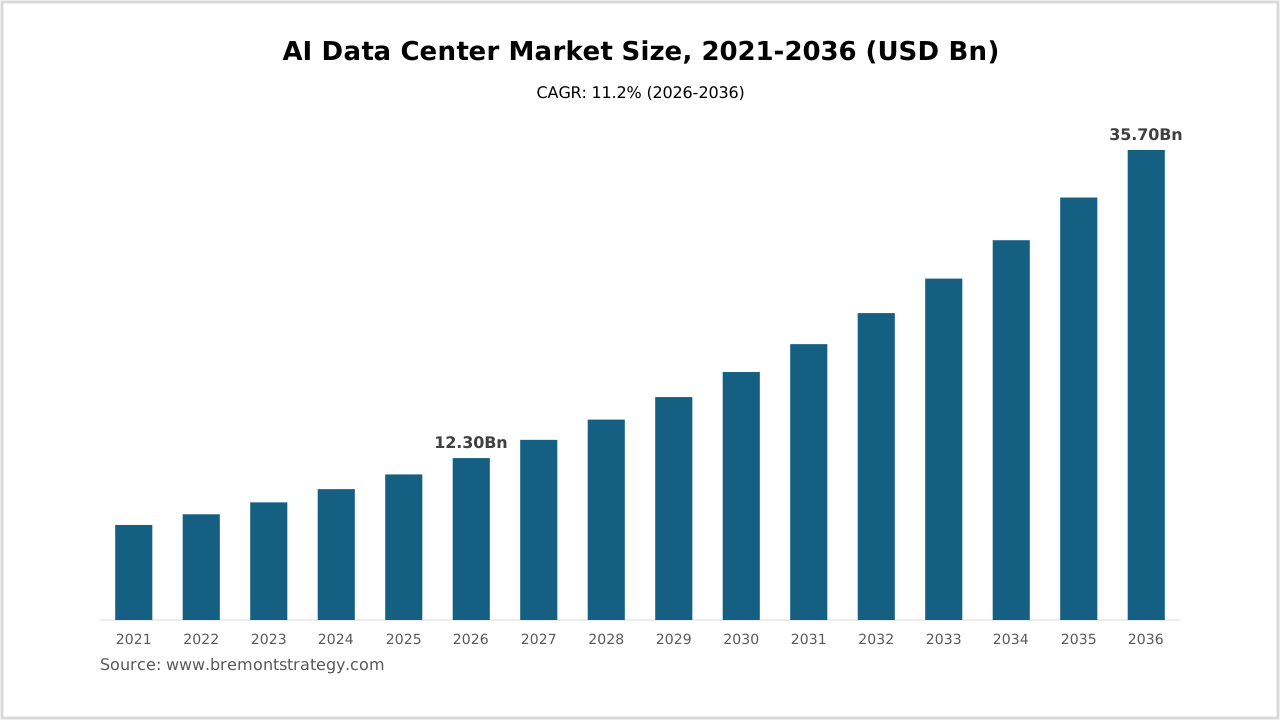
The AI Data Center market was valued at $12.3 Billion in 2026 and is projected to reach $35.7 Billion by 2036, growing at a CAGR of 11.2% during the forecast period 2026-2036. This growth is driven by the increasing demand for high-performance computing and data processing capabilities to support AI applications.
AI Data Centers are specialized facilities designed to handle the immense computational requirements of AI workloads. These centers integrate advanced hardware, software, and networking solutions to optimize data processing and storage. Unlike traditional data centers, AI Data Centers are equipped with GPUs and TPUs to accelerate machine learning and deep learning tasks, making them distinct in their ability to manage complex AI algorithms efficiently.
The overall demand for AI Data Centers is propelled by the exponential growth in data generation and the need for real-time data analytics across various industries. As businesses increasingly adopt AI technologies for operational efficiency and competitive advantage, the demand for robust data center infrastructure continues to rise.
Technological advancements in AI hardware, such as the development of more efficient GPUs and AI chips, are shaping the R&D focus. Companies are investing in enhancing the power efficiency and processing capabilities of these components to support the growing complexity of AI models.
Competitive dynamics in the AI Data Center market are influenced by factors such as pricing, technical performance, and customer support. Vendors compete by offering scalable and flexible solutions that can be tailored to specific industry needs, with performance and reliability being critical factors for adoption.
As AI technologies evolve, there is a growing emphasis on developing edge AI data centers that bring computational power closer to data sources, reducing latency and improving real-time processing capabilities.
AI Data Center Market Key Takeaways
- The AI Data Center market is expected to grow from $12.3 Billion in 2026 to $35.7 Billion by 2036, at a CAGR of 11.2%.
- The Hardware segment is anticipated to hold the largest market share, driven by the increasing deployment of advanced GPUs and TPUs.
- North America is projected to be the leading region, accounting for over 35% of the market share, due to the presence of major tech companies and early adoption of AI technologies.
- The Cloud deployment model is expected to grow at the fastest rate, with a CAGR of 13.5%, as organizations seek scalable and flexible AI solutions.
- Rising demand for real-time data processing and analytics is a significant driver for the AI Data Center market.
AI Data Center Market Key Drivers
| Drivers | Impact |
|---|---|
| Data Explosion | The increasing volume of data generated is driving the need for AI Data Centers. |
| AI Adoption | Growing AI implementation across industries boosts demand for specialized data centers. |
| Cloud Migration | Shift to cloud-based solutions accelerates AI Data Center deployment. |
| Edge Computing | Demand for low-latency processing is fostering edge AI data center growth. |
| Technological Advancements | Innovations in AI hardware enhance data center capabilities. |
Data Explosion
The exponential increase in data generated by IoT devices, social media, and enterprise applications is a primary driver for AI Data Centers. These centers are essential for processing and analyzing vast datasets in real-time, enabling businesses to derive actionable insights and improve decision-making processes. As data volumes continue to grow, the demand for scalable and efficient AI Data Centers will rise correspondingly.
AI Adoption
Industries such as healthcare, finance, and retail are increasingly adopting AI technologies to enhance operational efficiencies and customer experiences. This trend necessitates the deployment of AI Data Centers that can support the computational demands of machine learning and deep learning applications. As AI becomes integral to business strategies, the need for dedicated data center infrastructure will expand.
Cloud Migration
The shift towards cloud-based solutions is accelerating the deployment of AI Data Centers. Cloud platforms offer scalable resources that can be quickly provisioned to meet the dynamic needs of AI workloads. This flexibility is particularly attractive to organizations looking to reduce capital expenditure while maintaining high-performance computing capabilities.
Edge Computing
Edge computing is emerging as a critical driver for AI Data Centers, particularly in applications requiring low-latency data processing. By bringing computational power closer to data sources, edge AI data centers enable real-time analytics and decision-making, which is crucial for applications such as autonomous vehicles and smart cities.
Technological Advancements
Continuous advancements in AI hardware, including the development of more efficient GPUs and AI accelerators, are enhancing the capabilities of AI Data Centers. These innovations allow for faster data processing and improved energy efficiency, making AI Data Centers more attractive to businesses looking to optimize their AI operations.
AI Data Center Market Opportunities and Challenges
| Opportunity | Challenges |
|---|---|
| Cloud Integration | Data Security Concerns |
| Edge AI Expansion | Infrastructure Costs |
| AI Hardware Innovations | Regulatory Compliance |
The AI Data Center market presents significant opportunities, particularly in cloud integration and edge AI expansion. As businesses increasingly migrate to cloud platforms, there is a growing need for AI Data Centers that can seamlessly integrate with these environments, offering scalable and flexible solutions. Additionally, the expansion of edge AI presents opportunities for data centers to support low-latency applications, providing real-time processing capabilities closer to data sources. Innovations in AI hardware, such as advanced GPUs and AI chips, further enhance the potential of AI Data Centers by improving performance and energy efficiency.
However, the market also faces several challenges, including data security concerns and infrastructure costs. As AI Data Centers handle sensitive data, ensuring robust security measures is critical to prevent breaches and maintain trust. The high costs associated with building and maintaining advanced data center infrastructure can also be a barrier for some organizations. Furthermore, regulatory compliance adds another layer of complexity, as data centers must adhere to various industry standards and regulations to operate legally and effectively.
AI Data Center Market Report Scope
| Attributes | Details |
|---|---|
| Report Title | AI Data Center Market Research Report 2036 |
| By Component | Hardware, Software, Services, Networking, Storage |
| By Deployment | On-Premises, Cloud, Hybrid, Edge |
| By Application | Data Management, Machine Learning, Natural Language Processing, Computer Vision, Predictive Analytics |
| By Industry | BFSI, Healthcare, Retail, Manufacturing, IT and Telecommunications, Government |
| By Region | North America, Europe, Asia Pacific, Latin America, Middle East & Africa |
| Countries Covered | North America (United States, Canada), Europe (Germany, France, UK, Italy, Spain, Rest of Europe), Asia Pacific (China, Japan, India, South Korea, Australia, Rest of Asia Pacific), Latin America (Brazil, Mexico, Argentina, Rest of Latin America), Middle East & Africa (UAE, Saudi Arabia, South Africa, Rest of Middle East & Africa) |
| Base Year | 2026 |
| Historic Data | 2021-2025 |
| Forecast Period | 2026-2036 |
| Number of Pages | 280 |
| Number of Tables & Figures | 350 |
| Customization Available | Yes, the report can be customized as per your need. |
AI Data Center Market Segment Analysis
The AI Data Center market is segmented into various categories, including component, deployment, application, industry, and region. Each segment plays a crucial role in shaping the market dynamics and growth prospects.
By Component Analysis
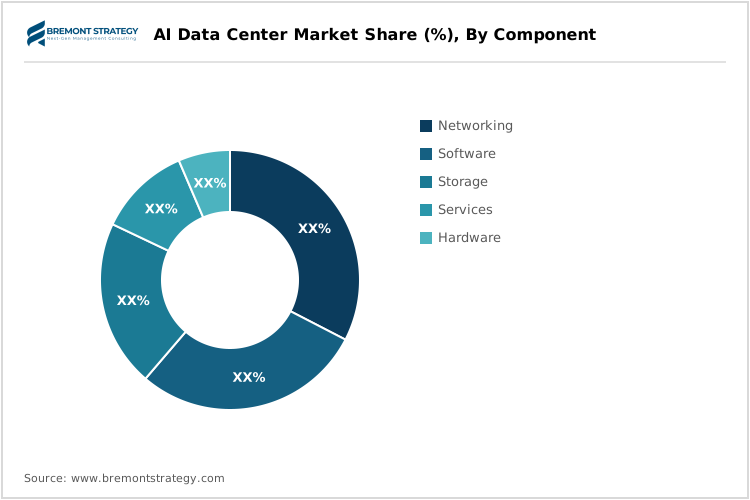
The component segment of the AI Data Center market includes hardware, software, services, networking, and storage. Hardware is expected to dominate the market due to the increasing demand for advanced GPUs and TPUs that enhance computational capabilities. These components are crucial for processing complex AI algorithms efficiently. The software segment is also significant, driven by the need for AI frameworks and platforms that facilitate machine learning and data analytics. Services, including consulting and maintenance, play a vital role in ensuring the smooth operation of AI Data Centers.
Networking and storage are essential components that support the seamless flow and storage of large volumes of data. As AI applications become more data-intensive, the demand for robust networking solutions and scalable storage systems is expected to rise. The integration of high-speed networking technologies, such as 5G, further enhances the performance of AI Data Centers, making them more efficient and responsive.
Overall, the hardware segment is anticipated to lead the market due to its critical role in powering AI workloads. The continuous advancements in AI hardware, such as the development of more efficient processors, are expected to drive the growth of this segment. Additionally, the increasing adoption of AI technologies across various industries will further boost the demand for hardware components.
By Deployment Analysis
The deployment segment is categorized into on-premises, cloud, hybrid, and edge. Cloud deployment is expected to witness the highest growth rate, driven by the flexibility and scalability it offers. Organizations are increasingly adopting cloud-based AI Data Centers to reduce capital expenditure and leverage the vast computational resources available on-demand. This trend is particularly prominent among small and medium-sized enterprises that require cost-effective solutions.
Hybrid deployment models are also gaining traction as they offer a balanced approach, combining the benefits of both on-premises and cloud solutions. This model allows organizations to maintain control over critical data while leveraging the scalability of cloud resources for non-sensitive workloads. Edge deployment is emerging as a significant trend, particularly in applications requiring low-latency data processing, such as autonomous vehicles and smart cities.
On-premises deployment remains relevant for industries with stringent data security requirements, such as healthcare and finance. These organizations prefer to maintain complete control over their data and infrastructure. However, the high costs associated with building and maintaining on-premises data centers may limit their adoption to larger enterprises with substantial resources.
By Application Analysis
The application segment of the AI Data Center market includes data management, machine learning, natural language processing, computer vision, and predictive analytics. Machine learning is expected to dominate the market, driven by its wide range of applications across various industries. From fraud detection in finance to personalized recommendations in retail, machine learning algorithms are integral to enhancing business processes and customer experiences.
Natural language processing (NLP) is another significant application, particularly in customer service and support. AI Data Centers enable the processing of large volumes of text and speech data, facilitating the development of advanced NLP models that improve communication and interaction with customers. Computer vision applications, such as facial recognition and image analysis, also rely heavily on the computational power provided by AI Data Centers.
Predictive analytics is gaining importance as organizations seek to leverage data-driven insights for strategic decision-making. AI Data Centers support the processing of historical and real-time data, enabling businesses to forecast trends and optimize operations. Overall, the increasing adoption of AI technologies across various applications is expected to drive the demand for AI Data Centers.
By Industry Analysis
The industry segment includes BFSI, healthcare, retail, manufacturing, IT and telecommunications, and government. The BFSI sector is anticipated to lead the market, driven by the need for advanced data analytics and fraud detection solutions. AI Data Centers enable financial institutions to process large volumes of transaction data in real-time, enhancing security and operational efficiency.
Healthcare is another significant industry, with AI Data Centers supporting applications such as medical imaging, diagnostics, and personalized medicine. The ability to process and analyze vast amounts of patient data is crucial for improving healthcare outcomes and advancing research. Retailers are leveraging AI Data Centers to enhance customer experiences through personalized recommendations and inventory management.
The manufacturing industry is adopting AI Data Centers for predictive maintenance and quality control, optimizing production processes and reducing downtime. In the IT and telecommunications sector, AI Data Centers support network optimization and customer service automation. Government agencies are also investing in AI Data Centers to enhance public services and improve decision-making processes.
By Region Analysis
The regional analysis of the AI Data Center market covers North America, Europe, Asia Pacific, Latin America, and the Middle East & Africa. North America is expected to lead the market, driven by the presence of major technology companies and early adoption of AI technologies. The region's strong focus on innovation and research further supports the growth of AI Data Centers.
Europe is anticipated to witness significant growth, with countries such as Germany, France, and the UK investing heavily in AI infrastructure. The region's emphasis on data privacy and security is expected to drive the demand for advanced AI Data Centers. Asia Pacific is projected to be the fastest-growing region, driven by rapid digitalization and the increasing adoption of AI technologies in countries like China, Japan, and India.
Latin America is also experiencing growth, with Brazil and Mexico leading the adoption of AI Data Centers. The region's focus on improving digital infrastructure and enhancing business competitiveness is expected to drive market growth. The Middle East & Africa is witnessing increasing investments in AI technologies, with countries like the UAE and Saudi Arabia leading the adoption of AI Data Centers.
AI Data Center Market Regional Outlook
| Regional Outlook | |
|---|---|
| Largest Market | North America |
| Fastest Growing Market | Asia Pacific |
| Emerging Countries | China, India, Brazil |
| Future Outlook | Strong growth driven by AI adoption and technological advancements. |
North America is the largest market for AI Data Centers, driven by the presence of leading technology companies and early adoption of AI technologies. The region's focus on innovation and research supports the growth of AI Data Centers, with the United States and Canada being key contributors to market expansion.
Europe is experiencing significant growth in the AI Data Center market, with countries like Germany, France, and the UK investing in advanced AI infrastructure. The region's emphasis on data privacy and security is driving demand for AI Data Centers that can ensure compliance with stringent regulations.
Asia-Pacific is the fastest-growing region, with rapid digitalization and increasing adoption of AI technologies in countries like China, Japan, and India. The region's strong economic growth and focus on technological advancements are expected to drive the expansion of AI Data Centers.
Latin America is witnessing growth in the AI Data Center market, with Brazil and Mexico leading the adoption of AI technologies. The region's focus on improving digital infrastructure and enhancing business competitiveness is expected to drive market growth.
The Middle East & Africa is seeing increasing investments in AI technologies, with countries like the UAE and Saudi Arabia leading the adoption of AI Data Centers. The region's focus on diversifying economies and enhancing public services is expected to drive demand for AI Data Centers.
AI Data Center Market Competitor Outlook
| Competitor Outlook | |
|---|---|
| Market Leader |
|
| Key Players |
|
| Key Competitive Factors |
|
AI Data Center Pricing Analysis
Pricing in the AI Data Center market is influenced by several factors, including the formulation and specification of hardware components, scale of deployment, and regional variations. The cost of advanced GPUs and AI accelerators, which are critical for high-performance computing, can significantly impact pricing. Additionally, the scale of deployment, whether on-premises, cloud, or hybrid, affects the overall cost structure. Regional variations in labor and infrastructure costs also contribute to pricing differences across markets.
Despite the potential for high costs, many organizations prioritize value-driven buying behavior over price sensitivity. The need for reliable and efficient AI Data Centers that can support critical business operations often outweighs cost considerations. Buyers are willing to invest in premium solutions that offer superior performance, scalability, and security, recognizing the long-term benefits of enhanced AI capabilities.
AI Data Center Consumer Buying Behaviour / Preference Analysis
Key Purchase Criteria
| Buying Factor | Relative Importance | Reason |
|---|---|---|
| Performance | Very High | Critical for AI workloads |
| Durability/Reliability | High | Ensures continuous operation |
| Certification/Compliance | Medium-High | Meets regulatory standards |
| Total Cost | Medium | Budget constraints |
| Differentiating Capability | High | Competitive advantage |
Typical buyers in the AI Data Center market include IT managers, data scientists, and chief technology officers who are responsible for overseeing the deployment and management of AI infrastructure. These professionals prioritize performance and reliability when selecting AI Data Centers, as these factors are crucial for supporting complex AI workloads and ensuring continuous operation.
Purchase decisions are heavily influenced by the need for compliance with industry regulations and standards, particularly in sectors such as healthcare and finance. Buyers also consider the total cost of ownership, balancing budget constraints with the need for advanced capabilities. Differentiating capabilities, such as scalability and integration with existing systems, are also important considerations that can provide a competitive advantage.
TABLE OF CONTENTS
1. Research Methodology
2. Market Structure
3. Executive Summary
4. AI Data Center Market Overview
- 4.1 Introduction
- Market Snapshot
- Assumptions, Inclusion & Exclusions
- Technological Advancements & Patent Analysis
- Case Studies
- Market Entry & Launch Strategies
- Macro-Economic Factors Impacting the Market Growth
- 4.2 AI Data Center Market Dynamics
- Market Drivers
- Market Restraints
- Market Opportunity
- 4.3 AI Data Center Market - Supply Chain Analysis
- Key Raw Material/Components Provider
- Key Manufacturers
- Key Distributors
- Key Consumers
- 4.4 Key Forces Shaping the AI Data Center Market
- Bargaining Power of Suppliers
- Bargaining Power of Buyers
- Threat of Substitution
- Threat of New Entrants
- Competitive Rivalry
- 4.1 Introduction
5. Global AI Data Center Market, By Component
- 5.1 Market Size, Value (USD Mn) & Volume (Units)
- Hardware
- Software
- Services
- Networking
- Storage
- 5.2 Key Market Trends & Growth Opportunities
- 5.3 Market Share (%) Analysis, 2021-2036
- 5.4 Year-on-Year (YoY) Growth Rate
- 5.5 Market Attractiveness
- 5.6 Global Investment & Trade Risks
- 5.7 Pricing Analysis, 2021-2036
- 5.8 Operating Margin/Profits, 2021-2036
- 5.1 Market Size, Value (USD Mn) & Volume (Units)
6. Global AI Data Center Market, By Deployment
- 6.1 Market Size, Value (USD Mn) & Volume (Units)
- On-Premises
- Cloud
- Hybrid
- Edge
- 6.2 Key Market Trends & Growth Opportunities
- 6.3 Market Share (%) Analysis, 2021-2036
- 6.4 Year-on-Year (YoY) Growth Rate
- 6.5 Market Attractiveness
- 6.6 Global Investment & Trade Risks
- 6.7 Pricing Analysis, 2021-2036
- 6.8 Operating Margin/Profits, 2021-2036
- 6.1 Market Size, Value (USD Mn) & Volume (Units)
7. Global AI Data Center Market, By Application
- 7.1 Market Size, Value (USD Mn) & Volume (Units)
- Data Management
- Machine Learning
- Natural Language Processing
- Computer Vision
- Predictive Analytics
- 7.2 Key Market Trends & Growth Opportunities
- 7.3 Market Share (%) Analysis, 2021-2036
- 7.4 Year-on-Year (YoY) Growth Rate
- 7.5 Market Attractiveness
- 7.6 Global Investment & Trade Risks
- 7.7 Pricing Analysis, 2021-2036
- 7.8 Operating Margin/Profits, 2021-2036
- 7.1 Market Size, Value (USD Mn) & Volume (Units)
8. Global AI Data Center Market, By Industry
- 8.1 Market Size, Value (USD Mn) & Volume (Units)
- BFSI
- Healthcare
- Retail
- Manufacturing
- IT and Telecommunications
- Government
- 8.2 Key Market Trends & Growth Opportunities
- 8.3 Market Share (%) Analysis, 2021-2036
- 8.4 Year-on-Year (YoY) Growth Rate
- 8.5 Market Attractiveness
- 8.6 Global Investment & Trade Risks
- 8.7 Pricing Analysis, 2021-2036
- 8.8 Operating Margin/Profits, 2021-2036
- 8.1 Market Size, Value (USD Mn) & Volume (Units)
9. Global AI Data Center Market, By Region
- 9.1 Market Size, Value (USD Mn) & Volume (Units)
- North America
- Europe
- Asia Pacific
- Latin America
- Middle East & Africa
- 9.2 Key Market Trends & Growth Opportunities
- 9.3 Market Share (%) Analysis, 2021-2036
- 9.4 Year-on-Year (YoY) Growth Rate
- 9.5 Market Attractiveness
- 9.6 Global Investment & Trade Risks
- 9.7 Pricing Analysis, 2021-2036
- 9.8 Operating Margin/Profits, 2021-2036
- 9.1 Market Size, Value (USD Mn) & Volume (Units)
10. Global AI Data Center Market, By North America
- 10.1 Market Size, Value (USD Mn) & Volume (Units)
- US
- Canada
- 10.2 Key Market Trends & Growth Opportunities
- 10.3 Market Share (%) Analysis, 2021-2036
- 10.4 Year-on-Year (YoY) Growth Rate
- 10.5 Market Attractiveness
- 10.6 Global Investment & Trade Risks
- 10.7 Pricing Analysis, 2021-2036
- 10.8 Operating Margin/Profits, 2021-2036
- 10.1 Market Size, Value (USD Mn) & Volume (Units)
11. Global AI Data Center Market, By Europe
- 11.1 Market Size, Value (USD Mn) & Volume (Units)
- Germany
- France
- UK
- Spain
- Italy
- Switzerland
- Russia
- Poland
- Rest of Europe
- 11.2 Key Market Trends & Growth Opportunities
- 11.3 Market Share (%) Analysis, 2021-2036
- 11.4 Year-on-Year (YoY) Growth Rate
- 11.5 Market Attractiveness
- 11.6 Global Investment & Trade Risks
- 11.7 Pricing Analysis, 2021-2036
- 11.8 Operating Margin/Profits, 2021-2036
- 11.1 Market Size, Value (USD Mn) & Volume (Units)
12. Global AI Data Center Market, By Asia Pacific
- 12.1 Market Size, Value (USD Mn) & Volume (Units)
- China
- Japan
- South Korea
- India
- Australia
- South East Asia
- Rest of APAC
- 12.2 Key Market Trends & Growth Opportunities
- 12.3 Market Share (%) Analysis, 2021-2036
- 12.4 Year-on-Year (YoY) Growth Rate
- 12.5 Market Attractiveness
- 12.6 Global Investment & Trade Risks
- 12.7 Pricing Analysis, 2021-2036
- 12.8 Operating Margin/Profits, 2021-2036
- 12.1 Market Size, Value (USD Mn) & Volume (Units)
13. Global AI Data Center Market, By Latin America
- 13.1 Market Size, Value (USD Mn) & Volume (Units)
- Brazil
- Mexico
- Argentina
- Rest of LATAM
- 13.2 Key Market Trends & Growth Opportunities
- 13.3 Market Share (%) Analysis, 2021-2036
- 13.4 Year-on-Year (YoY) Growth Rate
- 13.5 Market Attractiveness
- 13.6 Global Investment & Trade Risks
- 13.7 Pricing Analysis, 2021-2036
- 13.8 Operating Margin/Profits, 2021-2036
- 13.1 Market Size, Value (USD Mn) & Volume (Units)
14. Global AI Data Center Market, By Middle East & Africa
- 14.1 Market Size, Value (USD Mn) & Volume (Units)
- Saudi Arabia
- UAE
- South Africa
- Rest of MEA
- 14.2 Key Market Trends & Growth Opportunities
- 14.3 Market Share (%) Analysis, 2021-2036
- 14.4 Year-on-Year (YoY) Growth Rate
- 14.5 Market Attractiveness
- 14.6 Global Investment & Trade Risks
- 14.7 Pricing Analysis, 2021-2036
- 14.8 Operating Margin/Profits, 2021-2036
- 14.1 Market Size, Value (USD Mn) & Volume (Units)
15. Competitive Analysis
- 15.1 Competition Landscape, Key Players
- Global Market Share (%) Analysis of Key Players in AI Data Center, in Value (USD Mn) & Volume (Units)
- Company Overview
- Company Financials
- News & Developments
- Strategic Initiatives
- 15.2 Company Profiles
- NVIDIA Corporation
- Intel Corporation
- Microsoft Corporation
- Amazon Web Services, Inc.
- Google LLC
- IBM Corporation
- Oracle Corporation
- Cisco Systems, Inc.
- Dell Technologies Inc.
- Hewlett Packard Enterprise Development LP
- Alibaba Group Holding Limited
- Tencent Holdings Limited
- Baidu, Inc.
- Advanced Micro Devices, Inc.
- Lenovo Group Limited
- Equinix, Inc.
- Digital Realty Trust, Inc.
- Fujitsu Limited
- Huawei Technologies Co., Ltd.
- SAP SE
- 15.1 Competition Landscape, Key Players
METHODOLOGY
To provide you with a comprehensive understanding of how we quantify your market opportunity, we utilize a multi-phased methodology designed to minimize risk and maximize strategic clarity. We begin the process by establishing a clear conceptual framework, often referred to as the TAM-SAM-SOM model. By starting with the Total Addressable Market, we look at the absolute global demand for your category. We then refine this into the Serviceable Addressable Market to account for your specific geographic and technological reach, and finally, we pinpoint the Serviceable Obtainable Market. This ensures that the final figures we present are not just theoretical "vanity metrics," but represent a realistic, capture-able revenue target for your business.
Our data collection process relies on a rigorous principle called triangulation, where we cross-reference multiple independent data streams to ensure accuracy. We initiate this with deep-dive secondary research, synthesizing high-value intelligence from audited financial filings, government trade databases, and specialized industry journals. This "desk research" phase provides a macro-economic baseline and identifies historical growth trajectories. However, because secondary data can sometimes lag behind real-time shifts, we supplement this with targeted primary research. This involves direct engagement with Key Opinion Leaders (KOLs) and structured quantitative surveys to capture the current pulse of the market and emerging buyer intent.
To ensure the integrity of our estimates, we employ a dual-modeling approach, calculating the market size from both the "Top-Down" and "Bottom-Up." The Top-Down analysis provides a valuable sanity check against broader economic trends, but we place the most weight on our Bottom-Up modeling. By taking granular data, such as the average transaction value and the actual number of potential customer touchpoints, and scaling them upward, we build a highly defensible model grounded in operational reality. This dual-verification method allows us to identify any discrepancies early, ensuring that the resulting data is robust enough to withstand the scrutiny of stakeholders or investors.
Finally, we recognize that a static market size figure is only a snapshot in time. To provide you with a roadmap for the future, we integrate trend analysis and Compound Annual Growth Rate (CAGR) forecasting into our final reporting. We analyze the underlying drivers, such as regulatory shifts, technological disruptions, or changing consumer behaviors, to predict how the market will evolve over the next three to five years. This ongoing tracking mechanism transforms a simple number into a dynamic strategic tool, allowing you to monitor your market share in real-time and pivot your resources as new opportunities emerge.
Frequently Asked Questions
What is the current size of the AI Data Center market?
The AI Data Center market size in the base year 2026 is valued at $12.3 billion.
What is the projected market size by 2036?
By 2036, the AI Data Center market is expected to reach a size of $35.7 billion.
What is the market's CAGR during the forecast period?
The AI Data Center market is projected to grow at a compound annual growth rate (CAGR) of 11.2% from 2026 to 2036.
Which region leads or is the fastest-growing in this market?
The North American region currently leads the AI Data Center market, while the Asia-Pacific region is anticipated to be the fastest-growing during the forecast period.
Which segment holds the largest share in the AI Data Center market?
The hardware segment holds the largest share in the AI Data Center market, driven by increasing demand for advanced computing infrastructure.
Who are the key players in the AI Data Center market?
Key players in the AI Data Center market include companies like NVIDIA Corporation, Intel Corporation, and IBM Corporation, among others.
What are the key growth drivers for the AI Data Center market?
Key growth drivers include the rising adoption of AI technologies, increasing data generation, and the need for efficient data processing and storage solutions.
Is the report customizable?
Yes, the report can be customized to meet specific requirements and provide tailored insights.