Crystalline Waterproofing Systems
Crystalline Waterproofing Systems Market Research Report 2036
Crystalline Waterproofing Systems Market Segments - by Component (Admixtures, Coatings, Additives, Membranes, Sealants, Others), Deployment (On-Site Application, Pre-Mixed, Post-Construction Application, Integral Systems, Surface Applied Systems, Others), Application (Basements, Tunnels, Water Treatment Plants, Bridges, Dams, Others), Industry (Construction, Infrastructure, Water Management, Mining, Energy, Others), and Region (North America, Europe, Asia Pacific, Latin America, Middle East & Africa) - The Market Forecasts are Provided in Terms of Value (USD)
Crystalline Waterproofing Systems Market Outlook
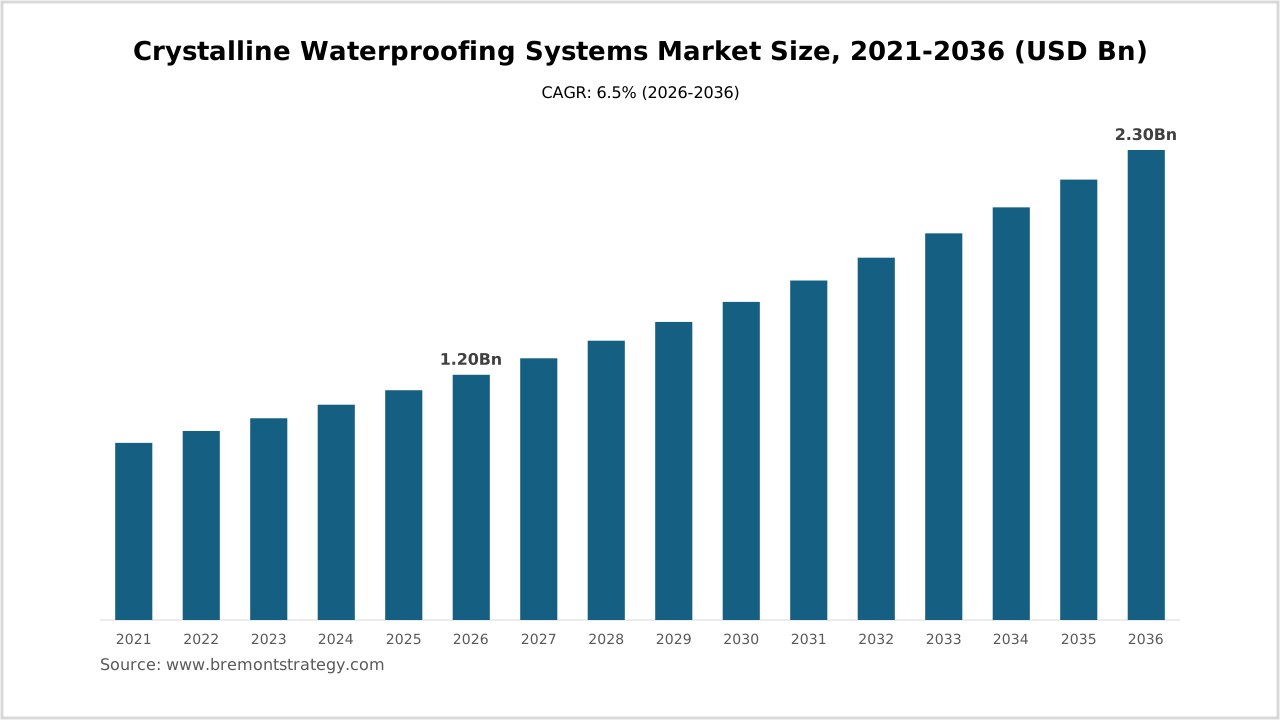
The Crystalline Waterproofing Systems market was valued at $1.2 billion in 2026 and is projected to reach $2.3 billion by 2036, growing at a CAGR of 6.5% during the forecast period 2026-2036. This market is characterized by the increasing demand for durable water-resistant materials in construction projects worldwide. With urbanization and infrastructure development on the rise, crystalline waterproofing solutions are becoming increasingly significant due to their long-lasting protective qualities and cost-effectiveness. The market is expected to flourish, driven by technological advancements, increased construction activities, and the need for sustainable building solutions. North America and Asia-Pacific are anticipated to lead the market owing to extensive infrastructural development and renovation activities. Key players are actively investing in research and development to innovate product offerings, thus fueling market growth.
Key Takeaways
- The market size of the Crystalline Waterproofing Systems in 2026 was $1.2 billion.
- It is expected to reach $2.3 billion by 2036, with a CAGR of 6.5%.
- North America and Asia-Pacific are dominant regions in the market.
- Technological advancements are a critical driver for market expansion.
- Increasing investments in infrastructure boosts the market demand.
- BASF SE and Sika AG are key market players.
- Innovations in product offerings enhance market growth potential.
- Rising adoption in water management and mining sectors.
Crystalline Waterproofing Systems Market Outlook 2026-2036
The global market for crystalline waterproofing systems is projected to witness substantial growth over the forecast period. The demand for these systems is primarily driven by the construction and infrastructure sectors, which are increasingly adopting these solutions for enhanced durability and longevity. As the construction industry continues to expand, particularly in emerging economies, the need for effective waterproofing solutions is bound to rise. The market is further bolstered by the benefits offered by crystalline waterproofing systems, such as reduced maintenance costs and long-term protection against water damage. Additionally, the emphasis on sustainable construction materials is likely to fuel the market growth over the coming years.
On the technological front, significant advancements are being made to improve the efficacy and application processes of crystalline waterproofing products. Companies are investing heavily in R&D to introduce innovative products that cater to the evolving demands of the end-users. The competitive landscape is characterized by strategic collaborations and partnerships among key players to expand market presence and enhance product offerings. As the global focus shifts towards sustainable development, crystalline waterproofing systems that conform to environmental standards are gaining popularity, thereby propelling market growth. The integration of advanced technologies such as nanotechnology in developing crystalline products is expected to open new avenues for market expansion.
Crystalline Waterproofing Systems Market Regional Outlook 2026-2036
Regionally, North America is expected to hold a significant share in the crystalline waterproofing systems market owing to the region's robust infrastructure and construction activities. The presence of major market players and the adoption of advanced construction materials contribute to the region's dominance. In addition, government regulations promoting sustainable building practices are encouraging the use of innovative waterproofing solutions, thereby driving the market forward.
In Europe, the market is poised for moderate growth, supported by stringent building codes and regulations that mandate the use of high-performance waterproofing solutions. The increasing need to renovate aging infrastructure in several European countries is expected to boost the adoption of crystalline waterproofing systems. Furthermore, the market in this region is characterized by the presence of several established players who offer a wide range of products tailored to meet diverse customer needs.
Asia-Pacific is projected to be the fastest-growing region in the crystalline waterproofing systems market. The rapid urbanization and expanding construction activities in countries like China, India, and Japan are primary growth drivers. The demand for sustainable and durable building materials is on the rise, fostering the adoption of crystalline waterproofing solutions. Moreover, the growing awareness about the benefits of these systems and the increasing investments in infrastructure projects are expected to contribute significantly to the regional market growth.
Key Growth Drivers of the Crystalline Waterproofing Systems Market
Technological Advancements in Construction Materials
Technological advancements have significantly impacted the crystalline waterproofing systems market, leading to the development of more efficient and durable products. Innovations such as nanotechnology and advanced polymer composites are being integrated to enhance the performance of waterproofing solutions. Companies are focusing on R&D to introduce products that are not only effective but also environmentally friendly, catering to the growing demand for sustainable construction materials.
Rise in Infrastructure Development
The burgeoning demand for infrastructure development, particularly in emerging economies, is a key driver of the crystalline waterproofing systems market. Governments and private entities are investing heavily in building and upgrading infrastructure, which necessitates reliable waterproofing solutions. The longevity and cost-effectiveness of crystalline solutions make them an attractive choice for large-scale projects, driving market growth.
Increasing Awareness of Sustainable Building Practices
As the focus on environmental sustainability intensifies, the construction industry is increasingly adopting green building practices. Crystalline waterproofing systems, known for their eco-friendly properties, are gaining popularity among builders and developers. These systems not only provide effective water resistance but also contribute to energy efficiency, aligning with global sustainability goals.
Expansion of the Construction Industry in Asia-Pacific
The construction industry in Asia-Pacific is witnessing rapid expansion, fueled by urbanization and industrialization. The demand for water-resistant materials is escalating as new projects are initiated and existing structures undergo renovation. Crystalline waterproofing systems, with their superior performance and cost benefits, are becoming the preferred choice in this burgeoning market, thereby supporting regional growth.
Crystalline Waterproofing Systems Market Segment Analysis
By Component
The component segment of the crystalline waterproofing systems market includes admixtures, coatings, additives, membranes, sealants, and others. Each of these components plays a crucial role in ensuring the effectiveness of waterproofing solutions, catering to diverse application needs.
Admixtures, being integral to concrete mixtures, provide enhanced durability and water resistance, making them a popular choice in construction projects. Coatings and membranes offer additional layers of protection, ideal for surfaces prone to water exposure.
Additives, on the other hand, are gaining traction for their ability to modify the properties of traditional waterproofing systems, enhancing performance. Sealants are crucial in safeguarding critical joints and seams from water ingress, thus ensuring structural integrity.
The growing demand for comprehensive waterproofing solutions is driving the adoption of these components, with manufacturers focusing on developing innovative products to meet diverse customer requirements.
By Deployment
The deployment segment comprises on-site application, pre-mixed, post-construction application, integral systems, surface applied systems, and others. Each deployment method offers unique advantages and is selected based on specific project needs.
On-site applications are favored for their flexibility and adaptability in complex construction projects. Pre-mixed solutions, being ready-to-use, offer convenience and consistency in performance, making them popular in time-sensitive projects.
Post-construction applications target existing structures, providing an effective means of enhancing water resistance without extensive modifications. Integral systems are embedded into building materials, offering long-term protection and complementing sustainable construction practices.
Surface-applied systems remain essential for their ease of application and ability to protect exposed surfaces from water damage, supporting the demand for versatile waterproofing solutions.
By Application
The application segment is crucial for understanding the diverse use cases of crystalline waterproofing systems, covering basements, tunnels, water treatment plants, bridges, dams, and others. Each application requires specific waterproofing characteristics to ensure optimal performance.
Basements and tunnels, being underground structures, face significant water pressure, necessitating robust waterproofing solutions. Crystalline systems, with their deep penetration capabilities, are ideal for such applications.
Infrastructures like bridges and dams are exposed to harsh environmental conditions; thus, effective waterproofing is critical to maintain structural integrity. Water treatment plants, requiring high standards of water resistance, benefit greatly from crystalline waterproofing systems.
The diverse application areas underscore the versatility and efficacy of these systems, fostering their adoption across different sectors and contributing to overall market expansion.
By Industry
The industry segment explores the adoption of crystalline waterproofing systems across various sectors, including construction, infrastructure, water management, mining, energy, and others. Each industry presents unique challenges and opportunities for waterproofing solutions.
The construction industry, as the primary consumer, drives significant demand for crystalline systems due to the need for durable and cost-effective building materials. Infrastructure projects, including roads and bridges, benefit from the long-lasting protection offered by these systems.
Water management facilities, with their critical requirement for water resistance, increasingly rely on crystalline solutions to ensure operational efficiency. The mining sector, with its demanding environmental conditions, seeks high-performance waterproofing systems to protect valuable assets.
The energy sector, particularly in renewable energy projects, is also embracing crystalline solutions to address water ingress challenges, highlighting the growing importance of these systems across diverse industrial applications.
By Region
Regional analysis of the crystalline waterproofing systems market reveals significant growth trends and opportunities across North America, Europe, Asia Pacific, Latin America, and the Middle East & Africa. Each region presents unique market dynamics influenced by local construction activities and regulatory frameworks.
North America, with its developed infrastructure and technological advancements, remains a key market. Europe follows closely, driven by stringent regulations and the need for sustainable construction solutions.
Asia-Pacific is anticipated to witness the fastest growth, fueled by urbanization and extensive construction projects. Latin America and the Middle East & Africa, though smaller in market share, offer substantial growth potential due to increasing investments in infrastructure development.
The regional diversity in market dynamics underscores the need for tailored strategies to capitalize on emerging opportunities and address region-specific challenges, ensuring sustained market growth.
Crystalline Waterproofing Systems Segment Comparison
| Segment | Market Share | Growth Rate | Key Insight |
|---|---|---|---|
| Admixtures | 30% | 7.0% | High demand in construction |
| Coatings | 20% | 6.5% | Preferred for surface applications |
| Additives | 15% | 5.8% | Enhance traditional systems |
| Membranes | 10% | 6.0% | Key in critical structures |
| Sealants | 8% | 5.7% | Essential for joint protection |
| On-Site Application | 12% | 6.2% | Flexible deployment |
| Pre-Mixed | 5% | 5.5% | Convenient use |
| Asia-Pacific | 25% | 8.0% | Fastest growing region |
| North America | 35% | 5.0% | Technological hub |
| Europe | 20% | 4.5% | Regulatory driven |
Crystalline Waterproofing Systems Market Opportunities and Threats 2026-2036
The crystalline waterproofing systems market presents numerous opportunities owing to the growing emphasis on sustainable construction practices. As the world moves towards eco-friendly building solutions, crystalline waterproofing systems, with their minimal environmental impact and high efficiency, are likely to witness increased adoption. The integration of advanced technologies in product development further enhances the market's growth prospects, offering innovative solutions that meet evolving consumer demands. Additionally, expanding urbanization and infrastructure development in emerging markets present lucrative opportunities for market players to establish a strong foothold.
However, the market faces several challenges that could hinder growth potential. The high initial cost of crystalline waterproofing systems may pose a barrier for small-scale construction projects, limiting market penetration. Moreover, the presence of alternative waterproofing solutions, such as bituminous and liquid-applied membranes, intensifies competition and could impact market share. The complexity of application and the need for skilled labor to implement these systems effectively may also restrict their widespread adoption in certain regions.
Despite these challenges, the market's growth trajectory remains positive, driven by the increasing demand for water-resistant materials in various industries. The mining and energy sectors, in particular, offer substantial growth opportunities as they seek durable solutions to protect critical infrastructure from water damage. The rising awareness about the long-term cost benefits and performance advantages of crystalline waterproofing systems further strengthens their market position.
In conclusion, while the market is poised for growth, strategic efforts are required to overcome existing challenges and capitalize on emerging opportunities. Companies must focus on cost-effective solutions, enhance product offerings, and invest in marketing and training initiatives to drive market expansion. By addressing these factors, the crystalline waterproofing systems market can secure a sustainable growth path over the forecast period.
Crystalline Waterproofing Systems Market Competitor Outlook 2026-2036
The competitive landscape of the crystalline waterproofing systems market is characterized by the presence of several key players, each striving to gain a competitive edge through innovation and strategic initiatives. Companies such as BASF SE and Sika AG lead the market with their extensive product portfolios and global reach. These industry giants invest heavily in research and development to introduce cutting-edge solutions that cater to the diverse needs of the construction and infrastructure sectors. Their strong brand equity and customer trust further reinforce their market dominance.
Emerging players are also making significant strides, focusing on niche markets and developing specialized products that address specific customer requirements. Companies like Xypex Chemical Corporation and Fosroc International Limited are leveraging their expertise in crystalline technology to offer unique solutions that enhance structural integrity and longevity. Collaborations and partnerships are common strategies employed by these players to expand their market presence and tap into new customer segments.
Furthermore, the market is witnessing increased consolidation activities, with larger players acquiring smaller firms to enhance their product offerings and distribution channels. This competitive environment encourages continuous innovation and improvement, driving overall market growth. As the demand for sustainable and high-performance waterproofing solutions rises, competitors are likely to intensify efforts to capitalize on emerging opportunities and maintain a strong market position.
Crystalline Waterproofing Systems Market Latest Industry Developments
- BASF SE launched a new range of eco-friendly crystalline waterproofing solutions.
- Sika AG acquired a leading waterproofing company to expand its product portfolio.
- W. R. Grace & Co. introduced a highly durable crystalline admixture for infrastructure projects.
- Xypex Chemical Corporation announced a partnership with a major construction firm to enhance product distribution.
- Fosroc International Limited expanded its R&D facilities to drive innovation in crystalline technology.
- Kryton International Inc. launched an advanced crystalline waterproofing system with enhanced performance metrics.
- GCP Applied Technologies Inc. entered a strategic alliance to penetrate emerging markets.
- RPM International Inc. introduced a new line of crystalline additives for critical infrastructure applications.
- MAPEI S.p.A. announced the development of a high-performance crystalline membrane for industrial use.
- Cemix Products Ltd. unveiled a cost-effective crystalline solution targeting residential projects.
- Chryso S.A.S. enhanced its product offerings with the acquisition of a regional waterproofing specialist.
- Penetron International Ltd. launched a series of educational workshops to promote crystalline waterproofing systems.
- Schomburg GmbH & Co. KG expanded its distribution network in Asia-Pacific to capture growing demand.
- Hycrete, Inc. developed a novel crystalline technology for enhanced water resistance in mining applications.
- CICO Technologies Limited introduced an innovative crystalline sealant for critical joint protection.
TABLE OF CONTENTS
1. Research Methodology
2. Market Structure
3. Executive Summary
4. Crystalline Waterproofing Systems Market Overview
- 4.1 Introduction
- Market Snapshot
- Assumptions, Inclusion & Exclusions
- Technological Advancements & Patent Analysis
- Case Studies
- Market Entry & Launch Strategies
- Macro-Economic Factors Impacting the Market Growth
- 4.2 Crystalline Waterproofing Systems Market Dynamics
- Market Drivers
- Market Restraints
- Market Opportunity
- 4.3 Crystalline Waterproofing Systems Market - Supply Chain Analysis
- Key Raw Material/Components Provider
- Key Manufacturers
- Key Distributors
- Key Consumers
- 4.4 Key Forces Shaping the Crystalline Waterproofing Systems Market
- Bargaining Power of Suppliers
- Bargaining Power of Buyers
- Threat of Substitution
- Threat of New Entrants
- Competitive Rivalry
- 4.1 Introduction
5. Global Crystalline Waterproofing Systems Market, By Component
- 5.1 Market Size, Value (USD Mn) & Volume (Units)
- Admixtures
- Coatings
- Additives
- Membranes
- Sealants
- Others
- 5.2 Key Market Trends & Growth Opportunities
- 5.3 Market Share (%) Analysis, 2021-2036
- 5.4 Year-on-Year (YoY) Growth Rate
- 5.5 Market Attractiveness
- 5.6 Global Investment & Trade Risks
- 5.7 Pricing Analysis, 2021-2036
- 5.8 Operating Margin/Profits, 2021-2036
- 5.1 Market Size, Value (USD Mn) & Volume (Units)
6. Global Crystalline Waterproofing Systems Market, By Deployment Mode
- 6.1 Market Size, Value (USD Mn) & Volume (Units)
- On-Site Application
- Pre-Mixed
- Post-Construction Application
- Integral Systems
- Surface Applied Systems
- Others
- 6.2 Key Market Trends & Growth Opportunities
- 6.3 Market Share (%) Analysis, 2021-2036
- 6.4 Year-on-Year (YoY) Growth Rate
- 6.5 Market Attractiveness
- 6.6 Global Investment & Trade Risks
- 6.7 Pricing Analysis, 2021-2036
- 6.8 Operating Margin/Profits, 2021-2036
- 6.1 Market Size, Value (USD Mn) & Volume (Units)
7. Global Crystalline Waterproofing Systems Market, By Application
- 7.1 Market Size, Value (USD Mn) & Volume (Units)
- Basements
- Tunnels
- Water Treatment Plants
- Bridges
- Dams
- Others
- 7.2 Key Market Trends & Growth Opportunities
- 7.3 Market Share (%) Analysis, 2021-2036
- 7.4 Year-on-Year (YoY) Growth Rate
- 7.5 Market Attractiveness
- 7.6 Global Investment & Trade Risks
- 7.7 Pricing Analysis, 2021-2036
- 7.8 Operating Margin/Profits, 2021-2036
- 7.1 Market Size, Value (USD Mn) & Volume (Units)
8. Global Crystalline Waterproofing Systems Market, By Industry Vertical
- 8.1 Market Size, Value (USD Mn) & Volume (Units)
- Construction
- Infrastructure
- Water Management
- Mining
- Energy
- Others
- 8.2 Key Market Trends & Growth Opportunities
- 8.3 Market Share (%) Analysis, 2021-2036
- 8.4 Year-on-Year (YoY) Growth Rate
- 8.5 Market Attractiveness
- 8.6 Global Investment & Trade Risks
- 8.7 Pricing Analysis, 2021-2036
- 8.8 Operating Margin/Profits, 2021-2036
- 8.1 Market Size, Value (USD Mn) & Volume (Units)
9. Global Crystalline Waterproofing Systems Market, By Region
- 9.1 Market Size, Value (USD Mn) & Volume (Units)
- North America
- Europe
- Asia Pacific
- Latin America
- Middle East & Africa
- 9.2 Key Market Trends & Growth Opportunities
- 9.3 Market Share (%) Analysis, 2021-2036
- 9.4 Year-on-Year (YoY) Growth Rate
- 9.5 Market Attractiveness
- 9.6 Global Investment & Trade Risks
- 9.7 Pricing Analysis, 2021-2036
- 9.8 Operating Margin/Profits, 2021-2036
- 9.1 Market Size, Value (USD Mn) & Volume (Units)
10. Global Crystalline Waterproofing Systems Market, By North America
- 10.1 Market Size, Value (USD Mn) & Volume (Units)
- US
- Canada
- 10.2 Key Market Trends & Growth Opportunities
- 10.3 Market Share (%) Analysis, 2021-2036
- 10.4 Year-on-Year (YoY) Growth Rate
- 10.5 Market Attractiveness
- 10.6 Global Investment & Trade Risks
- 10.7 Pricing Analysis, 2021-2036
- 10.8 Operating Margin/Profits, 2021-2036
- 10.1 Market Size, Value (USD Mn) & Volume (Units)
11. Global Crystalline Waterproofing Systems Market, By Europe
- 11.1 Market Size, Value (USD Mn) & Volume (Units)
- Germany
- France
- UK
- Spain
- Italy
- Switzerland
- Russia
- Poland
- Rest of Europe
- 11.2 Key Market Trends & Growth Opportunities
- 11.3 Market Share (%) Analysis, 2021-2036
- 11.4 Year-on-Year (YoY) Growth Rate
- 11.5 Market Attractiveness
- 11.6 Global Investment & Trade Risks
- 11.7 Pricing Analysis, 2021-2036
- 11.8 Operating Margin/Profits, 2021-2036
- 11.1 Market Size, Value (USD Mn) & Volume (Units)
12. Global Crystalline Waterproofing Systems Market, By Asia Pacific
- 12.1 Market Size, Value (USD Mn) & Volume (Units)
- China
- Japan
- South Korea
- India
- Australia
- South East Asia
- Rest of APAC
- 12.2 Key Market Trends & Growth Opportunities
- 12.3 Market Share (%) Analysis, 2021-2036
- 12.4 Year-on-Year (YoY) Growth Rate
- 12.5 Market Attractiveness
- 12.6 Global Investment & Trade Risks
- 12.7 Pricing Analysis, 2021-2036
- 12.8 Operating Margin/Profits, 2021-2036
- 12.1 Market Size, Value (USD Mn) & Volume (Units)
13. Global Crystalline Waterproofing Systems Market, By Latin America
- 13.1 Market Size, Value (USD Mn) & Volume (Units)
- Brazil
- Mexico
- Argentina
- Rest of LATAM
- 13.2 Key Market Trends & Growth Opportunities
- 13.3 Market Share (%) Analysis, 2021-2036
- 13.4 Year-on-Year (YoY) Growth Rate
- 13.5 Market Attractiveness
- 13.6 Global Investment & Trade Risks
- 13.7 Pricing Analysis, 2021-2036
- 13.8 Operating Margin/Profits, 2021-2036
- 13.1 Market Size, Value (USD Mn) & Volume (Units)
14. Global Crystalline Waterproofing Systems Market, By Middle East & Africa
- 14.1 Market Size, Value (USD Mn) & Volume (Units)
- Saudi Arabia
- UAE
- South Africa
- Rest of MEA
- 14.2 Key Market Trends & Growth Opportunities
- 14.3 Market Share (%) Analysis, 2021-2036
- 14.4 Year-on-Year (YoY) Growth Rate
- 14.5 Market Attractiveness
- 14.6 Global Investment & Trade Risks
- 14.7 Pricing Analysis, 2021-2036
- 14.8 Operating Margin/Profits, 2021-2036
- 14.1 Market Size, Value (USD Mn) & Volume (Units)
15. Competitive Analysis
- 15.1 Competition Landscape, Key Players
- Global Market Share (%) Analysis of Key Players in Crystalline Waterproofing Systems, in Value (USD Mn) & Volume (Units)
- Company Overview
- Company Financials
- News & Developments
- Strategic Initiatives
- 15.2 Company Profiles
- BASF SE
- Sika AG
- W. R. Grace & Co.
- Xypex Chemical Corporation
- Fosroc International Limited
- Kryton International Inc.
- GCP Applied Technologies Inc.
- RPM International Inc.
- MAPEI S.p.A.
- Cemix Products Ltd.
- Chryso S.A.S.
- Penetron International Ltd.
- Schomburg GmbH & Co. KG
- Hycrete, Inc.
- CICO Technologies Limited
- Aquafin, Inc.
- Oscrete Construction Products
- KÖSTER Bauchemie AG
- Sodamco-Weber
- Normet Group Oy
- 15.1 Competition Landscape, Key Players
METHODOLOGY
To provide you with a comprehensive understanding of how we quantify your market opportunity, we utilize a multi-phased methodology designed to minimize risk and maximize strategic clarity. We begin the process by establishing a clear conceptual framework, often referred to as the TAM-SAM-SOM model. By starting with the Total Addressable Market, we look at the absolute global demand for your category. We then refine this into the Serviceable Addressable Market to account for your specific geographic and technological reach, and finally, we pinpoint the Serviceable Obtainable Market. This ensures that the final figures we present are not just theoretical "vanity metrics," but represent a realistic, capture-able revenue target for your business.
Our data collection process relies on a rigorous principle called triangulation, where we cross-reference multiple independent data streams to ensure accuracy. We initiate this with deep-dive secondary research, synthesizing high-value intelligence from audited financial filings, government trade databases, and specialized industry journals. This "desk research" phase provides a macro-economic baseline and identifies historical growth trajectories. However, because secondary data can sometimes lag behind real-time shifts, we supplement this with targeted primary research. This involves direct engagement with Key Opinion Leaders (KOLs) and structured quantitative surveys to capture the current pulse of the market and emerging buyer intent.
To ensure the integrity of our estimates, we employ a dual-modeling approach, calculating the market size from both the "Top-Down" and "Bottom-Up." The Top-Down analysis provides a valuable sanity check against broader economic trends, but we place the most weight on our Bottom-Up modeling. By taking granular data, such as the average transaction value and the actual number of potential customer touchpoints, and scaling them upward, we build a highly defensible model grounded in operational reality. This dual-verification method allows us to identify any discrepancies early, ensuring that the resulting data is robust enough to withstand the scrutiny of stakeholders or investors.
Finally, we recognize that a static market size figure is only a snapshot in time. To provide you with a roadmap for the future, we integrate trend analysis and Compound Annual Growth Rate (CAGR) forecasting into our final reporting. We analyze the underlying drivers, such as regulatory shifts, technological disruptions, or changing consumer behaviors, to predict how the market will evolve over the next three to five years. This ongoing tracking mechanism transforms a simple number into a dynamic strategic tool, allowing you to monitor your market share in real-time and pivot your resources as new opportunities emerge.