Industrial Display
Industrial Display Market Research Report 2036
Industrial Display Market Segments - by Component (Displays, Controllers, Software, Accessories, Services), Deployment (On-Premises, Cloud-Based, Hybrid), Application (HMI, Remote Monitoring, Interactive Display, Digital Signage, Control Rooms), Industry (Manufacturing, Energy & Power, Oil & Gas, Transportation, Healthcare, Automotive), End User (OEMs, System Integrators, End-User Industries, Distributors), and Region (North America, Europe, Asia Pacific, Latin America, Middle East & Africa) - The Market Forecasts are Provided in Terms of Value (USD)
Industrial Display Market Outlook
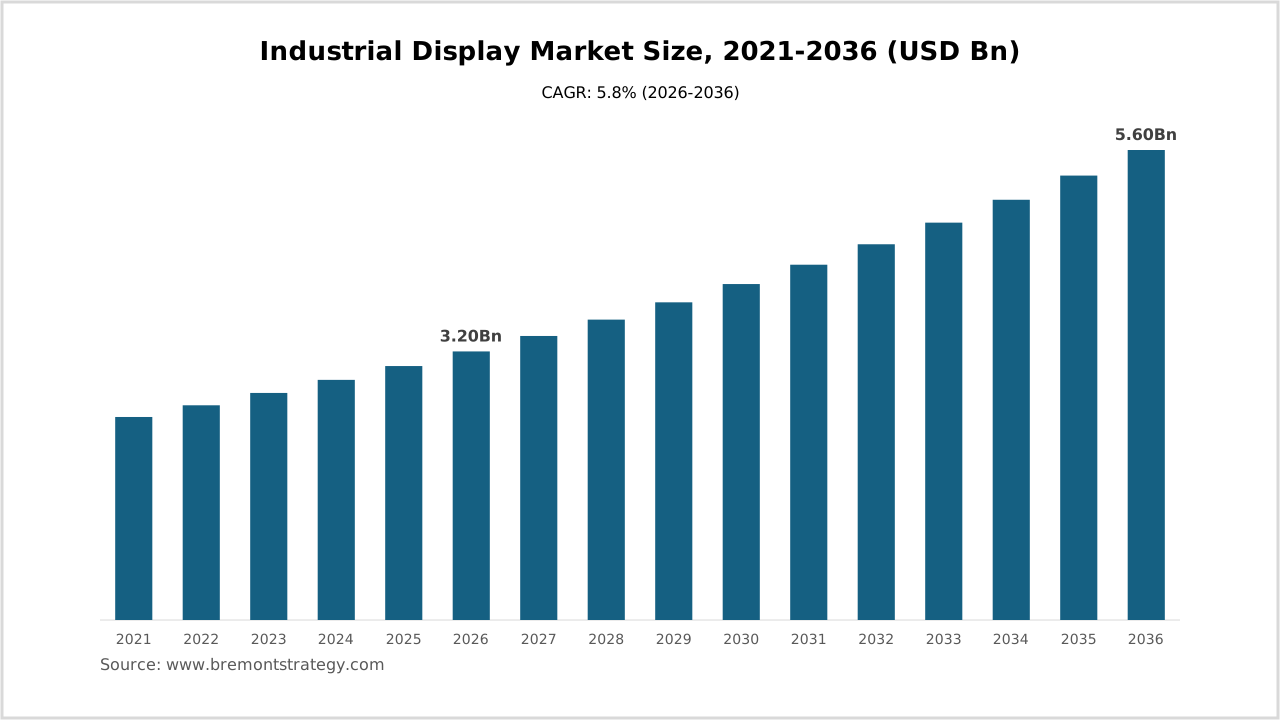
The Industrial Display market was valued at $3.2 Billion in 2026 and is projected to reach $5.6 Billion by 2036, growing at a CAGR of 5.8% during the forecast period 2026-2036. This growth is driven by increasing demand for advanced display technologies in industrial applications, particularly in sectors such as manufacturing and transportation.
Industrial displays are specialized electronic display systems designed for use in harsh industrial environments. They are distinct from conventional displays due to their durability, high brightness, and ability to operate under extreme conditions. These displays are essential in providing real-time data and enhancing operational efficiency across various industries.
The primary drivers of demand include the growing adoption of automation and IoT technologies across industries, which require robust display solutions for monitoring and control purposes. Additionally, the shift towards smart manufacturing and Industry 4.0 is further propelling the demand for industrial displays.
Technological advancements in display technologies, such as OLED and quantum dot displays, are expected to enhance the performance and capabilities of industrial displays. R&D efforts are focused on improving energy efficiency, resolution, and interactivity to meet the evolving needs of industrial applications.
Competitive dynamics in the market are influenced by factors such as price, technical performance, and after-sales support. Vendors compete by offering innovative features and robust customer support, which are critical in influencing adoption. Distribution networks and partnerships also play a significant role in expanding market reach.
Industrial Display Market Key Takeaways
- The Industrial Display market is expected to grow from $3.2 Billion in 2026 to $5.6 Billion by 2036, at a CAGR of 5.8%.
- The "Displays" sub-segment within the "By Component" category is projected to hold a significant market share, driven by advancements in display technologies.
- Asia Pacific is anticipated to be the leading region, accounting for a substantial share of the market due to rapid industrialization and technological adoption.
- The increasing integration of IoT in industrial applications is a major demand driver, enhancing the need for advanced display solutions.
Industrial Display Market Key Drivers
| Drivers | Impact |
|---|---|
| Automation and IoT Integration | Enhances demand for real-time monitoring displays. |
| Industry 4.0 Adoption | Drives need for advanced display technologies. |
| Technological Advancements | Improves display performance and capabilities. |
| Increased Industrialization | Boosts demand for durable and reliable displays. |
Automation and IoT Integration
The integration of automation and IoT in industrial settings is a significant driver for the Industrial Display market. These technologies require reliable display solutions for real-time monitoring and data visualization, enhancing operational efficiency and decision-making processes. As industries increasingly adopt IoT-enabled devices, the demand for advanced industrial displays is expected to rise substantially.
Industry 4.0 Adoption
Industry 4.0 represents the fourth industrial revolution, characterized by the integration of digital technologies into manufacturing processes. This trend is driving the demand for sophisticated display technologies that can support complex data visualization and control applications. As companies transition to smart manufacturing, the need for high-performance industrial displays is becoming more pronounced.
Technological Advancements
Advancements in display technologies, such as OLED and quantum dot displays, are significantly impacting the Industrial Display market. These technologies offer superior performance in terms of brightness, resolution, and energy efficiency, making them ideal for industrial applications. Continuous R&D efforts are focused on enhancing these attributes to meet the specific needs of industrial users.
Increased Industrialization
The rapid industrialization in emerging economies is contributing to the growth of the Industrial Display market. As industries expand and modernize, there is an increasing demand for durable and reliable display solutions that can withstand harsh environmental conditions. This trend is particularly evident in regions like Asia Pacific, where industrial growth is robust.
Industrial Display Market Opportunities and Challenges
| Opportunity | Challenges |
|---|---|
| Smart Manufacturing | High Initial Costs |
| Emerging Markets | Technical Complexity |
| Advanced Display Technologies | Regulatory Compliance |
The Industrial Display market presents several opportunities, particularly in the realm of smart manufacturing. As industries adopt more sophisticated manufacturing processes, the demand for advanced display solutions that can support these processes is increasing. Additionally, emerging markets offer significant growth potential as they continue to industrialize and modernize their infrastructure. The development of advanced display technologies, such as OLED and quantum dots, also provides opportunities for market expansion by offering superior performance and energy efficiency.
However, the market also faces several challenges. High initial costs associated with advanced display technologies can be a barrier to adoption, especially for small and medium-sized enterprises. The technical complexity of integrating these displays into existing systems can also pose challenges, requiring specialized knowledge and skills. Furthermore, regulatory compliance in different regions can be a hurdle, as manufacturers must ensure that their products meet local standards and regulations.
Industrial Display Market Report Scope
| Attributes | Details |
|---|---|
| Report Title | Industrial Display Market Research Report 2036 |
| By Component | Displays, Controllers, Software, Accessories, Services |
| By Deployment | On-Premises, Cloud-Based, Hybrid |
| By Application | HMI, Remote Monitoring, Interactive Display, Digital Signage, Control Rooms |
| By Industry | Manufacturing, Energy & Power, Oil & Gas, Transportation, Healthcare, Automotive |
| By End User | OEMs, System Integrators, End-User Industries, Distributors |
| By Region | North America, Europe, Asia Pacific, Latin America, Middle East & Africa |
| Countries Covered | North America (United States, Canada), Europe (Germany, France, UK, Italy, Spain, Rest of Europe), Asia Pacific (China, Japan, India, South Korea, Australia, Rest of Asia Pacific), Latin America (Brazil, Mexico, Argentina, Rest of Latin America), Middle East & Africa (UAE, Saudi Arabia, South Africa, Rest of Middle East & Africa) |
| Base Year | 2026 |
| Historic Data | 2021-2025 |
| Forecast Period | 2026-2036 |
| Number of Pages | 280 |
| Number of Tables & Figures | 350 |
| Customization Available | Yes, the report can be customized as per your need. |
Industrial Display Market Segment Analysis
This section provides a comprehensive analysis of the Industrial Display market's segmentation. It covers various categories, including components, deployment methods, applications, industries, end users, and regional markets.
By Component Analysis
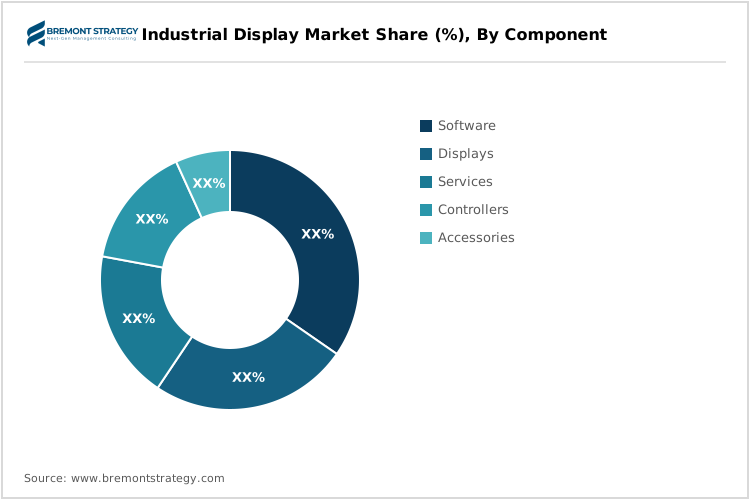
The "Displays" sub-segment dominates the component category, driven by the increasing demand for high-performance display panels in industrial settings. These displays are essential for providing clear and reliable data visualization, which is critical for operational efficiency. Controllers and software are also significant, as they enable the integration and management of display systems within industrial processes.
Accessories and services are growing in importance as industries seek comprehensive solutions that include installation, maintenance, and support. The trend towards customized display solutions is driving demand for these components, as businesses require tailored systems to meet specific operational needs.
By Deployment Analysis
On-premises deployment is the most common method in the industrial display market, as it offers greater control and security over display systems. However, cloud-based and hybrid deployments are gaining traction due to their scalability and flexibility. These methods allow for remote management and data access, which is increasingly important in modern industrial operations.
Hybrid deployment models are particularly appealing to industries looking to balance the benefits of on-premises and cloud-based systems. This approach allows for the integration of advanced technologies while maintaining critical data on-site, ensuring both innovation and security.
By Application Analysis
Human-Machine Interface (HMI) applications lead the application segment, as they are crucial for facilitating interaction between operators and industrial systems. The demand for intuitive and responsive HMI displays is growing as industries focus on enhancing user experience and operational efficiency.
Remote monitoring and control room applications are also significant, driven by the need for real-time data access and management. These applications are essential in industries such as energy and transportation, where timely decision-making is critical. Interactive displays and digital signage are expanding their presence, particularly in sectors like healthcare and retail.
By Industry Analysis
The manufacturing industry is the largest consumer of industrial displays, driven by the need for robust and reliable display solutions in production environments. The energy and power sector also represents a significant market, as displays are used for monitoring and managing complex systems.
Transportation and automotive industries are increasingly adopting advanced display technologies to enhance safety and efficiency. In healthcare, displays are used for patient monitoring and information dissemination, while the oil and gas sector relies on durable displays for field operations.
By End User Analysis
OEMs and system integrators are the primary end users of industrial displays, as they incorporate these systems into larger solutions for industrial clients. End-user industries also represent a significant market, as they directly purchase display systems for operational use.
Distributors play a crucial role in the market by facilitating the availability and distribution of display products across various regions. Their extensive networks and partnerships with manufacturers help ensure that industrial displays reach a wide range of customers.
By Region Analysis
North America is a mature market for industrial displays, characterized by high adoption rates of advanced technologies and a strong focus on innovation. The region's well-established industrial base and emphasis on automation drive demand for sophisticated display solutions.
Europe follows closely, with a strong presence of manufacturing and automotive industries that require reliable and high-performance displays. The region's commitment to Industry 4.0 and digital transformation further supports market growth.
Asia Pacific is the fastest-growing region, driven by rapid industrialization and technological advancements. Countries like China, Japan, and India are investing heavily in modernizing their industrial infrastructure, creating significant demand for industrial displays.
Latin America is emerging as a promising market, with countries like Brazil and Mexico focusing on industrial development and modernization. The region's growing emphasis on automation and digitalization supports the adoption of advanced display technologies.
The Middle East & Africa region is experiencing steady growth, driven by investments in infrastructure and energy projects. The demand for durable and reliable display solutions is increasing as industries in the region expand and modernize their operations.
Industrial Display Market Regional Outlook
| Regional Outlook | |
|---|---|
| Largest Market | Asia Pacific |
| Fastest Growing Market | Asia Pacific |
| Emerging Countries | Brazil, India, South Africa |
| Future Outlook | Strong growth driven by technological advancements and industrialization. |
Industrial Display Market Competitor Outlook
| Competitor Outlook | |
|---|---|
| Market Leader |
|
| Key Players |
|
| Key Competitive Factors |
|
Industrial Display Pricing Analysis
Pricing in the Industrial Display market is influenced by several factors, including formulation, specification, scale, and region. The complexity of display technologies, such as OLED and quantum dots, can lead to higher costs, while economies of scale can reduce prices. Regional variations in labor and material costs also impact pricing, with developed regions typically having higher price points due to advanced technology integration and regulatory compliance.
Price sensitivity in the market varies, with some buyers prioritizing cost-effectiveness while others focus on value-driven purchasing decisions. Industries with critical operational needs, such as energy and transportation, often prioritize performance and reliability over cost, seeking displays that offer long-term durability and advanced features. In contrast, cost-sensitive sectors may opt for more affordable solutions that meet basic operational requirements.
Industrial Display Consumer Buying Behaviour / Preference Analysis
Key Purchase Criteria
| Buying Factor | Relative Importance | Reason |
|---|---|---|
| Performance | Very High | Critical for operational efficiency |
| Durability/Reliability | High | Essential for harsh environments |
| Certification/Compliance | Medium-High | Ensures regulatory adherence |
| Total Cost | Medium | Budget constraints |
| Differentiating Capability | High | Competitive advantage |
Typical buyers in the Industrial Display market include procurement managers, operations managers, and IT specialists within industries such as manufacturing, energy, and transportation. These professionals are responsible for ensuring that display solutions meet the specific needs of their operations, including performance, reliability, and compliance with industry standards.
Purchase decisions are heavily influenced by factors such as performance and durability, as these attributes directly impact operational efficiency and equipment lifespan. Buyers also consider the total cost of ownership, including installation and maintenance, when evaluating display solutions. The ability of a display to offer unique features or capabilities that provide a competitive edge is also a key consideration in the decision-making process.
TABLE OF CONTENTS
1. Research Methodology
2. Market Structure
3. Executive Summary
4. Industrial Display Market Overview
- 4.1 Introduction
- Market Snapshot
- Assumptions, Inclusion & Exclusions
- Technological Advancements & Patent Analysis
- Case Studies
- Market Entry & Launch Strategies
- Macro-Economic Factors Impacting the Market Growth
- 4.2 Industrial Display Market Dynamics
- Market Drivers
- Market Restraints
- Market Opportunity
- 4.3 Industrial Display Market - Supply Chain Analysis
- Key Raw Material/Components Provider
- Key Manufacturers
- Key Distributors
- Key Consumers
- 4.4 Key Forces Shaping the Industrial Display Market
- Bargaining Power of Suppliers
- Bargaining Power of Buyers
- Threat of Substitution
- Threat of New Entrants
- Competitive Rivalry
- 4.1 Introduction
5. Global Industrial Display Market, By Component
- 5.1 Market Size, Value (USD Mn) & Volume (Units)
- Displays
- Controllers
- Software
- Accessories
- Services
- 5.2 Key Market Trends & Growth Opportunities
- 5.3 Market Share (%) Analysis, 2021-2036
- 5.4 Year-on-Year (YoY) Growth Rate
- 5.5 Market Attractiveness
- 5.6 Global Investment & Trade Risks
- 5.7 Pricing Analysis, 2021-2036
- 5.8 Operating Margin/Profits, 2021-2036
- 5.1 Market Size, Value (USD Mn) & Volume (Units)
6. Global Industrial Display Market, By Deployment
- 6.1 Market Size, Value (USD Mn) & Volume (Units)
- On-Premises
- Cloud-Based
- Hybrid
- 6.2 Key Market Trends & Growth Opportunities
- 6.3 Market Share (%) Analysis, 2021-2036
- 6.4 Year-on-Year (YoY) Growth Rate
- 6.5 Market Attractiveness
- 6.6 Global Investment & Trade Risks
- 6.7 Pricing Analysis, 2021-2036
- 6.8 Operating Margin/Profits, 2021-2036
- 6.1 Market Size, Value (USD Mn) & Volume (Units)
7. Global Industrial Display Market, By Application
- 7.1 Market Size, Value (USD Mn) & Volume (Units)
- HMI
- Remote Monitoring
- Interactive Display
- Digital Signage
- Control Rooms
- 7.2 Key Market Trends & Growth Opportunities
- 7.3 Market Share (%) Analysis, 2021-2036
- 7.4 Year-on-Year (YoY) Growth Rate
- 7.5 Market Attractiveness
- 7.6 Global Investment & Trade Risks
- 7.7 Pricing Analysis, 2021-2036
- 7.8 Operating Margin/Profits, 2021-2036
- 7.1 Market Size, Value (USD Mn) & Volume (Units)
8. Global Industrial Display Market, By Industry
- 8.1 Market Size, Value (USD Mn) & Volume (Units)
- Manufacturing
- Energy & Power
- Oil & Gas
- Transportation
- Healthcare
- Automotive
- 8.2 Key Market Trends & Growth Opportunities
- 8.3 Market Share (%) Analysis, 2021-2036
- 8.4 Year-on-Year (YoY) Growth Rate
- 8.5 Market Attractiveness
- 8.6 Global Investment & Trade Risks
- 8.7 Pricing Analysis, 2021-2036
- 8.8 Operating Margin/Profits, 2021-2036
- 8.1 Market Size, Value (USD Mn) & Volume (Units)
9. Global Industrial Display Market, By End User
- 9.1 Market Size, Value (USD Mn) & Volume (Units)
- OEMs
- System Integrators
- End-User Industries
- Distributors
- 9.2 Key Market Trends & Growth Opportunities
- 9.3 Market Share (%) Analysis, 2021-2036
- 9.4 Year-on-Year (YoY) Growth Rate
- 9.5 Market Attractiveness
- 9.6 Global Investment & Trade Risks
- 9.7 Pricing Analysis, 2021-2036
- 9.8 Operating Margin/Profits, 2021-2036
- 9.1 Market Size, Value (USD Mn) & Volume (Units)
10. Global Industrial Display Market, By Region
- 10.1 Market Size, Value (USD Mn) & Volume (Units)
- North America
- Europe
- Asia Pacific
- Latin America
- Middle East & Africa
- 10.2 Key Market Trends & Growth Opportunities
- 10.3 Market Share (%) Analysis, 2021-2036
- 10.4 Year-on-Year (YoY) Growth Rate
- 10.5 Market Attractiveness
- 10.6 Global Investment & Trade Risks
- 10.7 Pricing Analysis, 2021-2036
- 10.8 Operating Margin/Profits, 2021-2036
- 10.1 Market Size, Value (USD Mn) & Volume (Units)
11. Global Industrial Display Market, By North America
- 11.1 Market Size, Value (USD Mn) & Volume (Units)
- US
- Canada
- 11.2 Key Market Trends & Growth Opportunities
- 11.3 Market Share (%) Analysis, 2021-2036
- 11.4 Year-on-Year (YoY) Growth Rate
- 11.5 Market Attractiveness
- 11.6 Global Investment & Trade Risks
- 11.7 Pricing Analysis, 2021-2036
- 11.8 Operating Margin/Profits, 2021-2036
- 11.1 Market Size, Value (USD Mn) & Volume (Units)
12. Global Industrial Display Market, By Europe
- 12.1 Market Size, Value (USD Mn) & Volume (Units)
- Germany
- France
- UK
- Spain
- Italy
- Switzerland
- Russia
- Poland
- Rest of Europe
- 12.2 Key Market Trends & Growth Opportunities
- 12.3 Market Share (%) Analysis, 2021-2036
- 12.4 Year-on-Year (YoY) Growth Rate
- 12.5 Market Attractiveness
- 12.6 Global Investment & Trade Risks
- 12.7 Pricing Analysis, 2021-2036
- 12.8 Operating Margin/Profits, 2021-2036
- 12.1 Market Size, Value (USD Mn) & Volume (Units)
13. Global Industrial Display Market, By Asia Pacific
- 13.1 Market Size, Value (USD Mn) & Volume (Units)
- China
- Japan
- South Korea
- India
- Australia
- South East Asia
- Rest of APAC
- 13.2 Key Market Trends & Growth Opportunities
- 13.3 Market Share (%) Analysis, 2021-2036
- 13.4 Year-on-Year (YoY) Growth Rate
- 13.5 Market Attractiveness
- 13.6 Global Investment & Trade Risks
- 13.7 Pricing Analysis, 2021-2036
- 13.8 Operating Margin/Profits, 2021-2036
- 13.1 Market Size, Value (USD Mn) & Volume (Units)
14. Global Industrial Display Market, By Latin America
- 14.1 Market Size, Value (USD Mn) & Volume (Units)
- Brazil
- Mexico
- Argentina
- Rest of LATAM
- 14.2 Key Market Trends & Growth Opportunities
- 14.3 Market Share (%) Analysis, 2021-2036
- 14.4 Year-on-Year (YoY) Growth Rate
- 14.5 Market Attractiveness
- 14.6 Global Investment & Trade Risks
- 14.7 Pricing Analysis, 2021-2036
- 14.8 Operating Margin/Profits, 2021-2036
- 14.1 Market Size, Value (USD Mn) & Volume (Units)
15. Global Industrial Display Market, By Middle East & Africa
- 15.1 Market Size, Value (USD Mn) & Volume (Units)
- Saudi Arabia
- UAE
- South Africa
- Rest of MEA
- 15.2 Key Market Trends & Growth Opportunities
- 15.3 Market Share (%) Analysis, 2021-2036
- 15.4 Year-on-Year (YoY) Growth Rate
- 15.5 Market Attractiveness
- 15.6 Global Investment & Trade Risks
- 15.7 Pricing Analysis, 2021-2036
- 15.8 Operating Margin/Profits, 2021-2036
- 15.1 Market Size, Value (USD Mn) & Volume (Units)
16. Competitive Analysis
- 16.1 Competition Landscape, Key Players
- Global Market Share (%) Analysis of Key Players in Industrial Display, in Value (USD Mn) & Volume (Units)
- Company Overview
- Company Financials
- News & Developments
- Strategic Initiatives
- 16.2 Company Profiles
- Samsung Electronics Co., Ltd.
- LG Display Co., Ltd.
- Sharp Corporation
- Panasonic Corporation
- AU Optronics Corp.
- BOE Technology Group Co., Ltd.
- Innolux Corporation
- Mitsubishi Electric Corporation
- Sony Corporation
- NEC Corporation
- Barco NV
- Planar Systems, Inc.
- E Ink Holdings Inc.
- Advantech Co., Ltd.
- Leyard Optoelectronic Co., Ltd.
- BenQ Corporation
- ViewSonic Corporation
- HannStar Display Corporation
- TCL Technology Group Corporation
- Delta Electronics, Inc.
- 16.1 Competition Landscape, Key Players
METHODOLOGY
To provide you with a comprehensive understanding of how we quantify your market opportunity, we utilize a multi-phased methodology designed to minimize risk and maximize strategic clarity. We begin the process by establishing a clear conceptual framework, often referred to as the TAM-SAM-SOM model. By starting with the Total Addressable Market, we look at the absolute global demand for your category. We then refine this into the Serviceable Addressable Market to account for your specific geographic and technological reach, and finally, we pinpoint the Serviceable Obtainable Market. This ensures that the final figures we present are not just theoretical "vanity metrics," but represent a realistic, capture-able revenue target for your business.
Our data collection process relies on a rigorous principle called triangulation, where we cross-reference multiple independent data streams to ensure accuracy. We initiate this with deep-dive secondary research, synthesizing high-value intelligence from audited financial filings, government trade databases, and specialized industry journals. This "desk research" phase provides a macro-economic baseline and identifies historical growth trajectories. However, because secondary data can sometimes lag behind real-time shifts, we supplement this with targeted primary research. This involves direct engagement with Key Opinion Leaders (KOLs) and structured quantitative surveys to capture the current pulse of the market and emerging buyer intent.
To ensure the integrity of our estimates, we employ a dual-modeling approach, calculating the market size from both the "Top-Down" and "Bottom-Up." The Top-Down analysis provides a valuable sanity check against broader economic trends, but we place the most weight on our Bottom-Up modeling. By taking granular data, such as the average transaction value and the actual number of potential customer touchpoints, and scaling them upward, we build a highly defensible model grounded in operational reality. This dual-verification method allows us to identify any discrepancies early, ensuring that the resulting data is robust enough to withstand the scrutiny of stakeholders or investors.
Finally, we recognize that a static market size figure is only a snapshot in time. To provide you with a roadmap for the future, we integrate trend analysis and Compound Annual Growth Rate (CAGR) forecasting into our final reporting. We analyze the underlying drivers, such as regulatory shifts, technological disruptions, or changing consumer behaviors, to predict how the market will evolve over the next three to five years. This ongoing tracking mechanism transforms a simple number into a dynamic strategic tool, allowing you to monitor your market share in real-time and pivot your resources as new opportunities emerge.
Frequently Asked Questions
What is the current size of the Industrial Display market?
The base year for the Industrial Display market is 2026, with a market size of $3.2 billion.
What is the projected market size by 2036?
By 2036, the Industrial Display market is expected to reach a size of $5.6 billion.
What is the market's CAGR during the forecast period?
The Industrial Display market is anticipated to grow at a compound annual growth rate (CAGR) of 5.8% from 2026 to 2036.
Which region leads in this market?
The Asia-Pacific region is currently the leader in the Industrial Display market, driven by rapid industrialization and technological advancements.
Which segment holds the largest share in the market?
The LCD segment holds the largest share in the Industrial Display market, owing to its widespread application in various industries.
Who are the key players in this market?
Key players in the Industrial Display market include companies like Samsung Electronics, LG Display, and Sharp Corporation.
What are the key growth drivers for the Industrial Display market?
The primary growth drivers include increasing demand for HMI (Human-Machine Interface) devices and advancements in display technologies.
Is the report customizable?
Yes, the report can be customized according to specific requirements to better meet client needs.