Life Science Membrane Technology
Life Science Membrane Technology Market Research Report 2036
Life Science Membrane Technology Market Segments - by Component (Membrane Filters, Membrane Systems, Membrane Accessories, Membrane Modules, Membrane Cartridges, Membrane Cassettes), Deployment (On-Premises, Cloud-Based, Hybrid, Hosted, Managed Services, Remote Monitoring), Application (Biopharmaceutical Processing, Water and Wastewater Treatment, Food and Beverage Filtration, Medical Devices, Industrial Gas Processing, Laboratory Filtration), Industry (Healthcare and Pharmaceuticals, Food and Beverage, Water and Wastewater Management, Chemical Processing, Biotechnology, Energy and Power), and Region (North America, Europe, Asia Pacific, Latin America, Middle East and Africa, Oceania) - The Market Forecasts are Provided in Terms of Value (USD)
Life Science Membrane Technology Market Outlook
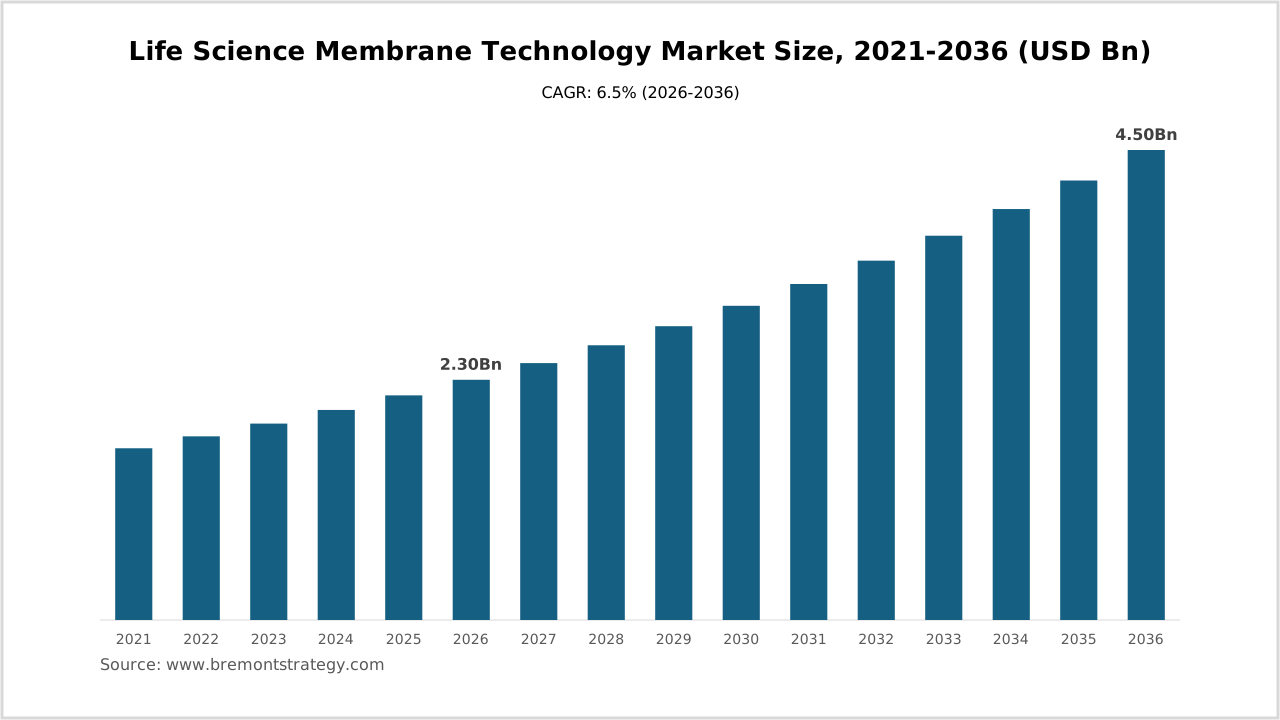
The Life Science Membrane Technology market was valued at $2.3 Billion in 2026 and is projected to reach $4.5 Billion by 2036, growing at a CAGR of 6.5% during the forecast period 2026-2036. This growth is driven by the increasing demand for efficient separation and purification processes in various industries, including healthcare and pharmaceuticals.
Life Science Membrane Technology involves the use of semi-permeable membranes to separate, concentrate, or purify components in a solution. This technology is distinct due to its ability to provide high selectivity and efficiency in separating molecules based on size, charge, or chemical affinity, making it a preferred choice over conventional filtration methods.
The overall demand is driven by the growing biopharmaceutical industry, which requires advanced filtration systems for drug manufacturing. Additionally, the need for sustainable water and wastewater treatment solutions is propelling the adoption of membrane technologies globally.
Technological advancements are focusing on enhancing membrane durability, selectivity, and fouling resistance. Research and development efforts are directed towards creating hybrid membranes and integrating smart technologies for real-time monitoring and control.
Competitive dynamics in this market are influenced by factors such as technical performance, cost-effectiveness, and after-sales support. Companies compete by offering innovative solutions and expanding their distribution networks to enhance market penetration.
Life Science Membrane Technology Market Key Takeaways
- The Life Science Membrane Technology market is expected to grow from $2.3 Billion in 2026 to $4.5 Billion by 2036, at a CAGR of 6.5%.
- The "Membrane Filters" sub-segment under "By component" is anticipated to hold the largest market share, driven by its extensive use in biopharmaceutical processing.
- North America is projected to be the leading region, accounting for over 35% of the market share by 2036.
- The increasing demand for efficient water and wastewater treatment solutions is a significant driver for the market.
Life Science Membrane Technology Market Key Drivers
| Drivers | Impact |
|---|---|
| Biopharmaceutical Growth | Increasing demand for advanced filtration in drug manufacturing. |
| Water Treatment Needs | Rising environmental regulations boosting membrane adoption. |
| Technological Advancements | Innovations enhancing membrane efficiency and lifespan. |
| Industrial Applications | Expanding use in food and beverage, and chemical processing. |
| Regulatory Support | Government initiatives promoting sustainable technologies. |
Biopharmaceutical Growth
The biopharmaceutical industry is experiencing rapid growth, necessitating the use of advanced filtration systems for the production of biologics and vaccines. Membrane technology plays a crucial role in ensuring the purity and safety of these products, thus driving its demand in this sector.
Water Treatment Needs
With increasing environmental concerns and stringent regulations on water quality, there is a heightened demand for effective water and wastewater treatment solutions. Membrane technology offers a sustainable and efficient method for removing contaminants, making it a preferred choice in this domain.
Technological Advancements
Continuous advancements in membrane materials and design are enhancing their performance and durability. Innovations such as hybrid membranes and smart filtration systems are improving efficiency, reducing costs, and expanding application areas, thereby driving market growth.
Industrial Applications
Membrane technology is increasingly being adopted in various industrial applications, including food and beverage processing and chemical manufacturing. Its ability to provide precise separation and purification is vital in maintaining product quality and compliance with industry standards.
Regulatory Support
Governments worldwide are implementing policies to promote sustainable technologies, including membrane systems. Financial incentives and regulatory support for adopting eco-friendly solutions are encouraging industries to invest in membrane technology, further boosting market expansion.
Life Science Membrane Technology Market Opportunities and Challenges
| Opportunity | Challenges |
|---|---|
| Biopharma Expansion | High Initial Costs |
| Water Scarcity Solutions | Membrane Fouling |
| Emerging Markets | Lack of Expertise |
The expansion of the biopharmaceutical sector presents significant opportunities for membrane technology, as it is essential for the production of high-purity drugs. Additionally, addressing water scarcity through advanced filtration systems offers a lucrative market potential. Emerging markets are also opening new avenues for growth, as industries in these regions increasingly adopt membrane solutions to meet regulatory standards and improve operational efficiency.
Despite these opportunities, the market faces challenges such as high initial costs associated with membrane system installation and maintenance. Membrane fouling, which reduces efficiency and lifespan, is a persistent issue requiring ongoing research and development. Furthermore, the lack of technical expertise in certain regions can hinder the adoption and effective implementation of membrane technologies.
Life Science Membrane Technology Market Report Scope
| Attributes | Details |
|---|---|
| Report Title | Life Science Membrane Technology Market Research Report 2036 |
| By component | Membrane Filters, Membrane Systems, Membrane Accessories, Membrane Modules, Membrane Cartridges, Membrane Cassettes |
| By deployment | On-Premises, Cloud-Based, Hybrid, Hosted, Managed Services, Remote Monitoring |
| By application | Biopharmaceutical Processing, Water and Wastewater Treatment, Food and Beverage Filtration, Medical Devices, Industrial Gas Processing, Laboratory Filtration |
| By industry | Healthcare and Pharmaceuticals, Food and Beverage, Water and Wastewater Management, Chemical Processing, Biotechnology, Energy and Power |
| By region | North America, Europe, Asia Pacific, Latin America, Middle East and Africa, Oceania |
| Countries Covered | North America (United States, Canada), Europe (Germany, France, UK, Italy, Spain, Rest of Europe), Asia Pacific (China, Japan, India, South Korea, Australia, Rest of Asia Pacific), Latin America (Brazil, Mexico, Argentina, Rest of Latin America), Middle East and Africa (UAE, Saudi Arabia, South Africa, Rest of MEA), Oceania (Australia, New Zealand) |
| Base Year | 2026 |
| Historic Data | 2021-2025 |
| Forecast Period | 2026-2036 |
| Number of Pages | 280 |
| Number of Tables & Figures | 350 |
| Customization Available | Yes, the report can be customized as per your need. |
Life Science Membrane Technology Market Segment Analysis
The Life Science Membrane Technology market is segmented into various categories, including components, deployment, applications, industries, and regions. Each segment offers unique insights into the market dynamics and growth opportunities.
By component Analysis
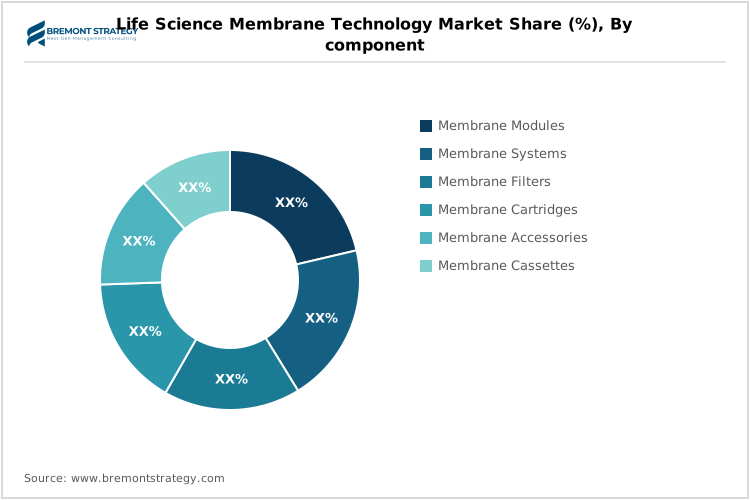
The "By component" segment includes Membrane Filters, Membrane Systems, Membrane Accessories, Membrane Modules, Membrane Cartridges, and Membrane Cassettes. Membrane Filters are anticipated to dominate this segment due to their widespread application in biopharmaceutical processing and water treatment. Their ability to provide high purity and efficiency makes them indispensable in critical applications. Membrane Systems are also gaining traction as they offer integrated solutions for complex filtration needs.
Membrane Accessories and Modules are essential for enhancing the functionality and performance of membrane systems, supporting their adoption across various industries. Membrane Cartridges and Cassettes are preferred for specific applications requiring modular and scalable solutions. The demand for these components is driven by the need for reliable and efficient filtration systems in diverse sectors.
By deployment Analysis
The deployment segment is categorized into On-Premises, Cloud-Based, Hybrid, Hosted, Managed Services, and Remote Monitoring. On-Premises solutions are prevalent due to their control and security benefits, especially in regulated industries like healthcare and pharmaceuticals. Cloud-Based and Hybrid models are gaining popularity due to their scalability and cost-effectiveness, allowing organizations to optimize resources and improve operational efficiency.
Managed Services and Remote Monitoring offer additional value by providing expert maintenance and real-time system performance insights, reducing downtime and operational costs. These deployment models are increasingly adopted by industries seeking to leverage advanced technologies without significant capital investment.
By application Analysis
The "By application" segment encompasses Biopharmaceutical Processing, Water and Wastewater Treatment, Food and Beverage Filtration, Medical Devices, Industrial Gas Processing, and Laboratory Filtration. Biopharmaceutical Processing leads this segment due to the critical role of membrane technology in ensuring drug purity and compliance with stringent regulatory standards. Water and Wastewater Treatment is another significant application, driven by the need for sustainable and efficient purification solutions.
Food and Beverage Filtration and Medical Devices applications are also witnessing growth as industries prioritize product quality and safety. Industrial Gas Processing and Laboratory Filtration are niche yet important applications where membrane technology provides precise separation and purification capabilities.
By industry Analysis
The industry segment includes Healthcare and Pharmaceuticals, Food and Beverage, Water and Wastewater Management, Chemical Processing, Biotechnology, and Energy and Power. Healthcare and Pharmaceuticals dominate due to the extensive use of membrane technology in drug manufacturing and quality control. Food and Beverage industries also contribute significantly, utilizing membranes for product filtration and safety assurance.
Water and Wastewater Management is a key industry, leveraging membrane technology for efficient and sustainable treatment solutions. Chemical Processing and Biotechnology industries are adopting membranes for their ability to enhance process efficiency and product quality. The Energy and Power sector is exploring membrane applications for clean energy production and resource optimization.
By region Analysis
The regional analysis covers North America, Europe, Asia Pacific, Latin America, Middle East and Africa, and Oceania. North America leads the market due to advanced healthcare infrastructure and significant R&D investments. Europe follows, driven by stringent environmental regulations and a strong biopharmaceutical sector. Asia Pacific is the fastest-growing region, fueled by industrial expansion and increasing demand for sustainable solutions.
Latin America and the Middle East and Africa are emerging markets with growing opportunities as industries in these regions adopt advanced technologies to meet regulatory standards and improve operational efficiency. Oceania, with its focus on environmental sustainability, is also witnessing increased adoption of membrane technology.
Life Science Membrane Technology Market Regional Outlook
| Regional Outlook | |
|---|---|
| Largest Market | North America |
| Fastest Growing Market | Asia Pacific |
| Emerging Countries | Brazil, India, South Africa |
| Future Outlook | Strong growth driven by sustainability and technological advancements. |
North America remains the largest market for Life Science Membrane Technology, supported by a robust healthcare sector and significant investments in R&D. The region's focus on innovation and quality drives demand for advanced membrane solutions.
Europe is characterized by stringent environmental regulations and a mature biopharmaceutical industry, contributing to steady market growth. The region's commitment to sustainability and technological advancements further supports membrane technology adoption.
Asia Pacific is the fastest-growing market, with rapid industrialization and increasing demand for sustainable solutions driving adoption. Countries like China and India are investing heavily in infrastructure and technology, enhancing market opportunities.
Latin America is emerging as a promising market, with industries adopting membrane technologies to improve efficiency and comply with environmental standards. The region's focus on water management and sustainable practices supports growth.
The Middle East and Africa are witnessing increased adoption of membrane technology, driven by the need for efficient water treatment solutions and industrial applications. The region's focus on sustainability and resource optimization is fostering market expansion.
Life Science Membrane Technology Market Competitor Outlook
| Competitor Outlook | |
|---|---|
| Market Leader |
|
| Key Players |
|
| Key Competitive Factors |
|
Life Science Membrane Technology Pricing Analysis
Pricing in the Life Science Membrane Technology market is influenced by factors such as formulation, specification, scale, and region. High-performance membranes with advanced features command premium prices, while standard products are more competitively priced. The scale of deployment also affects pricing, with larger installations benefiting from economies of scale. Regional variations in labor and material costs further contribute to price differences.
Price sensitivity varies across industries, with some sectors prioritizing cost-effectiveness while others focus on value-driven factors such as performance and reliability. In highly regulated industries like pharmaceuticals, the emphasis is on quality and compliance, making buyers willing to invest in premium solutions. Conversely, industries with tighter budgets may opt for cost-effective alternatives that meet basic requirements.
Life Science Membrane Technology Consumer Buying Behaviour / Preference Analysis
Key Purchase Criteria
| Buying Factor | Relative Importance | Reason |
|---|---|---|
| Performance | Very High | Ensures product quality |
| Durability/Reliability | High | Reduces maintenance costs |
| Certification/Compliance | Medium-High | Regulatory adherence |
| Total Cost | Medium | Budget constraints |
| Differentiating Capability | High | Competitive advantage |
Typical buyers in the Life Science Membrane Technology market include procurement managers, R&D directors, and operations managers in industries such as pharmaceuticals, water treatment, and food and beverage. These buyers prioritize performance and reliability, as these factors directly impact product quality and operational efficiency. Compliance with industry standards is also crucial, particularly in regulated sectors.
Purchase decisions are influenced by the need for solutions that offer a balance between cost and performance. Buyers seek products that provide long-term value through durability and reduced maintenance requirements. Additionally, the ability to differentiate through unique capabilities or advanced features can significantly impact buying preferences, as companies aim to maintain a competitive edge.
TABLE OF CONTENTS
1. Research Methodology
2. Market Structure
3. Executive Summary
4. Life Science Membrane Technology Market Overview
- 4.1 Introduction
- Market Snapshot
- Assumptions, Inclusion & Exclusions
- Technological Advancements & Patent Analysis
- Case Studies
- Market Entry & Launch Strategies
- Macro-Economic Factors Impacting the Market Growth
- 4.2 Life Science Membrane Technology Market Dynamics
- Market Drivers
- Market Restraints
- Market Opportunity
- 4.3 Life Science Membrane Technology Market - Supply Chain Analysis
- Key Raw Material/Components Provider
- Key Manufacturers
- Key Distributors
- Key Consumers
- 4.4 Key Forces Shaping the Life Science Membrane Technology Market
- Bargaining Power of Suppliers
- Bargaining Power of Buyers
- Threat of Substitution
- Threat of New Entrants
- Competitive Rivalry
- 4.1 Introduction
5. Global Life Science Membrane Technology Market, By Component
- 5.1 Market Size, Value (USD Mn) & Volume (Units)
- Membrane Filters
- Membrane Systems
- Membrane Accessories
- Membrane Modules
- Membrane Cartridges
- Membrane Cassettes
- 5.2 Key Market Trends & Growth Opportunities
- 5.3 Market Share (%) Analysis, 2021-2036
- 5.4 Year-on-Year (YoY) Growth Rate
- 5.5 Market Attractiveness
- 5.6 Global Investment & Trade Risks
- 5.7 Pricing Analysis, 2021-2036
- 5.8 Operating Margin/Profits, 2021-2036
- 5.1 Market Size, Value (USD Mn) & Volume (Units)
6. Global Life Science Membrane Technology Market, By Deployment Mode
- 6.1 Market Size, Value (USD Mn) & Volume (Units)
- On-Premises
- Cloud-Based
- Hybrid
- Hosted
- Managed Services
- Remote Monitoring
- 6.2 Key Market Trends & Growth Opportunities
- 6.3 Market Share (%) Analysis, 2021-2036
- 6.4 Year-on-Year (YoY) Growth Rate
- 6.5 Market Attractiveness
- 6.6 Global Investment & Trade Risks
- 6.7 Pricing Analysis, 2021-2036
- 6.8 Operating Margin/Profits, 2021-2036
- 6.1 Market Size, Value (USD Mn) & Volume (Units)
7. Global Life Science Membrane Technology Market, By Application
- 7.1 Market Size, Value (USD Mn) & Volume (Units)
- Biopharmaceutical Processing
- Water and Wastewater Treatment
- Food and Beverage Filtration
- Medical Devices
- Industrial Gas Processing
- Laboratory Filtration
- 7.2 Key Market Trends & Growth Opportunities
- 7.3 Market Share (%) Analysis, 2021-2036
- 7.4 Year-on-Year (YoY) Growth Rate
- 7.5 Market Attractiveness
- 7.6 Global Investment & Trade Risks
- 7.7 Pricing Analysis, 2021-2036
- 7.8 Operating Margin/Profits, 2021-2036
- 7.1 Market Size, Value (USD Mn) & Volume (Units)
8. Global Life Science Membrane Technology Market, By Industry Vertical
- 8.1 Market Size, Value (USD Mn) & Volume (Units)
- Healthcare and Pharmaceuticals
- Food and Beverage
- Water and Wastewater Management
- Chemical Processing
- Biotechnology
- Energy and Power
- 8.2 Key Market Trends & Growth Opportunities
- 8.3 Market Share (%) Analysis, 2021-2036
- 8.4 Year-on-Year (YoY) Growth Rate
- 8.5 Market Attractiveness
- 8.6 Global Investment & Trade Risks
- 8.7 Pricing Analysis, 2021-2036
- 8.8 Operating Margin/Profits, 2021-2036
- 8.1 Market Size, Value (USD Mn) & Volume (Units)
9. Global Life Science Membrane Technology Market, By Region
- 9.1 Market Size, Value (USD Mn) & Volume (Units)
- North America
- Europe
- Asia Pacific
- Latin America
- Middle East & Africa
- 9.2 Key Market Trends & Growth Opportunities
- 9.3 Market Share (%) Analysis, 2021-2036
- 9.4 Year-on-Year (YoY) Growth Rate
- 9.5 Market Attractiveness
- 9.6 Global Investment & Trade Risks
- 9.7 Pricing Analysis, 2021-2036
- 9.8 Operating Margin/Profits, 2021-2036
- 9.1 Market Size, Value (USD Mn) & Volume (Units)
10. Global Life Science Membrane Technology Market, By North America
- 10.1 Market Size, Value (USD Mn) & Volume (Units)
- US
- Canada
- 10.2 Key Market Trends & Growth Opportunities
- 10.3 Market Share (%) Analysis, 2021-2036
- 10.4 Year-on-Year (YoY) Growth Rate
- 10.5 Market Attractiveness
- 10.6 Global Investment & Trade Risks
- 10.7 Pricing Analysis, 2021-2036
- 10.8 Operating Margin/Profits, 2021-2036
- 10.1 Market Size, Value (USD Mn) & Volume (Units)
11. Global Life Science Membrane Technology Market, By Europe
- 11.1 Market Size, Value (USD Mn) & Volume (Units)
- Germany
- France
- UK
- Spain
- Italy
- Switzerland
- Russia
- Poland
- Rest of Europe
- 11.2 Key Market Trends & Growth Opportunities
- 11.3 Market Share (%) Analysis, 2021-2036
- 11.4 Year-on-Year (YoY) Growth Rate
- 11.5 Market Attractiveness
- 11.6 Global Investment & Trade Risks
- 11.7 Pricing Analysis, 2021-2036
- 11.8 Operating Margin/Profits, 2021-2036
- 11.1 Market Size, Value (USD Mn) & Volume (Units)
12. Global Life Science Membrane Technology Market, By Asia Pacific
- 12.1 Market Size, Value (USD Mn) & Volume (Units)
- China
- Japan
- South Korea
- India
- Australia
- South East Asia
- Rest of APAC
- 12.2 Key Market Trends & Growth Opportunities
- 12.3 Market Share (%) Analysis, 2021-2036
- 12.4 Year-on-Year (YoY) Growth Rate
- 12.5 Market Attractiveness
- 12.6 Global Investment & Trade Risks
- 12.7 Pricing Analysis, 2021-2036
- 12.8 Operating Margin/Profits, 2021-2036
- 12.1 Market Size, Value (USD Mn) & Volume (Units)
13. Global Life Science Membrane Technology Market, By Latin America
- 13.1 Market Size, Value (USD Mn) & Volume (Units)
- Brazil
- Mexico
- Argentina
- Rest of LATAM
- 13.2 Key Market Trends & Growth Opportunities
- 13.3 Market Share (%) Analysis, 2021-2036
- 13.4 Year-on-Year (YoY) Growth Rate
- 13.5 Market Attractiveness
- 13.6 Global Investment & Trade Risks
- 13.7 Pricing Analysis, 2021-2036
- 13.8 Operating Margin/Profits, 2021-2036
- 13.1 Market Size, Value (USD Mn) & Volume (Units)
14. Global Life Science Membrane Technology Market, By Middle East & Africa
- 14.1 Market Size, Value (USD Mn) & Volume (Units)
- Saudi Arabia
- UAE
- South Africa
- Rest of MEA
- 14.2 Key Market Trends & Growth Opportunities
- 14.3 Market Share (%) Analysis, 2021-2036
- 14.4 Year-on-Year (YoY) Growth Rate
- 14.5 Market Attractiveness
- 14.6 Global Investment & Trade Risks
- 14.7 Pricing Analysis, 2021-2036
- 14.8 Operating Margin/Profits, 2021-2036
- 14.1 Market Size, Value (USD Mn) & Volume (Units)
15. Competitive Analysis
- 15.1 Competition Landscape, Key Players
- Global Market Share (%) Analysis of Key Players in Life Science Membrane Technology, in Value (USD Mn) & Volume (Units)
- Company Overview
- Company Financials
- News & Developments
- Strategic Initiatives
- 15.2 Company Profiles
- Merck KGaA
- Danaher Corporation
- Thermo Fisher Scientific Inc.
- Sartorius AG
- 3M Company
- Pall Corporation
- GE Healthcare
- Asahi Kasei Corporation
- Koch Membrane Systems
- Toray Industries, Inc.
- MilliporeSigma
- Novasep Holding SAS
- Alfa Laval AB
- GVS S.p.A.
- Microdyn-Nadir GmbH
- Hyflux Ltd
- Pentair plc
- Donaldson Company, Inc.
- Porvair Filtration Group
- Parker Hannifin Corporation
- 15.1 Competition Landscape, Key Players
METHODOLOGY
To provide you with a comprehensive understanding of how we quantify your market opportunity, we utilize a multi-phased methodology designed to minimize risk and maximize strategic clarity. We begin the process by establishing a clear conceptual framework, often referred to as the TAM-SAM-SOM model. By starting with the Total Addressable Market, we look at the absolute global demand for your category. We then refine this into the Serviceable Addressable Market to account for your specific geographic and technological reach, and finally, we pinpoint the Serviceable Obtainable Market. This ensures that the final figures we present are not just theoretical "vanity metrics," but represent a realistic, capture-able revenue target for your business.
Our data collection process relies on a rigorous principle called triangulation, where we cross-reference multiple independent data streams to ensure accuracy. We initiate this with deep-dive secondary research, synthesizing high-value intelligence from audited financial filings, government trade databases, and specialized industry journals. This "desk research" phase provides a macro-economic baseline and identifies historical growth trajectories. However, because secondary data can sometimes lag behind real-time shifts, we supplement this with targeted primary research. This involves direct engagement with Key Opinion Leaders (KOLs) and structured quantitative surveys to capture the current pulse of the market and emerging buyer intent.
To ensure the integrity of our estimates, we employ a dual-modeling approach, calculating the market size from both the "Top-Down" and "Bottom-Up." The Top-Down analysis provides a valuable sanity check against broader economic trends, but we place the most weight on our Bottom-Up modeling. By taking granular data, such as the average transaction value and the actual number of potential customer touchpoints, and scaling them upward, we build a highly defensible model grounded in operational reality. This dual-verification method allows us to identify any discrepancies early, ensuring that the resulting data is robust enough to withstand the scrutiny of stakeholders or investors.
Finally, we recognize that a static market size figure is only a snapshot in time. To provide you with a roadmap for the future, we integrate trend analysis and Compound Annual Growth Rate (CAGR) forecasting into our final reporting. We analyze the underlying drivers, such as regulatory shifts, technological disruptions, or changing consumer behaviors, to predict how the market will evolve over the next three to five years. This ongoing tracking mechanism transforms a simple number into a dynamic strategic tool, allowing you to monitor your market share in real-time and pivot your resources as new opportunities emerge.
Frequently Asked Questions
What is the current size of the Life Science Membrane Technology market?
The Life Science Membrane Technology market size in the base year 2026 is valued at $2.3 billion.
What is the projected market size by 2036?
By 2036, the Life Science Membrane Technology market is expected to reach $4.5 billion.
What is the market's CAGR during the forecast period?
The market is anticipated to grow at a compound annual growth rate (CAGR) of 6.5% from 2026 to 2036.
Which region is leading or fastest-growing in this market?
The Asia-Pacific region is projected to be the fastest-growing market for Life Science Membrane Technology during the forecast period.
Which segment holds the largest share in this market?
The microfiltration segment currently holds the largest share in the Life Science Membrane Technology market.
Who are the key players in this market?
Key players in the Life Science Membrane Technology market include Merck KGaA, Danaher Corporation, and Sartorius AG.
What are the key growth drivers for this market?
Key growth drivers include increasing demand for biopharmaceuticals and advancements in membrane technology.
Is the report customizable?
Yes, the report can be customized as per specific requirements to better suit your needs.