Microgravity Experimentation
Microgravity Experimentation Market Research Report 2034
Microgravity Experimentation Market Segments - by Component (Hardware, Software, Services, Consumables, Data Analytics Tools), Deployment (On-Site, Space-Based, Cloud-Based, Hybrid, Remote Monitoring), Application (Biotechnology, Material Science, Fluid Dynamics, Combustion Science, Astrobiology), Industry (Aerospace, Pharmaceuticals, Agriculture, Energy, Education and Research), and Region (North America, Europe, Asia Pacific, Latin America, Middle East & Africa) - The Market Forecasts are Provided in Terms of Value (USD)
Microgravity Experimentation Market Outlook
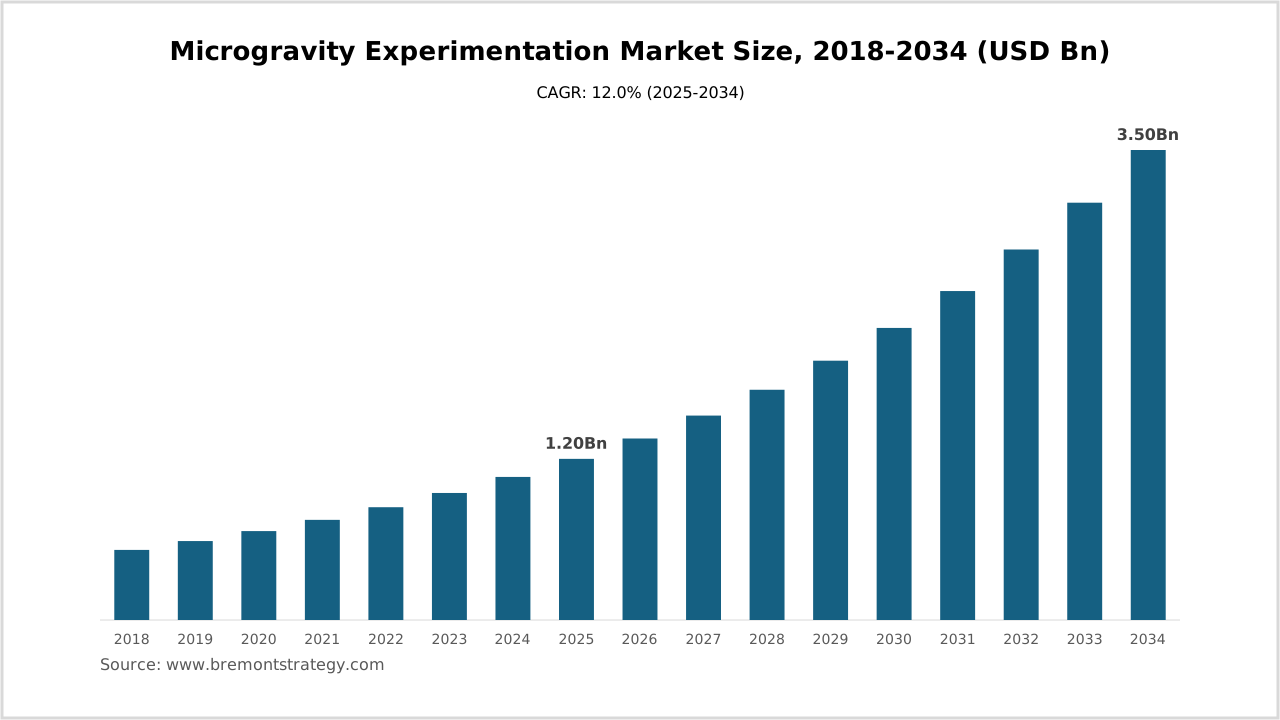
The Microgravity Experimentation market was valued at $1.2 billion in 2025 and is projected to reach $3.5 billion by 2034, growing at a CAGR of 12% during the forecast period 2026-2034. This market is witnessing substantial growth due to the increasing demand for space-based research and experimentation. The ability to conduct experiments in microgravity environments offers unparalleled opportunities for scientific advancements, particularly in fields such as biotechnology and material science. The market is driven by the continuous investments from space agencies and private companies aiming to leverage the unique conditions of space for research and development. The expansion of commercial spaceflight and the establishment of international space stations are further propelling the market growth. Additionally, the integration of advanced technologies such as AI and IoT in microgravity experimentation is enhancing the capabilities and efficiency of research conducted in space.
Key Takeaways
- The market size in 2025 was $1.2 billion.
- Expected market size by 2034 is $3.5 billion.
- Projected CAGR of 12% from 2026 to 2034.
- North America holds the largest market share.
- Key drivers include advancements in space technology and increased funding.
- Major players include NASA, SpaceX, and Blue Origin.
- Biotechnology and material science are leading applications.
- Cloud-based deployment is gaining traction.
Microgravity Experimentation Market Outlook 2025-2034
The Microgravity Experimentation market is poised for significant growth over the next decade, driven by the increasing interest in space-based research and the unique advantages offered by microgravity environments. The ability to conduct experiments in space provides researchers with opportunities to explore phenomena that are not possible under Earth's gravity, leading to groundbreaking discoveries and innovations. The market is expected to expand as more organizations, both public and private, invest in space exploration and research infrastructure.
Technological advancements are playing a crucial role in the market's growth, with innovations in spacecraft design, data analytics tools, and remote monitoring systems enhancing the efficiency and effectiveness of microgravity experiments. The collaboration between international space agencies and private companies is fostering a competitive yet collaborative environment, driving further advancements and reducing costs. As a result, the market is becoming more accessible to a broader range of industries, including pharmaceuticals, agriculture, and energy, which are exploring the potential benefits of microgravity research.
Microgravity Experimentation Market Regional Outlook 2025-2034
North America is expected to maintain its dominance in the Microgravity Experimentation market, driven by the presence of major space agencies such as NASA and leading private companies like SpaceX and Blue Origin. The region's robust infrastructure, coupled with substantial government and private investments, is fostering a conducive environment for market growth. The United States, in particular, is at the forefront of space research and development, with numerous initiatives aimed at expanding the capabilities of microgravity experimentation.
Europe is also a significant player in the market, with the European Space Agency (ESA) leading various collaborative projects and research initiatives. The region's commitment to scientific research and innovation is supported by strong governmental policies and funding mechanisms. Countries like Germany, France, and the United Kingdom are investing heavily in space exploration, contributing to the market's growth.
Asia-Pacific is emerging as a lucrative market for microgravity experimentation, with countries such as China, India, and Japan making substantial investments in space technology. The region's growing interest in space exploration, coupled with advancements in technology and infrastructure, is driving market expansion. Collaborative efforts between Asian space agencies and international partners are further enhancing the region's capabilities and market potential.
Key Growth Drivers of the Microgravity Experimentation Market
Advancements in Space Technology
The rapid advancements in space technology are a primary driver of the Microgravity Experimentation market. Innovations in spacecraft design, propulsion systems, and data analytics tools are enhancing the capabilities of microgravity experiments, allowing for more complex and precise research to be conducted in space.
Increased Funding and Investments
Both government and private sector investments are fueling the growth of the market. Space agencies and private companies are allocating significant resources to develop infrastructure and technologies necessary for conducting microgravity experiments, leading to increased opportunities and market expansion.
Growing Interest in Space-Based Research
There is a growing interest among researchers and industries in leveraging the unique conditions of space for scientific research. Microgravity environments offer unparalleled opportunities for experimentation, particularly in fields such as biotechnology and material science, driving demand for microgravity experimentation.
Collaboration Between Public and Private Sectors
The collaboration between public space agencies and private companies is fostering a competitive yet collaborative environment, driving further advancements in the market. These partnerships are leading to cost reductions, increased innovation, and expanded access to microgravity experimentation.
Microgravity Experimentation Market Segment Analysis
By Component
The component segment of the Microgravity Experimentation market includes hardware, software, services, consumables, and data analytics tools. Hardware components, such as spacecraft and research modules, are essential for conducting experiments in space, and advancements in this area are driving market growth.
Software and data analytics tools are becoming increasingly important as they enable researchers to analyze and interpret data collected from experiments more efficiently. The integration of AI and machine learning is enhancing the capabilities of these tools, leading to more accurate and insightful results.
By Deployment
The deployment segment includes on-site, space-based, cloud-based, hybrid, and remote monitoring solutions. Space-based deployment is the most traditional form, involving experiments conducted directly in space environments, while cloud-based and hybrid solutions are gaining traction due to their flexibility and cost-effectiveness.
Remote monitoring solutions allow researchers to conduct and monitor experiments from Earth, reducing the need for human presence in space and lowering costs. These advancements are making microgravity experimentation more accessible to a wider range of industries and researchers.
By Application
Applications of microgravity experimentation include biotechnology, material science, fluid dynamics, combustion science, and astrobiology. Biotechnology is one of the leading applications, with researchers exploring the effects of microgravity on biological processes and organisms.
Material science is another significant application, with experiments focusing on the development of new materials and understanding the properties of existing ones in microgravity conditions. These applications are driving demand for microgravity experimentation and contributing to market growth.
By Industry
The Microgravity Experimentation market serves various industries, including aerospace, pharmaceuticals, agriculture, energy, and education and research. The aerospace industry is a major contributor, with companies and agencies conducting experiments to improve spacecraft design and performance.
The pharmaceutical industry is exploring the potential of microgravity to enhance drug development and testing processes, while the agriculture industry is investigating the effects of space conditions on plant growth and crop production. These industries are driving demand for microgravity experimentation and contributing to market expansion.
By Region
The regional analysis of the Microgravity Experimentation market includes North America, Europe, Asia Pacific, Latin America, and the Middle East & Africa. North America is the largest market, driven by the presence of major space agencies and private companies.
Europe is also a significant market, with strong governmental support and funding for space research. Asia Pacific is emerging as a lucrative market, with countries like China and India making substantial investments in space technology and infrastructure.
Microgravity Experimentation Segment Comparison
| Segment | Market Share | Growth Rate | Key Insight |
|---|---|---|---|
| Hardware | 30% | 10% | Essential for space experiments |
| Software | 20% | 15% | AI enhancing capabilities |
| Services | 15% | 12% | Growing demand for expertise |
| Consumables | 10% | 8% | Vital for experiments |
| Data Analytics Tools | 25% | 18% | Key for data interpretation |
| On-Site | 35% | 9% | Traditional deployment |
| Space-Based | 40% | 11% | Direct space experiments |
| Cloud-Based | 15% | 20% | Cost-effective solutions |
| Hybrid | 5% | 22% | Combines multiple methods |
| Remote Monitoring | 5% | 25% | Reduces human presence |
Microgravity Experimentation Market Opportunities and Threats 2025-2034
The Microgravity Experimentation market presents numerous opportunities for growth and innovation. The increasing interest in space-based research and the unique advantages offered by microgravity environments are driving demand for experimentation in this field. As more industries recognize the potential benefits of microgravity research, the market is expected to expand, offering new opportunities for companies and researchers to explore.
Technological advancements are creating new opportunities for the market, with innovations in spacecraft design, data analytics tools, and remote monitoring systems enhancing the capabilities of microgravity experiments. These advancements are making it easier and more cost-effective for researchers to conduct experiments in space, leading to increased market accessibility and growth.
However, the market also faces several threats and challenges. The high costs associated with space research and the need for significant investments in infrastructure and technology can be barriers to entry for some companies and researchers. Additionally, the market is subject to regulatory and political uncertainties, which can impact the availability of funding and resources for microgravity experimentation.
Despite these challenges, the market is expected to continue growing, driven by the increasing demand for space-based research and the unique opportunities offered by microgravity environments. Companies and researchers that can navigate the challenges and capitalize on the opportunities will be well-positioned for success in this dynamic and rapidly evolving market.
Microgravity Experimentation Market Competitor Outlook 2025-2034
The Microgravity Experimentation market is characterized by intense competition among key players, including NASA, SpaceX, Blue Origin, and others. These companies are at the forefront of space research and development, driving innovation and advancements in the market. NASA, as a leading space agency, continues to play a pivotal role in the market, with numerous initiatives aimed at expanding the capabilities of microgravity experimentation.
Private companies like SpaceX and Blue Origin are also making significant contributions to the market, with their focus on commercial spaceflight and the development of new technologies for space research. These companies are investing heavily in infrastructure and technology, driving competition and innovation in the market.
International players such as the European Space Agency, Roscosmos, and JAXA are also key contributors to the market, with collaborative projects and research initiatives aimed at advancing microgravity experimentation. The competitive landscape is further enriched by the presence of emerging players and startups, which are introducing new technologies and solutions to the market.
Microgravity Experimentation Market Latest Industry Developments
- NASA announced new funding for microgravity research projects.
- SpaceX launched a new spacecraft designed for microgravity experiments.
- Blue Origin expanded its commercial spaceflight program.
- European Space Agency initiated a new collaborative research project.
- Roscosmos developed a new microgravity research module.
- JAXA launched a new satellite for space-based research.
- Thales Alenia Space introduced new data analytics tools for space research.
- Virgin Galactic announced plans for a new space tourism program.
- Axiom Space secured funding for a new space station project.
- Bigelow Aerospace developed new inflatable habitats for space research.
- CASIS expanded its partnership with private companies for research projects.
- ISRO launched a new mission focused on microgravity experiments.
- DLR initiated a new research program in collaboration with international partners.
- NanoRacks developed new hardware solutions for space experiments.
- Made In Space announced new advancements in 3D printing technology for space.
TABLE OF CONTENTS
1. Research Methodology
2. Market Structure
3. Executive Summary
4. Microgravity Experimentation Market Overview
- 4.1 Introduction
- Market Snapshot
- Assumptions, Inclusion & Exclusions
- Technological Advancements & Patent Analysis
- Case Studies
- Market Entry & Launch Strategies
- Macro-Economic Factors Impacting the Market Growth
- 4.2 Microgravity Experimentation Market Dynamics
- Market Drivers
- Market Restraints
- Market Opportunity
- 4.3 Microgravity Experimentation Market - Supply Chain Analysis
- Key Raw Material/Components Provider
- Key Manufacturers
- Key Distributors
- Key Consumers
- 4.4 Key Forces Shaping the Microgravity Experimentation Market
- Bargaining Power of Suppliers
- Bargaining Power of Buyers
- Threat of Substitution
- Threat of New Entrants
- Competitive Rivalry
- 4.1 Introduction
5. Global Microgravity Experimentation Market, By Component
- 5.1 Market Size, Value (USD Mn) & Volume (Units)
- Hardware
- Software
- Services
- Consumables
- Data Analytics Tools
- 5.2 Key Market Trends & Growth Opportunities
- 5.3 Market Share (%) Analysis, 2018-2034
- 5.4 Year-on-Year (YoY) Growth Rate
- 5.5 Market Attractiveness
- 5.6 Global Investment & Trade Risks
- 5.7 Pricing Analysis, 2018-2034
- 5.8 Operating Margin/Profits, 2018-2034
- 5.1 Market Size, Value (USD Mn) & Volume (Units)
6. Global Microgravity Experimentation Market, By Deployment Mode
- 6.1 Market Size, Value (USD Mn) & Volume (Units)
- On-Site
- Space-Based
- Cloud-Based
- Hybrid
- Remote Monitoring
- 6.2 Key Market Trends & Growth Opportunities
- 6.3 Market Share (%) Analysis, 2018-2034
- 6.4 Year-on-Year (YoY) Growth Rate
- 6.5 Market Attractiveness
- 6.6 Global Investment & Trade Risks
- 6.7 Pricing Analysis, 2018-2034
- 6.8 Operating Margin/Profits, 2018-2034
- 6.1 Market Size, Value (USD Mn) & Volume (Units)
7. Global Microgravity Experimentation Market, By Application
- 7.1 Market Size, Value (USD Mn) & Volume (Units)
- Biotechnology
- Material Science
- Fluid Dynamics
- Combustion Science
- Astrobiology
- 7.2 Key Market Trends & Growth Opportunities
- 7.3 Market Share (%) Analysis, 2018-2034
- 7.4 Year-on-Year (YoY) Growth Rate
- 7.5 Market Attractiveness
- 7.6 Global Investment & Trade Risks
- 7.7 Pricing Analysis, 2018-2034
- 7.8 Operating Margin/Profits, 2018-2034
- 7.1 Market Size, Value (USD Mn) & Volume (Units)
8. Global Microgravity Experimentation Market, By Industry Vertical
- 8.1 Market Size, Value (USD Mn) & Volume (Units)
- Aerospace
- Pharmaceuticals
- Agriculture
- Energy
- Education and Research
- 8.2 Key Market Trends & Growth Opportunities
- 8.3 Market Share (%) Analysis, 2018-2034
- 8.4 Year-on-Year (YoY) Growth Rate
- 8.5 Market Attractiveness
- 8.6 Global Investment & Trade Risks
- 8.7 Pricing Analysis, 2018-2034
- 8.8 Operating Margin/Profits, 2018-2034
- 8.1 Market Size, Value (USD Mn) & Volume (Units)
9. Global Microgravity Experimentation Market, By Region
- 9.1 Market Size, Value (USD Mn) & Volume (Units)
- North America
- Europe
- Asia Pacific
- Latin America
- Middle East & Africa
- 9.2 Key Market Trends & Growth Opportunities
- 9.3 Market Share (%) Analysis, 2018-2034
- 9.4 Year-on-Year (YoY) Growth Rate
- 9.5 Market Attractiveness
- 9.6 Global Investment & Trade Risks
- 9.7 Pricing Analysis, 2018-2034
- 9.8 Operating Margin/Profits, 2018-2034
- 9.1 Market Size, Value (USD Mn) & Volume (Units)
10. Global Microgravity Experimentation Market, By North America
- 10.1 Market Size, Value (USD Mn) & Volume (Units)
- US
- Canada
- 10.2 Key Market Trends & Growth Opportunities
- 10.3 Market Share (%) Analysis, 2018-2034
- 10.4 Year-on-Year (YoY) Growth Rate
- 10.5 Market Attractiveness
- 10.6 Global Investment & Trade Risks
- 10.7 Pricing Analysis, 2018-2034
- 10.8 Operating Margin/Profits, 2018-2034
- 10.1 Market Size, Value (USD Mn) & Volume (Units)
11. Global Microgravity Experimentation Market, By Europe
- 11.1 Market Size, Value (USD Mn) & Volume (Units)
- Germany
- France
- UK
- Spain
- Italy
- Switzerland
- Russia
- Poland
- Rest of Europe
- 11.2 Key Market Trends & Growth Opportunities
- 11.3 Market Share (%) Analysis, 2018-2034
- 11.4 Year-on-Year (YoY) Growth Rate
- 11.5 Market Attractiveness
- 11.6 Global Investment & Trade Risks
- 11.7 Pricing Analysis, 2018-2034
- 11.8 Operating Margin/Profits, 2018-2034
- 11.1 Market Size, Value (USD Mn) & Volume (Units)
12. Global Microgravity Experimentation Market, By Asia Pacific
- 12.1 Market Size, Value (USD Mn) & Volume (Units)
- China
- Japan
- South Korea
- India
- Australia
- South East Asia
- Rest of APAC
- 12.2 Key Market Trends & Growth Opportunities
- 12.3 Market Share (%) Analysis, 2018-2034
- 12.4 Year-on-Year (YoY) Growth Rate
- 12.5 Market Attractiveness
- 12.6 Global Investment & Trade Risks
- 12.7 Pricing Analysis, 2018-2034
- 12.8 Operating Margin/Profits, 2018-2034
- 12.1 Market Size, Value (USD Mn) & Volume (Units)
13. Global Microgravity Experimentation Market, By Latin America
- 13.1 Market Size, Value (USD Mn) & Volume (Units)
- Brazil
- Mexico
- Argentina
- Rest of LATAM
- 13.2 Key Market Trends & Growth Opportunities
- 13.3 Market Share (%) Analysis, 2018-2034
- 13.4 Year-on-Year (YoY) Growth Rate
- 13.5 Market Attractiveness
- 13.6 Global Investment & Trade Risks
- 13.7 Pricing Analysis, 2018-2034
- 13.8 Operating Margin/Profits, 2018-2034
- 13.1 Market Size, Value (USD Mn) & Volume (Units)
14. Global Microgravity Experimentation Market, By Middle East & Africa
- 14.1 Market Size, Value (USD Mn) & Volume (Units)
- Saudi Arabia
- UAE
- South Africa
- Rest of MEA
- 14.2 Key Market Trends & Growth Opportunities
- 14.3 Market Share (%) Analysis, 2018-2034
- 14.4 Year-on-Year (YoY) Growth Rate
- 14.5 Market Attractiveness
- 14.6 Global Investment & Trade Risks
- 14.7 Pricing Analysis, 2018-2034
- 14.8 Operating Margin/Profits, 2018-2034
- 14.1 Market Size, Value (USD Mn) & Volume (Units)
15. Competitive Analysis
- 15.1 Competition Landscape, Key Players
- Global Market Share (%) Analysis of Key Players in Microgravity Experimentation, in Value (USD Mn) & Volume (Units)
- Company Overview
- Company Financials
- News & Developments
- Strategic Initiatives
- 15.2 Company Profiles
- NASA
- European Space Agency
- SpaceX
- Blue Origin
- Boeing
- Lockheed Martin
- Northrop Grumman
- Sierra Nevada Corporation
- Airbus Defence and Space
- Roscosmos
- JAXA (Japan Aerospace Exploration Agency)
- Thales Alenia Space
- NanoRacks
- Made In Space
- Virgin Galactic
- Axiom Space
- Bigelow Aerospace
- CASIS (Center for the Advancement of Science in Space)
- ISRO (Indian Space Research Organisation)
- DLR (German Aerospace Center)
- 15.1 Competition Landscape, Key Players
METHODOLOGY
To provide you with a comprehensive understanding of how we quantify your market opportunity, we utilize a multi-phased methodology designed to minimize risk and maximize strategic clarity. We begin the process by establishing a clear conceptual framework, often referred to as the TAM-SAM-SOM model. By starting with the Total Addressable Market, we look at the absolute global demand for your category. We then refine this into the Serviceable Addressable Market to account for your specific geographic and technological reach, and finally, we pinpoint the Serviceable Obtainable Market. This ensures that the final figures we present are not just theoretical "vanity metrics," but represent a realistic, capture-able revenue target for your business.
Our data collection process relies on a rigorous principle called triangulation, where we cross-reference multiple independent data streams to ensure accuracy. We initiate this with deep-dive secondary research, synthesizing high-value intelligence from audited financial filings, government trade databases, and specialized industry journals. This "desk research" phase provides a macro-economic baseline and identifies historical growth trajectories. However, because secondary data can sometimes lag behind real-time shifts, we supplement this with targeted primary research. This involves direct engagement with Key Opinion Leaders (KOLs) and structured quantitative surveys to capture the current pulse of the market and emerging buyer intent.
To ensure the integrity of our estimates, we employ a dual-modeling approach, calculating the market size from both the "Top-Down" and "Bottom-Up." The Top-Down analysis provides a valuable sanity check against broader economic trends, but we place the most weight on our Bottom-Up modeling. By taking granular data, such as the average transaction value and the actual number of potential customer touchpoints, and scaling them upward, we build a highly defensible model grounded in operational reality. This dual-verification method allows us to identify any discrepancies early, ensuring that the resulting data is robust enough to withstand the scrutiny of stakeholders or investors.
Finally, we recognize that a static market size figure is only a snapshot in time. To provide you with a roadmap for the future, we integrate trend analysis and Compound Annual Growth Rate (CAGR) forecasting into our final reporting. We analyze the underlying drivers, such as regulatory shifts, technological disruptions, or changing consumer behaviors, to predict how the market will evolve over the next three to five years. This ongoing tracking mechanism transforms a simple number into a dynamic strategic tool, allowing you to monitor your market share in real-time and pivot your resources as new opportunities emerge.