Nut processing machine
Nut processing machine Market Research Report 2036
Nut Processing Machine Market Segments - by Component (Processing Unit, Sorting Unit, Shelling Unit, Cleaning Unit, Packaging Unit, Control Systems), Deployment (On-Premises, Cloud-Based, Hybrid, Mobile, Remote Monitoring), Application (Almond Processing, Cashew Processing, Walnut Processing, Pistachio Processing, Hazelnut Processing, Peanut Processing), Industry (Food and Beverage, Agriculture, Retail, Wholesale, Export, Food Service), and Region (North America, Europe, Asia Pacific, Latin America, Middle East & Africa) - The Market Forecasts are Provided in Terms of Value (USD)
Nut processing machine Market Outlook
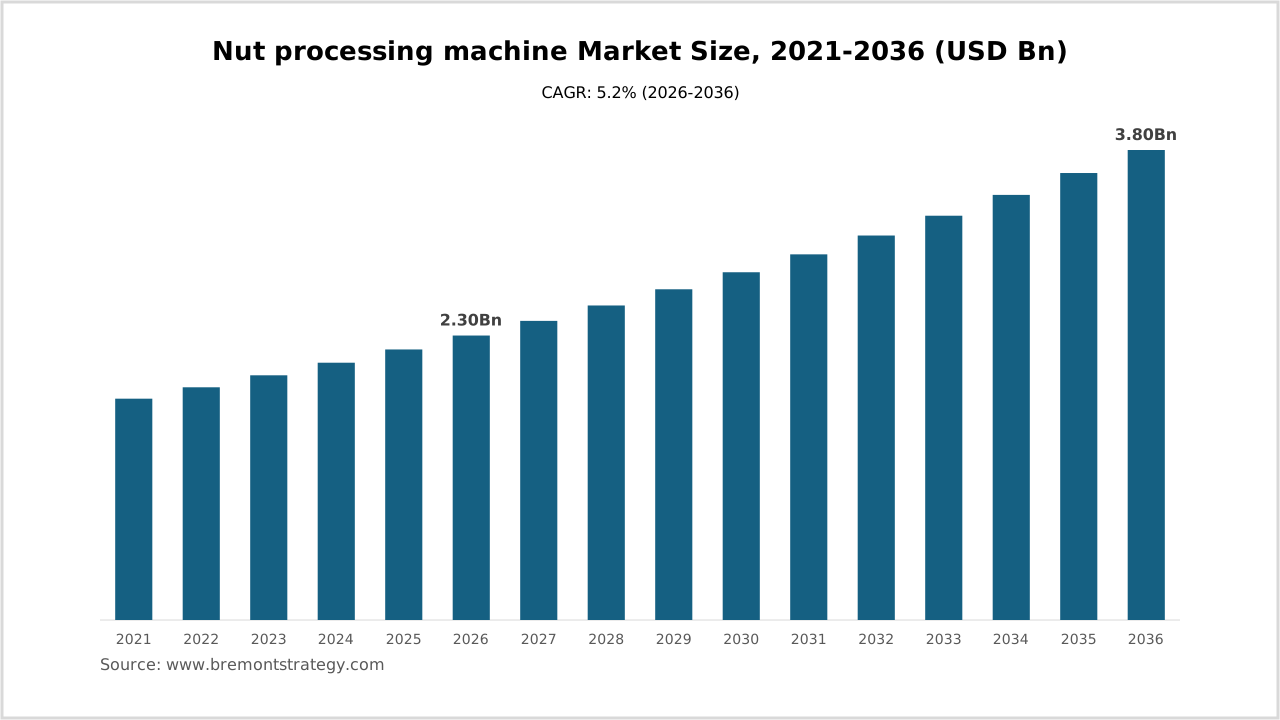
The Nut processing machine market was valued at $2.3 Billion in 2026 and is projected to reach $3.8 Billion by 2036, growing at a CAGR of 5.2% during the forecast period 2026-2036. This growth is primarily driven by increasing demand for processed nuts due to their rising popularity as healthy snacks and ingredients in various food products.
Nut processing machines are specialized equipment designed to automate the processing of nuts, including shelling, sorting, cleaning, and packaging. These machines offer high precision and efficiency, significantly reducing manual labor and processing time compared to traditional methods. Their ability to handle large volumes with consistent quality makes them distinct from conventional approaches.
The demand for nut processing machines is fueled by structural shifts in consumer preferences towards healthy and convenient food options. Additionally, the expansion of the food and beverage industry and the increasing trend of nut-based products in retail and food services are significant drivers of market growth.
Technological advancements in nut processing machines focus on enhancing automation, precision, and energy efficiency. R&D efforts are directed towards developing machines with advanced control systems and remote monitoring capabilities to improve operational efficiency and reduce downtime.
Competitive dynamics in the nut processing machine market are influenced by factors such as price, technical performance, distribution networks, and after-sales support. Companies compete by offering innovative solutions that cater to specific customer needs, with technical performance and reliability being crucial for adoption.
Nut processing machine Market Key Takeaways
- The Nut processing machine market is expected to grow from $2.3 Billion in 2026 to $3.8 Billion by 2036, at a CAGR of 5.2%.
- The Processing Unit segment leads the market, accounting for over 35% of the market share, driven by its essential role in the nut processing workflow.
- North America is the largest regional market, contributing to over 30% of the global revenue, due to high demand for processed nuts and advanced food processing infrastructure.
- The increasing consumer preference for healthy snacks and nut-based products is a primary demand driver in this market.
Nut processing machine Market Key Drivers
| Drivers | Impact |
|---|---|
| Health Trends | Growing consumer preference for healthy snacks boosts demand for processed nuts. |
| Automation Demand | Need for efficiency and reduced labor costs drives adoption of automated machines. |
| Technological Advancements | Innovations in processing technology enhance machine performance and appeal. |
| Export Growth | Rising global demand for nuts increases processing machine requirements. |
Health Trends
The increasing awareness of health and wellness among consumers is driving the demand for healthy snacks, including nuts. As nuts are rich in nutrients, they have become a popular choice for health-conscious individuals. This trend is significantly boosting the demand for nut processing machines, as manufacturers seek to meet the growing consumer demand for processed and packaged nuts.
Automation Demand
With the rising cost of labor and the need for efficient production processes, the demand for automation in nut processing is increasing. Nut processing machines offer automated solutions that reduce the need for manual labor, enhance production speed, and improve product consistency, making them an attractive investment for manufacturers.
Technological Advancements
Continuous advancements in technology are leading to the development of more sophisticated nut processing machines. These machines offer enhanced features such as precision sorting, energy efficiency, and advanced control systems, making them more appealing to manufacturers looking to improve their production capabilities and reduce operational costs.
Export Growth
The global demand for nuts is on the rise, driven by increasing consumption in emerging markets and the popularity of nuts as a healthy snack option. This growth is leading to increased export opportunities for nut producers, which in turn drives the demand for efficient nut processing machines to meet international quality standards and production volumes.
Nut processing machine Market Opportunities and Challenges
| Opportunity | Challenges |
|---|---|
| Rising Health Consciousness | High Initial Investment |
| Technological Innovation | Regulatory Compliance |
| Emerging Markets | Supply Chain Disruptions |
Opportunities in the nut processing machine market are primarily driven by the rising health consciousness among consumers, leading to increased demand for nuts as healthy snack options. Technological innovation presents another opportunity, as advancements in automation and precision processing can significantly enhance production efficiency and product quality. Additionally, emerging markets offer substantial growth potential as they adopt modern food processing technologies to meet local and export demands.
Challenges in the market include the high initial investment required for purchasing advanced nut processing machines, which can be a barrier for small and medium-sized enterprises. Regulatory compliance is another challenge, as manufacturers must adhere to stringent food safety and quality standards. Furthermore, supply chain disruptions, as seen during global events like the COVID-19 pandemic, can impact the availability and cost of raw materials and components, posing a threat to market stability.
Nut processing machine Market Report Scope
| Attributes | Details |
|---|---|
| Report Title | Nut processing machine Market Research Report 2036 |
| By Component | Processing Unit, Sorting Unit, Shelling Unit, Cleaning Unit, Packaging Unit, Control Systems |
| By Deployment | On-Premises, Cloud-Based, Hybrid, Mobile, Remote Monitoring |
| By Application | Almond Processing, Cashew Processing, Walnut Processing, Pistachio Processing, Hazelnut Processing, Peanut Processing |
| By Industry | Food and Beverage, Agriculture, Retail, Wholesale, Export, Food Service |
| By Region | North America, Europe, Asia Pacific, Latin America, Middle East & Africa |
| Countries Covered | North America (United States, Canada), Europe (Germany, France, UK, Italy, Spain, Rest of Europe), Asia Pacific (China, India, Japan, South Korea, Australia, Rest of Asia Pacific), Latin America (Brazil, Mexico, Argentina, Rest of Latin America), Middle East & Africa (GCC, South Africa, Rest of Middle East & Africa) |
| Base Year | 2026 |
| Historic Data | 2021-2025 |
| Forecast Period | 2026-2036 |
| Number of Pages | 280 |
| Number of Tables & Figures | 350 |
| Customization Available | Yes, the report can be customized as per your need. |
Nut processing machine Market Segment Analysis
The Nut processing machine market is segmented into various categories, including By Component, By Deployment, By Application, By Industry, and By Region. Each segment offers unique insights into the market's dynamics and growth opportunities.
By Component Analysis
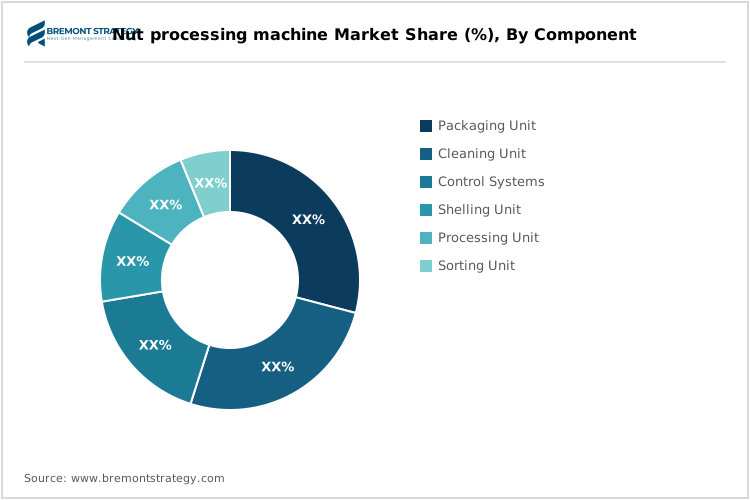
The Processing Unit segment dominates the market due to its critical role in the initial stages of nut processing, where nuts are cracked, shelled, and prepared for further processing. The efficiency and reliability of processing units are vital for maintaining product quality and throughput, making them indispensable in large-scale operations.
Sorting Units are also essential, as they ensure that only high-quality nuts proceed to packaging and distribution. Advanced sorting technologies, such as optical and laser sorting, enhance accuracy and reduce waste, contributing to their growing adoption.
Shelling Units play a crucial role in the processing of nuts like almonds and cashews, where precise shell removal is necessary to preserve the integrity of the nut. Innovations in shelling technology focus on minimizing damage and maximizing yield.
By Deployment Analysis
On-Premises deployment remains the most common due to its suitability for large-scale operations where control over processing is critical. These systems offer robust performance and security, making them ideal for established processing facilities.
Cloud-Based solutions are gaining traction, especially among smaller enterprises looking for cost-effective and scalable options. They offer flexibility and ease of access, allowing operators to manage processing activities remotely.
Hybrid deployment models combine the benefits of on-premises and cloud-based systems, providing a balanced approach to performance and flexibility. This model is particularly appealing to companies transitioning towards digital transformation.
By Application Analysis
Almond Processing is the leading application segment, driven by the high demand for almonds in snacks, confectionery, and dairy alternatives. The versatility and nutritional benefits of almonds make them a staple in health-focused diets.
Cashew Processing follows closely, with significant demand in both raw and roasted forms. The unique taste and texture of cashews have made them a popular choice in culinary applications worldwide.
Walnut and Pistachio Processing are also growing segments, supported by their increasing use in gourmet and health food products. Innovations in processing technology continue to enhance the quality and shelf life of these nuts.
By Industry Analysis
The Food and Beverage industry is the largest consumer of nut processing machines, utilizing them to produce a wide range of nut-based products. The industry's focus on innovation and product diversification drives the demand for advanced processing solutions.
Agriculture is another significant sector, where nut processing machines are used to add value to raw agricultural produce. The integration of modern processing technologies in agriculture enhances productivity and profitability.
Retail and Wholesale sectors benefit from the increased availability of processed nuts, which are packaged and distributed to meet consumer demand. The growth of e-commerce and specialty stores further supports this trend.
By Region Analysis
North America leads the market due to its advanced food processing industry and high consumer demand for healthy snacks. The presence of major players and a strong focus on innovation contribute to the region's dominance.
Europe is a mature market with a strong emphasis on quality and sustainability. The region's stringent food safety regulations drive the adoption of advanced processing technologies.
Asia Pacific is the fastest-growing region, fueled by rising disposable incomes and changing dietary preferences. The region's expanding middle class and increasing health awareness are key drivers of market growth.
Latin America presents significant growth opportunities, supported by abundant raw material availability and increasing investments in food processing infrastructure. The region's focus on export markets further boosts demand.
The Middle East & Africa region is emerging as a promising market, with growing investments in food processing and a rising demand for packaged and processed foods. The region's strategic location also supports export activities.
Nut processing machine Market Regional Outlook
| Regional Outlook | |
|---|---|
| Largest Market | North America |
| Fastest Growing Market | Asia Pacific |
| Emerging Countries | India, Brazil, South Africa |
| Future Outlook | Continued growth driven by health trends and technological advancements. |
In North America, the nut processing machine market benefits from a well-established food processing industry and a strong consumer base for healthy snacks. The region's focus on innovation and quality assurance supports the adoption of advanced processing technologies.
Europe's market is characterized by a mature industry with a strong emphasis on sustainability and quality. The region's regulatory environment drives the adoption of cutting-edge processing solutions to meet stringent food safety standards.
Asia-Pacific is experiencing rapid growth, driven by increasing consumer demand for processed nuts and the expansion of the middle class. The region's dynamic market environment and focus on health and wellness are key growth drivers.
Latin America offers significant growth potential due to its rich agricultural resources and growing investments in food processing infrastructure. The region's focus on export markets further enhances demand for efficient processing solutions.
The Middle East & Africa region is emerging as a promising market, with increasing investments in food processing and a rising demand for packaged and processed foods. The region's strategic location also supports export activities.
Nut processing machine Market Competitor Outlook
| Competitor Outlook | |
|---|---|
| Market Leader |
|
| Key Players |
|
| Key Competitive Factors |
|
Nut processing machine Pricing Analysis
Pricing in the nut processing machine market is influenced by several factors, including the formulation and specification of the machines, the scale of production, and the region of deployment. Machines with advanced features such as automation and precision control tend to be priced higher due to the added value they provide in terms of efficiency and product quality. Additionally, regional variations in labor and material costs can impact pricing, with machines in developed markets often commanding premium prices.
Price sensitivity varies among buyers, with larger enterprises focusing on value-driven purchasing decisions that prioritize long-term operational efficiency and cost savings. In contrast, smaller businesses may be more price-sensitive, seeking affordable solutions that meet their immediate processing needs. As a result, manufacturers often offer a range of products at different price points to cater to diverse customer segments, balancing cost with performance and reliability.
Nut processing machine Consumer Buying Behaviour / Preference Analysis
Key Purchase Criteria
| Buying Factor | Relative Importance | Reason |
|---|---|---|
| Performance | Very High | Ensures efficiency and quality |
| Durability/Reliability | High | Long-term investment |
| Certification/Compliance | Medium-High | Regulatory standards |
| Total Cost | Medium | Budget constraints |
| Differentiating Capability | Medium | Competitive advantage |
Typical buyers of nut processing machines include procurement managers, operations managers, and plant engineers in food processing companies. These professionals prioritize factors such as machine performance, reliability, and compliance with industry standards when making purchasing decisions. The ability of a machine to deliver consistent quality and efficiency is of paramount importance, as it directly impacts production outcomes and profitability.
Purchasing decisions are also influenced by the total cost of ownership, which includes not only the initial purchase price but also maintenance, operational costs, and potential downtime. Buyers seek machines that offer a balance between cost and performance, with a strong emphasis on reliability and long-term value. As such, manufacturers that can demonstrate the cost-effectiveness and superior performance of their machines are more likely to succeed in this competitive market.
TABLE OF CONTENTS
1. Research Methodology
2. Market Structure
3. Executive Summary
4. Nut processing machine Market Overview
- 4.1 Introduction
- Market Snapshot
- Assumptions, Inclusion & Exclusions
- Technological Advancements & Patent Analysis
- Case Studies
- Market Entry & Launch Strategies
- Macro-Economic Factors Impacting the Market Growth
- 4.2 Nut processing machine Market Dynamics
- Market Drivers
- Market Restraints
- Market Opportunity
- 4.3 Nut processing machine Market - Supply Chain Analysis
- Key Raw Material/Components Provider
- Key Manufacturers
- Key Distributors
- Key Consumers
- 4.4 Key Forces Shaping the Nut processing machine Market
- Bargaining Power of Suppliers
- Bargaining Power of Buyers
- Threat of Substitution
- Threat of New Entrants
- Competitive Rivalry
- 4.1 Introduction
5. Global Nut processing machine Market, By Component
- 5.1 Market Size, Value (USD Mn) & Volume (Units)
- Processing Unit
- Sorting Unit
- Shelling Unit
- Cleaning Unit
- Packaging Unit
- Control Systems
- 5.2 Key Market Trends & Growth Opportunities
- 5.3 Market Share (%) Analysis, 2021-2036
- 5.4 Year-on-Year (YoY) Growth Rate
- 5.5 Market Attractiveness
- 5.6 Global Investment & Trade Risks
- 5.7 Pricing Analysis, 2021-2036
- 5.8 Operating Margin/Profits, 2021-2036
- 5.1 Market Size, Value (USD Mn) & Volume (Units)
6. Global Nut processing machine Market, By Deployment
- 6.1 Market Size, Value (USD Mn) & Volume (Units)
- On-Premises
- Cloud-Based
- Hybrid
- Mobile
- Remote Monitoring
- 6.2 Key Market Trends & Growth Opportunities
- 6.3 Market Share (%) Analysis, 2021-2036
- 6.4 Year-on-Year (YoY) Growth Rate
- 6.5 Market Attractiveness
- 6.6 Global Investment & Trade Risks
- 6.7 Pricing Analysis, 2021-2036
- 6.8 Operating Margin/Profits, 2021-2036
- 6.1 Market Size, Value (USD Mn) & Volume (Units)
7. Global Nut processing machine Market, By Application
- 7.1 Market Size, Value (USD Mn) & Volume (Units)
- Almond Processing
- Cashew Processing
- Walnut Processing
- Pistachio Processing
- Hazelnut Processing
- Peanut Processing
- 7.2 Key Market Trends & Growth Opportunities
- 7.3 Market Share (%) Analysis, 2021-2036
- 7.4 Year-on-Year (YoY) Growth Rate
- 7.5 Market Attractiveness
- 7.6 Global Investment & Trade Risks
- 7.7 Pricing Analysis, 2021-2036
- 7.8 Operating Margin/Profits, 2021-2036
- 7.1 Market Size, Value (USD Mn) & Volume (Units)
8. Global Nut processing machine Market, By Industry
- 8.1 Market Size, Value (USD Mn) & Volume (Units)
- Food and Beverage
- Agriculture
- Retail
- Wholesale
- Export
- Food Service
- 8.2 Key Market Trends & Growth Opportunities
- 8.3 Market Share (%) Analysis, 2021-2036
- 8.4 Year-on-Year (YoY) Growth Rate
- 8.5 Market Attractiveness
- 8.6 Global Investment & Trade Risks
- 8.7 Pricing Analysis, 2021-2036
- 8.8 Operating Margin/Profits, 2021-2036
- 8.1 Market Size, Value (USD Mn) & Volume (Units)
9. Global Nut processing machine Market, By Region
- 9.1 Market Size, Value (USD Mn) & Volume (Units)
- North America
- Europe
- Asia Pacific
- Latin America
- Middle East & Africa
- 9.2 Key Market Trends & Growth Opportunities
- 9.3 Market Share (%) Analysis, 2021-2036
- 9.4 Year-on-Year (YoY) Growth Rate
- 9.5 Market Attractiveness
- 9.6 Global Investment & Trade Risks
- 9.7 Pricing Analysis, 2021-2036
- 9.8 Operating Margin/Profits, 2021-2036
- 9.1 Market Size, Value (USD Mn) & Volume (Units)
10. Global Nut processing machine Market, By North America
- 10.1 Market Size, Value (USD Mn) & Volume (Units)
- US
- Canada
- 10.2 Key Market Trends & Growth Opportunities
- 10.3 Market Share (%) Analysis, 2021-2036
- 10.4 Year-on-Year (YoY) Growth Rate
- 10.5 Market Attractiveness
- 10.6 Global Investment & Trade Risks
- 10.7 Pricing Analysis, 2021-2036
- 10.8 Operating Margin/Profits, 2021-2036
- 10.1 Market Size, Value (USD Mn) & Volume (Units)
11. Global Nut processing machine Market, By Europe
- 11.1 Market Size, Value (USD Mn) & Volume (Units)
- Germany
- France
- UK
- Spain
- Italy
- Switzerland
- Russia
- Poland
- Rest of Europe
- 11.2 Key Market Trends & Growth Opportunities
- 11.3 Market Share (%) Analysis, 2021-2036
- 11.4 Year-on-Year (YoY) Growth Rate
- 11.5 Market Attractiveness
- 11.6 Global Investment & Trade Risks
- 11.7 Pricing Analysis, 2021-2036
- 11.8 Operating Margin/Profits, 2021-2036
- 11.1 Market Size, Value (USD Mn) & Volume (Units)
12. Global Nut processing machine Market, By Asia Pacific
- 12.1 Market Size, Value (USD Mn) & Volume (Units)
- China
- Japan
- South Korea
- India
- Australia
- South East Asia
- Rest of APAC
- 12.2 Key Market Trends & Growth Opportunities
- 12.3 Market Share (%) Analysis, 2021-2036
- 12.4 Year-on-Year (YoY) Growth Rate
- 12.5 Market Attractiveness
- 12.6 Global Investment & Trade Risks
- 12.7 Pricing Analysis, 2021-2036
- 12.8 Operating Margin/Profits, 2021-2036
- 12.1 Market Size, Value (USD Mn) & Volume (Units)
13. Global Nut processing machine Market, By Latin America
- 13.1 Market Size, Value (USD Mn) & Volume (Units)
- Brazil
- Mexico
- Argentina
- Rest of LATAM
- 13.2 Key Market Trends & Growth Opportunities
- 13.3 Market Share (%) Analysis, 2021-2036
- 13.4 Year-on-Year (YoY) Growth Rate
- 13.5 Market Attractiveness
- 13.6 Global Investment & Trade Risks
- 13.7 Pricing Analysis, 2021-2036
- 13.8 Operating Margin/Profits, 2021-2036
- 13.1 Market Size, Value (USD Mn) & Volume (Units)
14. Global Nut processing machine Market, By Middle East & Africa
- 14.1 Market Size, Value (USD Mn) & Volume (Units)
- Saudi Arabia
- UAE
- South Africa
- Rest of MEA
- 14.2 Key Market Trends & Growth Opportunities
- 14.3 Market Share (%) Analysis, 2021-2036
- 14.4 Year-on-Year (YoY) Growth Rate
- 14.5 Market Attractiveness
- 14.6 Global Investment & Trade Risks
- 14.7 Pricing Analysis, 2021-2036
- 14.8 Operating Margin/Profits, 2021-2036
- 14.1 Market Size, Value (USD Mn) & Volume (Units)
15. Competitive Analysis
- 15.1 Competition Landscape, Key Players
- Global Market Share (%) Analysis of Key Players in Nut processing machine, in Value (USD Mn) & Volume (Units)
- Company Overview
- Company Financials
- News & Developments
- Strategic Initiatives
- 15.2 Company Profiles
- Buhler Group
- Tomra Systems ASA
- Key Technology, Inc.
- Bertuzzi Food Processing Srl
- Brovind - GBV Impianti Srl
- JBT Corporation
- Marel HF
- GEA Group AG
- Satake Corporation
- Alvan Blanch Development Company Ltd
- Bucher Industries AG
- Hosokawa Micron Group
- Heat and Control, Inc.
- LMC - Lewis M. Carter Manufacturing, LLC
- FAM NV
- Agritec International Ltd
- Cimbria A/S
- Petkus Technologie GmbH
- Sormac B.V.
- Kiremko B.V.
- 15.1 Competition Landscape, Key Players
METHODOLOGY
To provide you with a comprehensive understanding of how we quantify your market opportunity, we utilize a multi-phased methodology designed to minimize risk and maximize strategic clarity. We begin the process by establishing a clear conceptual framework, often referred to as the TAM-SAM-SOM model. By starting with the Total Addressable Market, we look at the absolute global demand for your category. We then refine this into the Serviceable Addressable Market to account for your specific geographic and technological reach, and finally, we pinpoint the Serviceable Obtainable Market. This ensures that the final figures we present are not just theoretical "vanity metrics," but represent a realistic, capture-able revenue target for your business.
Our data collection process relies on a rigorous principle called triangulation, where we cross-reference multiple independent data streams to ensure accuracy. We initiate this with deep-dive secondary research, synthesizing high-value intelligence from audited financial filings, government trade databases, and specialized industry journals. This "desk research" phase provides a macro-economic baseline and identifies historical growth trajectories. However, because secondary data can sometimes lag behind real-time shifts, we supplement this with targeted primary research. This involves direct engagement with Key Opinion Leaders (KOLs) and structured quantitative surveys to capture the current pulse of the market and emerging buyer intent.
To ensure the integrity of our estimates, we employ a dual-modeling approach, calculating the market size from both the "Top-Down" and "Bottom-Up." The Top-Down analysis provides a valuable sanity check against broader economic trends, but we place the most weight on our Bottom-Up modeling. By taking granular data, such as the average transaction value and the actual number of potential customer touchpoints, and scaling them upward, we build a highly defensible model grounded in operational reality. This dual-verification method allows us to identify any discrepancies early, ensuring that the resulting data is robust enough to withstand the scrutiny of stakeholders or investors.
Finally, we recognize that a static market size figure is only a snapshot in time. To provide you with a roadmap for the future, we integrate trend analysis and Compound Annual Growth Rate (CAGR) forecasting into our final reporting. We analyze the underlying drivers, such as regulatory shifts, technological disruptions, or changing consumer behaviors, to predict how the market will evolve over the next three to five years. This ongoing tracking mechanism transforms a simple number into a dynamic strategic tool, allowing you to monitor your market share in real-time and pivot your resources as new opportunities emerge.
Frequently Asked Questions
What is the current size of the Nut processing machine market?
The base year for the Nut processing machine market is 2026, with a market size of $2.3 billion.
What is the projected market size by 2036?
The Nut processing machine market is projected to reach a size of $3.8 billion by the year 2036.
What is the market's CAGR during the forecast period?
The compound annual growth rate (CAGR) for the Nut processing machine market is expected to be 5.2% from 2026 to 2036.
Which region is the fastest-growing in this market?
The Asia-Pacific region is anticipated to be the fastest-growing market for Nut processing machines during the forecast period.
Which segment holds the largest share in the Nut processing machine market?
The roasting segment holds the largest share in the Nut processing machine market, driven by increasing demand for roasted nuts.
Who are the key players in this market?
Key players in the Nut processing machine market include companies such as ABC Machinery, Buhler AG, and Tomra Systems ASA.
What are the key growth drivers for this market?
Key growth drivers include rising consumer demand for processed nuts and technological advancements in processing machinery.
Is the report customizable?
Yes, the report can be customized as per specific requirements to better suit individual business needs.