Rapid STI Testing
Rapid STI Testing Market Research Report 2036
Rapid STI Testing Market Segments - by Component (Test Kits, Instruments, Reagents, Software, Services), Deployment (Point-of-Care, Laboratory-Based, Home Testing, Clinics, Hospitals), Application (Chlamydia Testing, Gonorrhea Testing, Syphilis Testing, HIV Testing, Herpes Simplex Virus Testing, Human Papillomavirus Testing), Industry (Healthcare Providers, Diagnostic Laboratories, Pharmaceutical Companies, Academic and Research Institutes, Government and Public Health Organizations), and Region (North America, Europe, Asia Pacific, Latin America, Middle East & Africa) - The Market Forecasts are Provided in Terms of Value (USD)
Rapid STI Testing Market Outlook
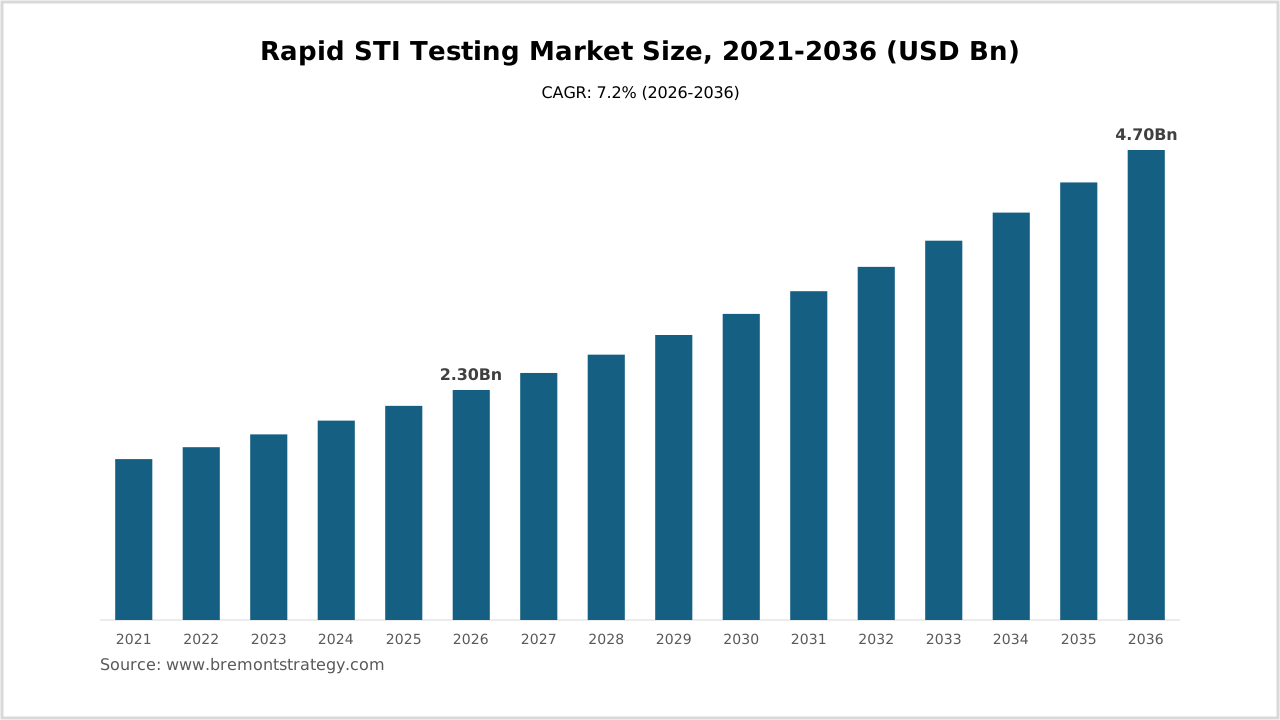
The Rapid STI Testing market was valued at $2.3 Billion in 2026 and is projected to reach $4.7 Billion by 2036, growing at a CAGR of 7.2% during the forecast period 2026-2036. This growth is primarily driven by increasing awareness and the need for early detection and treatment of sexually transmitted infections.
Rapid STI Testing involves the use of advanced diagnostic tools that provide quick and accurate results, often within minutes to hours, compared to conventional laboratory testing methods. This technology is distinct due to its convenience, speed, and the ability to be used in various settings, including point-of-care locations, which enhances patient compliance and follow-up.
Overall demand is driven by structural forces such as the rising prevalence of STIs globally, increased public health initiatives for STI awareness, and the growing demand for privacy and convenience in testing. Additionally, the expansion of healthcare infrastructure and increased healthcare spending are key contributors to market growth.
Technology development trends in the Rapid STI Testing market are focused on enhancing the accuracy, speed, and ease of use of tests. Research and development efforts are directed towards multiplex testing capabilities, which allow simultaneous detection of multiple infections, and the integration of digital health technologies for better data management and patient engagement.
Competitive dynamics in the market are shaped by factors such as pricing strategies, technical performance, distribution networks, and customer support services. Adoption is heavily influenced by the reliability and accuracy of test results, ease of use, and the availability of comprehensive after-sales support.
Rapid STI Testing Market Key Takeaways
- The Rapid STI Testing market is expected to grow from $2.3 Billion in 2026 to $4.7 Billion by 2036, at a CAGR of 7.2% during the forecast period.
- The test kits segment is projected to hold the largest market share, driven by their widespread use in point-of-care settings and home testing applications.
- North America is anticipated to be the leading region, accounting for over 35% of the market share, due to advanced healthcare infrastructure and high awareness levels.
- Increasing government initiatives and public health campaigns are significant demand drivers, promoting regular testing and early detection of STIs.
Rapid STI Testing Market Key Drivers
| Drivers | Impact |
|---|---|
| Rising STI Prevalence | Increasing STI rates globally are driving the demand for rapid testing solutions. |
| Technological Advancements | Innovations in testing technology enhance accuracy and reduce time-to-result. |
| Government Initiatives | Public health campaigns are boosting awareness and encouraging regular testing. |
| Consumer Demand for Convenience | Growing preference for privacy and convenience in testing is increasing demand for home testing kits. |
Rising STI Prevalence
The global increase in sexually transmitted infections is a primary driver for the Rapid STI Testing market. As STI rates continue to rise, there is a heightened need for effective and quick diagnostic solutions that can facilitate timely treatment and reduce transmission rates. This trend is particularly pronounced in regions with high population densities and limited access to traditional healthcare services.
Technological Advancements
Technological innovations in rapid testing have significantly improved the accuracy and speed of STI diagnostics. Developments such as point-of-care testing devices and multiplex assays enable healthcare providers to deliver reliable results quickly, which is crucial for effective patient management and reducing the spread of infections.
Government Initiatives
Government-led health initiatives and public awareness campaigns are critical in promoting STI testing. These programs aim to reduce stigma, encourage regular testing, and provide education on prevention and treatment, thereby increasing the adoption of rapid testing solutions.
Consumer Demand for Convenience
There is an increasing consumer preference for convenient and private testing options, such as home testing kits. This demand is driven by the desire for confidentiality, ease of access, and the ability to conduct tests without the need for a healthcare professional, making rapid STI testing an attractive option.
Rapid STI Testing Market Opportunities and Challenges
| Opportunity | Challenges |
|---|---|
| Home Testing Kits | Regulatory Compliance |
| Digital Health Integration | Data Privacy Concerns |
| Emerging Markets | Infrastructure Limitations |
Opportunities in the Rapid STI Testing market are abundant, with the home testing kits segment poised for significant growth due to consumer demand for privacy and convenience. The integration of digital health technologies presents another opportunity, allowing for enhanced data management and patient engagement. Additionally, emerging markets offer vast potential as healthcare infrastructure develops and awareness increases, providing new avenues for market expansion.
However, the market faces several challenges, including regulatory compliance issues that can hinder the introduction of new products. Data privacy concerns are also prevalent, particularly with the integration of digital health solutions. In emerging markets, infrastructure limitations can restrict access to rapid testing technologies, posing a barrier to market penetration and growth.
Rapid STI Testing Market Report Scope
| Attributes | Details |
|---|---|
| Report Title | Rapid STI Testing Market Research Report 2036 |
| By component | Test Kits, Instruments, Reagents, Software, Services |
| By deployment | Point-of-Care, Laboratory-Based, Home Testing, Clinics, Hospitals |
| By application | Chlamydia Testing, Gonorrhea Testing, Syphilis Testing, HIV Testing, Herpes Simplex Virus Testing, Human Papillomavirus Testing |
| By industry | Healthcare Providers, Diagnostic Laboratories, Pharmaceutical Companies, Academic and Research Institutes, Government and Public Health Organizations |
| By region | North America, Europe, Asia Pacific, Latin America, Middle East & Africa |
| Countries Covered | North America (United States, Canada), Europe (Germany, France, UK, Italy, Spain, Rest of Europe), Asia Pacific (China, Japan, India, Australia, South Korea, Rest of Asia Pacific), Latin America (Brazil, Mexico, Rest of Latin America), Middle East & Africa (Saudi Arabia, UAE, South Africa, Rest of Middle East & Africa) |
| Base Year | 2026 |
| Historic Data | 2021-2025 |
| Forecast Period | 2026-2036 |
| Number of Pages | 280 |
| Number of Tables & Figures | 350 |
| Customization Available | Yes, the report can be customized as per your need. |
Rapid STI Testing Market Segment Analysis
The Rapid STI Testing market is segmented into various categories, including component, deployment, application, industry, and region. Each segment offers unique insights into the market dynamics and growth opportunities.
By component Analysis
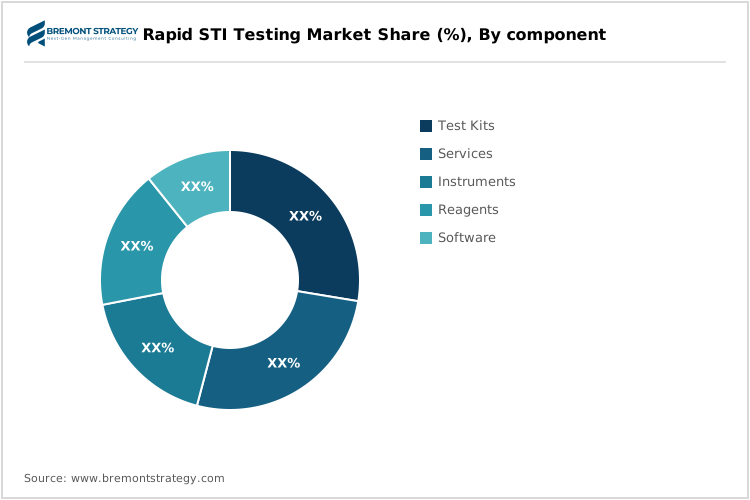
The component segment includes test kits, instruments, reagents, software, and services. Test kits dominate this segment due to their widespread use in both clinical and home settings, offering quick and reliable results. Instruments and reagents are essential for laboratory-based testing, providing high accuracy and supporting complex diagnostic processes. Software solutions are increasingly being integrated to enhance data management and reporting capabilities, while services encompass training and maintenance, ensuring optimal performance of testing solutions.
Test kits are particularly favored for their convenience and ability to deliver rapid results, making them ideal for point-of-care and home testing applications. Instruments, while more complex, offer higher throughput and are crucial for large-scale testing in clinical laboratories. Reagents are critical for the accuracy and reliability of tests, ensuring consistent performance across different testing environments.
Software and services are gaining traction as they offer added value through improved data handling and customer support. The integration of digital solutions is enhancing the overall efficiency and effectiveness of rapid STI testing, allowing for better patient management and follow-up.
By deployment Analysis
The deployment segment is categorized into point-of-care, laboratory-based, home testing, clinics, and hospitals. Point-of-care testing is leading this segment due to its ability to provide immediate results, which is crucial for timely diagnosis and treatment. Laboratory-based testing remains important for its high accuracy and capacity to handle large volumes of samples.
Home testing is experiencing rapid growth as consumers seek privacy and convenience, allowing individuals to conduct tests in the comfort of their own homes. Clinics and hospitals continue to be significant deployment settings, offering comprehensive testing and treatment services, particularly for complex cases requiring professional medical intervention.
Point-of-care testing is preferred for its speed and ease of use, making it ideal for emergency situations and remote locations. Laboratory-based testing, while slower, offers the highest accuracy and is essential for confirmatory testing and detailed analysis. Home testing appeals to consumers who prioritize confidentiality and convenience, driving its adoption in the market.
By application Analysis
Application segments include chlamydia testing, gonorrhea testing, syphilis testing, HIV testing, herpes simplex virus testing, and human papillomavirus testing. HIV testing leads this segment due to the high prevalence of the virus and the critical need for early detection and treatment.
Chlamydia and gonorrhea testing are also significant due to their high incidence rates and potential for serious health complications if left untreated. Syphilis testing is crucial for preventing congenital syphilis and managing outbreaks, while herpes simplex virus testing is important for diagnosing and managing recurrent infections.
Human papillomavirus testing is gaining importance with the increasing focus on cervical cancer prevention and the availability of vaccines. Each application segment addresses specific public health needs, with HIV testing being the most critical due to its impact on global health and the availability of effective treatments that can significantly improve patient outcomes.
By industry Analysis
The industry segment includes healthcare providers, diagnostic laboratories, pharmaceutical companies, academic and research institutes, and government and public health organizations. Healthcare providers are the primary users of rapid STI testing, utilizing these solutions to deliver timely and effective patient care.
Diagnostic laboratories play a crucial role in providing high-volume testing and confirmatory diagnostics, ensuring accuracy and reliability. Pharmaceutical companies are involved in the development and commercialization of new testing solutions, while academic and research institutes focus on advancing testing technologies and methodologies.
Government and public health organizations are key stakeholders, driving awareness and adoption through public health initiatives and funding programs. Each industry segment contributes to the market's growth and development, with healthcare providers and diagnostic laboratories being the most significant due to their direct involvement in patient care and testing services.
By region Analysis
The regional analysis covers North America, Europe, Asia Pacific, Latin America, and the Middle East & Africa. North America leads the market due to its advanced healthcare infrastructure and high awareness levels, while Asia Pacific is the fastest-growing region, driven by increasing healthcare investments and a rising prevalence of STIs.
Europe holds a significant share of the market, supported by strong public health initiatives and a well-established healthcare system. Latin America and the Middle East & Africa are emerging markets, offering growth opportunities as healthcare access improves and awareness increases.
North America's leadership is attributed to its robust healthcare system and proactive public health policies. Asia Pacific's rapid growth is fueled by economic development and increasing healthcare expenditure, while Europe benefits from comprehensive healthcare coverage and strong regulatory frameworks. Latin America and the Middle East & Africa present opportunities for expansion as healthcare infrastructure continues to develop.
Rapid STI Testing Market Regional Outlook
| Regional Outlook | |
|---|---|
| Largest Market | North America |
| Fastest Growing Market | Asia Pacific |
| Emerging Countries | Brazil, India, South Africa |
| Future Outlook | The market is expected to witness robust growth driven by technological advancements and increasing awareness. |
North America remains the largest market for Rapid STI Testing, driven by high awareness levels, advanced healthcare infrastructure, and strong public health initiatives. The region's focus on early detection and treatment of STIs contributes significantly to its market dominance.
Europe is characterized by a well-established healthcare system and comprehensive public health policies that support widespread testing and prevention efforts. The region's commitment to reducing STI rates through education and access to testing services ensures steady market growth.
Asia-Pacific is the fastest-growing region, with rapid economic development, increasing healthcare investments, and a rising prevalence of STIs driving demand for rapid testing solutions. The region's expanding healthcare infrastructure and focus on improving public health outcomes present significant growth opportunities.
Latin America is an emerging market with potential for growth as healthcare access improves and awareness of STIs increases. Government initiatives and international partnerships are crucial in expanding testing services and reducing the burden of STIs in the region.
The Middle East & Africa face challenges related to healthcare infrastructure and access, but ongoing efforts to improve public health and increase awareness of STIs offer opportunities for market expansion. Collaborative initiatives and investments in healthcare systems are essential for driving growth in this region.
Rapid STI Testing Market Competitor Outlook
| Competitor Outlook | |
|---|---|
| Market Leader |
|
| Key Players |
|
| Key Competitive Factors |
|
Rapid STI Testing Pricing Analysis
Pricing in the Rapid STI Testing market is influenced by several factors, including the formulation and specification of the test kits, the scale of production, and the region of distribution. Advanced tests with higher accuracy and rapid results tend to be priced higher, while economies of scale can reduce costs. Regional pricing variations are also significant, with developed markets typically having higher prices due to advanced healthcare infrastructure and higher operational costs.
Price sensitivity in the market varies, with some consumers prioritizing cost over features, especially in price-sensitive regions. However, there is a growing trend towards value-driven purchasing, where buyers are willing to pay a premium for tests that offer superior accuracy, ease of use, and comprehensive support services. This shift is driven by increased awareness of the importance of accurate and timely STI diagnosis.
Rapid STI Testing Consumer Buying Behaviour / Preference Analysis
Key Purchase Criteria
| Buying Factor | Relative Importance | Reason |
|---|---|---|
| Performance | Very High | Accuracy and reliability |
| Durability/Reliability | High | Consistent results |
| Certification/Compliance | Medium-High | Regulatory approval |
| Total Cost | Medium | Budget constraints |
| Differentiating Capability | High | Unique features |
Typical buyers in the Rapid STI Testing market include healthcare providers, laboratory managers, and procurement officers in hospitals and clinics. These professionals prioritize performance and reliability in their purchasing decisions, seeking tests that offer high accuracy and consistent results. Regulatory compliance and certification are also important, ensuring that products meet industry standards and are approved for use.
Purchasing decisions are influenced by factors such as total cost, with budget constraints playing a role, particularly in public health settings. However, there is a growing emphasis on differentiating capabilities, with buyers looking for tests that offer unique features, such as multiplexing or digital integration, that enhance the overall testing experience and patient outcomes.
TABLE OF CONTENTS
1. Research Methodology
2. Market Structure
3. Executive Summary
4. Rapid STI Testing Market Overview
- 4.1 Introduction
- Market Snapshot
- Assumptions, Inclusion & Exclusions
- Technological Advancements & Patent Analysis
- Case Studies
- Market Entry & Launch Strategies
- Macro-Economic Factors Impacting the Market Growth
- 4.2 Rapid STI Testing Market Dynamics
- Market Drivers
- Market Restraints
- Market Opportunity
- 4.3 Rapid STI Testing Market - Supply Chain Analysis
- Key Raw Material/Components Provider
- Key Manufacturers
- Key Distributors
- Key Consumers
- 4.4 Key Forces Shaping the Rapid STI Testing Market
- Bargaining Power of Suppliers
- Bargaining Power of Buyers
- Threat of Substitution
- Threat of New Entrants
- Competitive Rivalry
- 4.1 Introduction
5. Global Rapid STI Testing Market, By Component
- 5.1 Market Size, Value (USD Mn) & Volume (Units)
- Test Kits
- Instruments
- Reagents
- Software
- Services
- 5.2 Key Market Trends & Growth Opportunities
- 5.3 Market Share (%) Analysis, 2021-2036
- 5.4 Year-on-Year (YoY) Growth Rate
- 5.5 Market Attractiveness
- 5.6 Global Investment & Trade Risks
- 5.7 Pricing Analysis, 2021-2036
- 5.8 Operating Margin/Profits, 2021-2036
- 5.1 Market Size, Value (USD Mn) & Volume (Units)
6. Global Rapid STI Testing Market, By Deployment Mode
- 6.1 Market Size, Value (USD Mn) & Volume (Units)
- Point-of-Care
- Laboratory-Based
- Home Testing
- Clinics
- Hospitals
- 6.2 Key Market Trends & Growth Opportunities
- 6.3 Market Share (%) Analysis, 2021-2036
- 6.4 Year-on-Year (YoY) Growth Rate
- 6.5 Market Attractiveness
- 6.6 Global Investment & Trade Risks
- 6.7 Pricing Analysis, 2021-2036
- 6.8 Operating Margin/Profits, 2021-2036
- 6.1 Market Size, Value (USD Mn) & Volume (Units)
7. Global Rapid STI Testing Market, By Application
- 7.1 Market Size, Value (USD Mn) & Volume (Units)
- Chlamydia Testing
- Gonorrhea Testing
- Syphilis Testing
- HIV Testing
- Herpes Simplex Virus Testing
- Human Papillomavirus Testing
- 7.2 Key Market Trends & Growth Opportunities
- 7.3 Market Share (%) Analysis, 2021-2036
- 7.4 Year-on-Year (YoY) Growth Rate
- 7.5 Market Attractiveness
- 7.6 Global Investment & Trade Risks
- 7.7 Pricing Analysis, 2021-2036
- 7.8 Operating Margin/Profits, 2021-2036
- 7.1 Market Size, Value (USD Mn) & Volume (Units)
8. Global Rapid STI Testing Market, By Industry Vertical
- 8.1 Market Size, Value (USD Mn) & Volume (Units)
- Healthcare Providers
- Diagnostic Laboratories
- Pharmaceutical Companies
- Academic and Research Institutes
- Government and Public Health Organizations
- 8.2 Key Market Trends & Growth Opportunities
- 8.3 Market Share (%) Analysis, 2021-2036
- 8.4 Year-on-Year (YoY) Growth Rate
- 8.5 Market Attractiveness
- 8.6 Global Investment & Trade Risks
- 8.7 Pricing Analysis, 2021-2036
- 8.8 Operating Margin/Profits, 2021-2036
- 8.1 Market Size, Value (USD Mn) & Volume (Units)
9. Global Rapid STI Testing Market, By Region
- 9.1 Market Size, Value (USD Mn) & Volume (Units)
- North America
- Europe
- Asia Pacific
- Latin America
- Middle East & Africa
- 9.2 Key Market Trends & Growth Opportunities
- 9.3 Market Share (%) Analysis, 2021-2036
- 9.4 Year-on-Year (YoY) Growth Rate
- 9.5 Market Attractiveness
- 9.6 Global Investment & Trade Risks
- 9.7 Pricing Analysis, 2021-2036
- 9.8 Operating Margin/Profits, 2021-2036
- 9.1 Market Size, Value (USD Mn) & Volume (Units)
10. Global Rapid STI Testing Market, By North America
- 10.1 Market Size, Value (USD Mn) & Volume (Units)
- US
- Canada
- 10.2 Key Market Trends & Growth Opportunities
- 10.3 Market Share (%) Analysis, 2021-2036
- 10.4 Year-on-Year (YoY) Growth Rate
- 10.5 Market Attractiveness
- 10.6 Global Investment & Trade Risks
- 10.7 Pricing Analysis, 2021-2036
- 10.8 Operating Margin/Profits, 2021-2036
- 10.1 Market Size, Value (USD Mn) & Volume (Units)
11. Global Rapid STI Testing Market, By Europe
- 11.1 Market Size, Value (USD Mn) & Volume (Units)
- Germany
- France
- UK
- Spain
- Italy
- Switzerland
- Russia
- Poland
- Rest of Europe
- 11.2 Key Market Trends & Growth Opportunities
- 11.3 Market Share (%) Analysis, 2021-2036
- 11.4 Year-on-Year (YoY) Growth Rate
- 11.5 Market Attractiveness
- 11.6 Global Investment & Trade Risks
- 11.7 Pricing Analysis, 2021-2036
- 11.8 Operating Margin/Profits, 2021-2036
- 11.1 Market Size, Value (USD Mn) & Volume (Units)
12. Global Rapid STI Testing Market, By Asia Pacific
- 12.1 Market Size, Value (USD Mn) & Volume (Units)
- China
- Japan
- South Korea
- India
- Australia
- South East Asia
- Rest of APAC
- 12.2 Key Market Trends & Growth Opportunities
- 12.3 Market Share (%) Analysis, 2021-2036
- 12.4 Year-on-Year (YoY) Growth Rate
- 12.5 Market Attractiveness
- 12.6 Global Investment & Trade Risks
- 12.7 Pricing Analysis, 2021-2036
- 12.8 Operating Margin/Profits, 2021-2036
- 12.1 Market Size, Value (USD Mn) & Volume (Units)
13. Global Rapid STI Testing Market, By Latin America
- 13.1 Market Size, Value (USD Mn) & Volume (Units)
- Brazil
- Mexico
- Argentina
- Rest of LATAM
- 13.2 Key Market Trends & Growth Opportunities
- 13.3 Market Share (%) Analysis, 2021-2036
- 13.4 Year-on-Year (YoY) Growth Rate
- 13.5 Market Attractiveness
- 13.6 Global Investment & Trade Risks
- 13.7 Pricing Analysis, 2021-2036
- 13.8 Operating Margin/Profits, 2021-2036
- 13.1 Market Size, Value (USD Mn) & Volume (Units)
14. Global Rapid STI Testing Market, By Middle East & Africa
- 14.1 Market Size, Value (USD Mn) & Volume (Units)
- Saudi Arabia
- UAE
- South Africa
- Rest of MEA
- 14.2 Key Market Trends & Growth Opportunities
- 14.3 Market Share (%) Analysis, 2021-2036
- 14.4 Year-on-Year (YoY) Growth Rate
- 14.5 Market Attractiveness
- 14.6 Global Investment & Trade Risks
- 14.7 Pricing Analysis, 2021-2036
- 14.8 Operating Margin/Profits, 2021-2036
- 14.1 Market Size, Value (USD Mn) & Volume (Units)
15. Competitive Analysis
- 15.1 Competition Landscape, Key Players
- Global Market Share (%) Analysis of Key Players in Rapid STI Testing, in Value (USD Mn) & Volume (Units)
- Company Overview
- Company Financials
- News & Developments
- Strategic Initiatives
- 15.2 Company Profiles
- Abbott Laboratories
- F. Hoffmann-La Roche AG
- bioMérieux SA
- Siemens Healthineers AG
- Becton, Dickinson and Company
- Thermo Fisher Scientific Inc.
- Hologic, Inc.
- Cepheid
- OraSure Technologies, Inc.
- Quidel Corporation
- Bio-Rad Laboratories, Inc.
- Danaher Corporation
- Qiagen N.V.
- Chembio Diagnostics, Inc.
- Trinity Biotech plc
- Alere Inc.
- MedMira Inc.
- Sekisui Diagnostics, LLC
- GenMark Diagnostics, Inc.
- Meridian Bioscience, Inc.
- 15.1 Competition Landscape, Key Players
METHODOLOGY
To provide you with a comprehensive understanding of how we quantify your market opportunity, we utilize a multi-phased methodology designed to minimize risk and maximize strategic clarity. We begin the process by establishing a clear conceptual framework, often referred to as the TAM-SAM-SOM model. By starting with the Total Addressable Market, we look at the absolute global demand for your category. We then refine this into the Serviceable Addressable Market to account for your specific geographic and technological reach, and finally, we pinpoint the Serviceable Obtainable Market. This ensures that the final figures we present are not just theoretical "vanity metrics," but represent a realistic, capture-able revenue target for your business.
Our data collection process relies on a rigorous principle called triangulation, where we cross-reference multiple independent data streams to ensure accuracy. We initiate this with deep-dive secondary research, synthesizing high-value intelligence from audited financial filings, government trade databases, and specialized industry journals. This "desk research" phase provides a macro-economic baseline and identifies historical growth trajectories. However, because secondary data can sometimes lag behind real-time shifts, we supplement this with targeted primary research. This involves direct engagement with Key Opinion Leaders (KOLs) and structured quantitative surveys to capture the current pulse of the market and emerging buyer intent.
To ensure the integrity of our estimates, we employ a dual-modeling approach, calculating the market size from both the "Top-Down" and "Bottom-Up." The Top-Down analysis provides a valuable sanity check against broader economic trends, but we place the most weight on our Bottom-Up modeling. By taking granular data, such as the average transaction value and the actual number of potential customer touchpoints, and scaling them upward, we build a highly defensible model grounded in operational reality. This dual-verification method allows us to identify any discrepancies early, ensuring that the resulting data is robust enough to withstand the scrutiny of stakeholders or investors.
Finally, we recognize that a static market size figure is only a snapshot in time. To provide you with a roadmap for the future, we integrate trend analysis and Compound Annual Growth Rate (CAGR) forecasting into our final reporting. We analyze the underlying drivers, such as regulatory shifts, technological disruptions, or changing consumer behaviors, to predict how the market will evolve over the next three to five years. This ongoing tracking mechanism transforms a simple number into a dynamic strategic tool, allowing you to monitor your market share in real-time and pivot your resources as new opportunities emerge.
Frequently Asked Questions
What is the current size of the Rapid STI Testing market?
The base year for the Rapid STI Testing market is 2026, with a market size of $2.3 billion.
What is the projected market size by 2036?
The market size for Rapid STI Testing is projected to reach $4.7 billion by 2036.
What is the market's CAGR during the forecast period?
The Rapid STI Testing market is expected to grow at a compound annual growth rate (CAGR) of 7.2% from 2026 to 2036.
Which region leads in the Rapid STI Testing market?
The North American region is currently leading the Rapid STI Testing market, with significant growth expected in the Asia-Pacific region.
Which segment holds the largest share in the Rapid STI Testing market?
The diagnostic centers segment holds the largest share in the Rapid STI Testing market, driven by increasing demand for quick and accurate testing solutions.
Who are the key players in the Rapid STI Testing market?
Key players in the Rapid STI Testing market include Abbott Laboratories, Bio-Rad Laboratories, and Roche Diagnostics, among others.
What are the key growth drivers for the Rapid STI Testing market?
Key growth drivers include increasing awareness of sexually transmitted infections, advancements in testing technology, and rising demand for point-of-care testing.
Is the report customizable?
Yes, the report can be customized to meet specific requirements and provide tailored insights.