Retractable Roof
Retractable Roof Market Research Report 2036
Retractable Roof Market Segments - by Component (Structure, Mechanism, Control System, Fabric/Cover Material, Accessories), Application (Residential, Commercial, Industrial, Sports Facilities, Entertainment Venues), Technology (Manual, Motorized, Smart Technology, Hybrid Systems), End User (Homeowners, Architects and Designers, Construction Companies, Sports Organizations, Event Management Companies), and Region (North America, Europe, Asia Pacific, Latin America, Middle East & Africa) - The Market Forecasts are Provided in Terms of Value (USD)
Retractable Roof Market Outlook
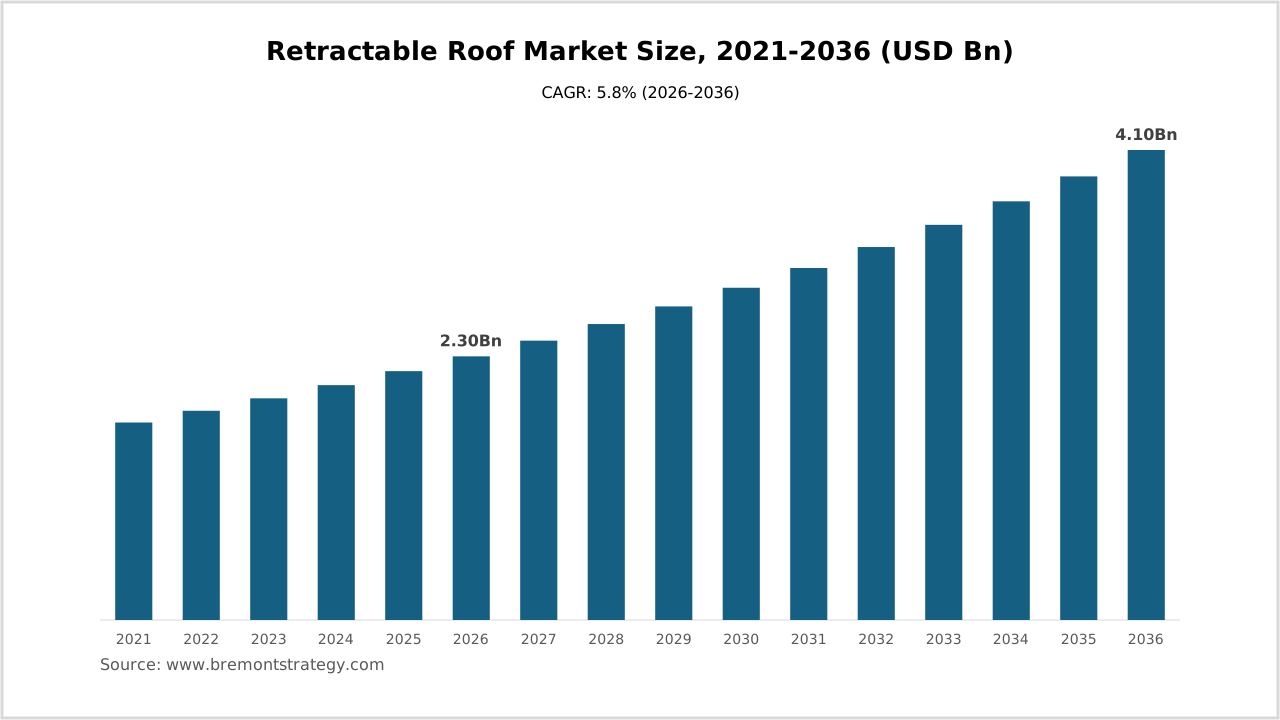
The Retractable Roof market was valued at $2.3 Billion in 2026 and is projected to reach $4.1 Billion by 2036, growing at a CAGR of 5.8% during the forecast period 2026-2036. This growth is driven by increasing demand for flexible architectural solutions that enhance the usability of spaces in various weather conditions.
Retractable roofs are innovative architectural solutions that allow for the opening and closing of a roof structure. These systems typically involve a combination of mechanical and control systems that enable the roof to retract and extend as needed. Unlike traditional fixed roofs, retractable roofs offer the advantage of adaptability, providing open-air environments when desired and protection from the elements when necessary.
The overall demand for retractable roofs is primarily driven by the growing trend towards sustainable and versatile building designs. The ability to optimize natural light and ventilation while maintaining the option for weather protection makes retractable roofs an attractive choice for both residential and commercial applications.
Technological advancements in materials and control systems are leading to more efficient and durable retractable roof solutions. R&D efforts are focused on developing smart technologies that integrate with building management systems, enhancing user convenience and energy efficiency.
Competitive dynamics in the retractable roof market are shaped by factors such as price, technical performance, distribution networks, and customer support. Companies that offer customizable solutions with superior technical features and strong after-sales service tend to have a competitive edge in this market.
Additionally, the market is witnessing a shift towards eco-friendly materials and designs, aligning with global sustainability goals. This trend is expected to further propel the adoption of retractable roofs in the coming years.
Retractable Roof Market Key Takeaways
- The Retractable Roof market is expected to grow from $2.3 Billion in 2026 to $4.1 Billion by 2036, at a CAGR of 5.8%.
- The "Commercial" application segment is anticipated to hold the largest market share, driven by the demand for flexible spaces in hospitality and retail sectors.
- North America is projected to be the leading region, accounting for over 35% of the market share, due to the high adoption rate of advanced architectural solutions.
- The increasing focus on energy-efficient building designs is a significant demand driver, encouraging the integration of retractable roofs in new constructions.
Retractable Roof Market Key Drivers
| Drivers | Impact |
|---|---|
| Technological Advancements | Enhance product efficiency and integration with smart systems. |
| Growing Urbanization | Increases demand for innovative building solutions. |
| Environmental Regulations | Boosts the adoption of sustainable building materials. |
| Rising Disposable Income | Enables greater investment in home and commercial renovations. |
Technological Advancements
Technological advancements in materials and control systems are pivotal in enhancing the efficiency and functionality of retractable roofs. The integration of smart technologies allows for automated operation and energy management, making these systems more appealing to tech-savvy consumers and businesses seeking to optimize building performance.
Growing Urbanization
As urban areas expand, the demand for innovative building solutions that maximize space and functionality increases. Retractable roofs offer a unique solution by providing flexible space usage, which is particularly valuable in densely populated urban environments where space is at a premium.
Environmental Regulations
Stringent environmental regulations are driving the construction industry towards more sustainable practices. Retractable roofs, with their potential to reduce energy consumption through natural lighting and ventilation, align well with these regulatory trends, encouraging broader adoption.
Rising Disposable Income
With rising disposable incomes, consumers and businesses are more willing to invest in architectural enhancements that offer both aesthetic and functional benefits. This trend supports the growth of the retractable roof market as more individuals and companies seek to upgrade their properties with modern, versatile solutions.
Retractable Roof Market Opportunities and Challenges
| Opportunity | Challenges |
|---|---|
| Smart Technology Integration | High Initial Costs |
| Expansion in Emerging Markets | Regulatory Compliance |
| Customization Demand | Technical Complexity |
The integration of smart technology presents a significant opportunity for the retractable roof market. As consumers increasingly demand smart home and building solutions, retractable roofs that offer automated control and integration with building management systems are gaining traction. Additionally, the expansion into emerging markets offers growth potential as urbanization and modernization efforts increase the demand for innovative architectural solutions. The growing trend towards customization also presents an opportunity, as consumers seek unique solutions tailored to their specific needs.
However, the market faces several challenges, including the high initial costs associated with retractable roof systems, which can deter potential buyers. Regulatory compliance is another hurdle, as manufacturers must navigate varying building codes and standards across different regions. The technical complexity of designing and installing retractable roofs also poses a challenge, requiring specialized expertise and increasing the risk of installation errors. Addressing these challenges will be crucial for market participants aiming to capitalize on the growth opportunities.
Retractable Roof Market Report Scope
| Attributes | Details |
|---|---|
| Report Title | Retractable Roof Market Research Report 2036 |
| By Component | Structure, Mechanism, Control System, Fabric/Cover Material, Accessories |
| By Application | Residential, Commercial, Industrial, Sports Facilities, Entertainment Venues |
| By Technology | Manual, Motorized, Smart Technology, Hybrid Systems |
| By End User | Homeowners, Architects and Designers, Construction Companies, Sports Organizations, Event Management Companies |
| By Region | North America, Europe, Asia Pacific, Latin America, Middle East & Africa |
| Countries Covered | North America (United States, Canada), Europe (Germany, France, UK, Italy, Spain, Rest of Europe), Asia Pacific (China, Japan, India, Australia, South Korea, Rest of Asia Pacific), Latin America (Brazil, Mexico, Argentina, Rest of Latin America), Middle East & Africa (UAE, Saudi Arabia, South Africa, Rest of Middle East & Africa) |
| Base Year | 2026 |
| Historic Data | 2021-2025 |
| Forecast Period | 2026-2036 |
| Number of Pages | 280 |
| Number of Tables & Figures | 350 |
| Customization Available | Yes, the report can be customized as per your need. |
Retractable Roof Market Segment Analysis
The retractable roof market is segmented by component, application, technology, end user, and region. Each segment offers unique insights into the market dynamics and growth potential, driven by specific demand factors and use cases.
By Component Analysis
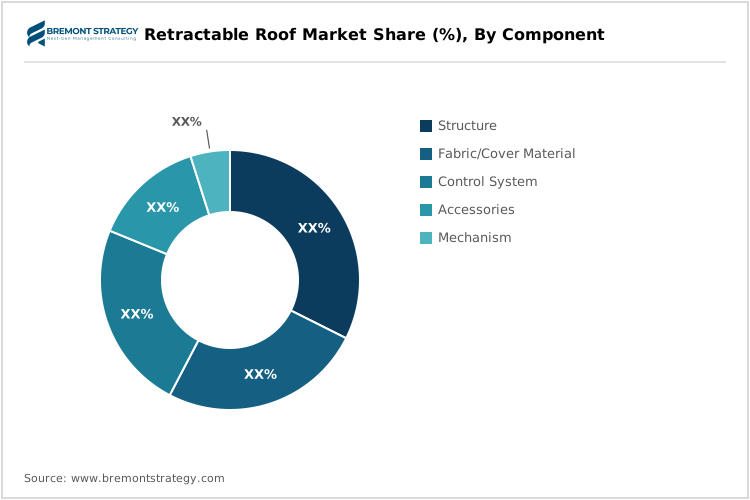
The "Structure" component is fundamental to the retractable roof system, providing the necessary support and framework for operation. This segment is expected to dominate the market due to the critical role it plays in ensuring the stability and durability of the roof system. The "Mechanism" component, which includes the moving parts, is also significant, with innovations focusing on enhancing reliability and reducing maintenance needs.
The "Control System" segment is gaining traction as smart technologies become more integrated into building management. These systems allow for automated and remote operation, increasing convenience and energy efficiency. The "Fabric/Cover Material" segment is driven by advancements in materials that offer improved weather resistance and aesthetic appeal.
"Accessories" such as lighting and sensors are becoming increasingly popular as consumers seek to enhance the functionality and comfort of their retractable roof systems. The demand for high-quality, durable components is expected to drive growth across all sub-segments.
By Application Analysis
The "Commercial" application segment is projected to hold the largest market share, driven by the need for adaptable spaces in sectors such as hospitality, retail, and corporate offices. The ability to transform spaces for different uses and events is a key factor driving demand in this segment.
The "Residential" segment is also experiencing growth as homeowners seek to enhance outdoor living spaces with flexible solutions that provide both shelter and openness. The trend towards outdoor entertainment areas is boosting demand in this segment.
"Sports Facilities" and "Entertainment Venues" are leveraging retractable roofs to offer spectators and participants a comfortable environment regardless of weather conditions, enhancing the overall experience and increasing venue utilization.
By Technology Analysis
The "Motorized" technology segment leads the market due to its convenience and ease of use, allowing users to operate the roof with minimal effort. This segment is particularly popular in commercial and high-end residential applications where user experience is paramount.
"Smart Technology" is the fastest-growing segment, driven by the integration of IoT and building management systems. These solutions offer automated operation, energy savings, and enhanced control, appealing to tech-savvy consumers and businesses.
"Manual" systems, while less prevalent, remain popular in cost-sensitive markets where simplicity and affordability are key considerations. "Hybrid Systems" that combine manual and motorized features offer a balance of cost and functionality, catering to a diverse range of needs.
By End User Analysis
"Homeowners" represent a significant portion of the market, driven by the desire to enhance property value and outdoor living spaces. The ability to customize solutions to fit specific needs and aesthetics is a key driver in this segment.
"Architects and Designers" are influential in specifying retractable roofs in new construction and renovation projects, seeking innovative solutions that enhance building functionality and appeal. Their role in shaping demand is crucial as they often set trends in building design.
"Construction Companies" are key end users, responsible for the installation and integration of retractable roofs in various projects. Their demand is driven by the increasing adoption of modern building practices that emphasize flexibility and sustainability.
By Region Analysis
North America leads the retractable roof market, driven by high adoption rates of advanced architectural solutions and a strong focus on energy-efficient building designs. The region's mature market is characterized by significant investments in commercial and residential construction.
Europe is the second-largest market, with demand driven by stringent environmental regulations and a strong emphasis on sustainable building practices. The region's focus on innovation and design excellence supports the growth of retractable roof systems.
The Asia-Pacific region is the fastest-growing market, fueled by rapid urbanization and infrastructure development. The increasing disposable income and modernization efforts in countries like China and India are key drivers of demand.
Latin America is emerging as a promising market, with growing interest in flexible and sustainable building solutions. The region's focus on tourism and hospitality is expected to drive demand for retractable roofs in commercial applications.
The Middle East & Africa region is witnessing steady growth, supported by investments in luxury real estate and sports infrastructure. The harsh climate conditions in the region make retractable roofs an attractive solution for enhancing comfort and usability.
Retractable Roof Market Regional Outlook
| Regional Outlook | |
|---|---|
| Largest Market | North America |
| Fastest Growing Market | Asia-Pacific |
| Emerging Countries | Brazil, India, UAE |
| Future Outlook | Strong growth expected in emerging markets driven by urbanization. |
North America dominates the retractable roof market, with a strong focus on innovation and energy efficiency driving demand. The region's well-established construction industry and high consumer awareness contribute to its leading position.
Europe remains a key market, with demand driven by environmental regulations and a focus on sustainable building practices. The region's emphasis on design and aesthetics supports the adoption of retractable roofs in both residential and commercial applications.
Asia-Pacific is the fastest-growing region, with rapid urbanization and infrastructure development fueling demand for modern architectural solutions. The region's growing middle class and increasing disposable income levels are key factors driving market growth.
Latin America presents significant growth potential, with increasing investments in tourism and hospitality sectors driving demand for flexible and innovative building solutions. The region's focus on enhancing the visitor experience is expected to support market expansion.
The Middle East & Africa region is experiencing steady growth, supported by investments in luxury real estate and sports infrastructure. The harsh climate conditions in the region make retractable roofs an attractive solution for enhancing comfort and usability.
Retractable Roof Market Competitor Outlook
| Competitor Outlook | |
|---|---|
| Market Leader |
|
| Key Players |
|
| Key Competitive Factors |
|
Retractable Roof Pricing Analysis
Pricing in the retractable roof market is influenced by various factors, including the complexity of the design, materials used, and the scale of the project. High-quality materials and advanced control systems can significantly increase costs, while standard designs and materials offer more affordable options. Regional variations also play a role, with labor and material costs differing across markets, impacting the overall pricing strategy.
Price sensitivity varies among different customer segments, with some prioritizing cost-effectiveness while others focus on value and performance. Commercial clients often prioritize long-term value and reliability, willing to invest in premium solutions that offer durability and advanced features. In contrast, residential customers may be more price-sensitive, seeking affordable solutions that meet their functional needs without exceeding budget constraints.
Retractable Roof Consumer Buying Behaviour / Preference Analysis
Key Purchase Criteria
| Buying Factor | Relative Importance | Reason |
|---|---|---|
| Performance | Very High | Ensures reliability and functionality |
| Durability/Reliability | High | Long-term investment value |
| Certification/Compliance | Medium-High | Meets regulatory standards |
| Total Cost | Medium | Budget constraints |
| Differentiating Capability | High | Unique features and customization |
Typical buyers in the retractable roof market include homeowners, architects, construction companies, and commercial property managers. Homeowners are often driven by the desire to enhance their outdoor living spaces, while architects and designers focus on innovative solutions that add value to their projects. Construction companies prioritize ease of installation and integration with existing structures.
Purchase decisions are heavily influenced by factors such as performance, durability, and compliance with regulatory standards. Buyers seek solutions that offer reliability and long-term value, with a growing emphasis on customization and unique features that differentiate products in a competitive market. Price remains an important consideration, but the overall value proposition and ability to meet specific needs are key drivers of purchasing behavior.
TABLE OF CONTENTS
1. Research Methodology
2. Market Structure
3. Executive Summary
4. Retractable Roof Market Overview
- 4.1 Introduction
- Market Snapshot
- Assumptions, Inclusion & Exclusions
- Technological Advancements & Patent Analysis
- Case Studies
- Market Entry & Launch Strategies
- Macro-Economic Factors Impacting the Market Growth
- 4.2 Retractable Roof Market Dynamics
- Market Drivers
- Market Restraints
- Market Opportunity
- 4.3 Retractable Roof Market - Supply Chain Analysis
- Key Raw Material/Components Provider
- Key Manufacturers
- Key Distributors
- Key Consumers
- 4.4 Key Forces Shaping the Retractable Roof Market
- Bargaining Power of Suppliers
- Bargaining Power of Buyers
- Threat of Substitution
- Threat of New Entrants
- Competitive Rivalry
- 4.1 Introduction
5. Global Retractable Roof Market, By Component
- 5.1 Market Size, Value (USD Mn) & Volume (Units)
- Structure
- Mechanism
- Control System
- Fabric/Cover Material
- Accessories
- 5.2 Key Market Trends & Growth Opportunities
- 5.3 Market Share (%) Analysis, 2021-2036
- 5.4 Year-on-Year (YoY) Growth Rate
- 5.5 Market Attractiveness
- 5.6 Global Investment & Trade Risks
- 5.7 Pricing Analysis, 2021-2036
- 5.8 Operating Margin/Profits, 2021-2036
- 5.1 Market Size, Value (USD Mn) & Volume (Units)
6. Global Retractable Roof Market, By Application
- 6.1 Market Size, Value (USD Mn) & Volume (Units)
- Residential
- Commercial
- Industrial
- Sports Facilities
- Entertainment Venues
- 6.2 Key Market Trends & Growth Opportunities
- 6.3 Market Share (%) Analysis, 2021-2036
- 6.4 Year-on-Year (YoY) Growth Rate
- 6.5 Market Attractiveness
- 6.6 Global Investment & Trade Risks
- 6.7 Pricing Analysis, 2021-2036
- 6.8 Operating Margin/Profits, 2021-2036
- 6.1 Market Size, Value (USD Mn) & Volume (Units)
7. Global Retractable Roof Market, By Technology
- 7.1 Market Size, Value (USD Mn) & Volume (Units)
- Manual
- Motorized
- Smart Technology
- Hybrid Systems
- 7.2 Key Market Trends & Growth Opportunities
- 7.3 Market Share (%) Analysis, 2021-2036
- 7.4 Year-on-Year (YoY) Growth Rate
- 7.5 Market Attractiveness
- 7.6 Global Investment & Trade Risks
- 7.7 Pricing Analysis, 2021-2036
- 7.8 Operating Margin/Profits, 2021-2036
- 7.1 Market Size, Value (USD Mn) & Volume (Units)
8. Global Retractable Roof Market, By End User
- 8.1 Market Size, Value (USD Mn) & Volume (Units)
- Homeowners
- Architects and Designers
- Construction Companies
- Sports Organizations
- Event Management Companies
- 8.2 Key Market Trends & Growth Opportunities
- 8.3 Market Share (%) Analysis, 2021-2036
- 8.4 Year-on-Year (YoY) Growth Rate
- 8.5 Market Attractiveness
- 8.6 Global Investment & Trade Risks
- 8.7 Pricing Analysis, 2021-2036
- 8.8 Operating Margin/Profits, 2021-2036
- 8.1 Market Size, Value (USD Mn) & Volume (Units)
9. Global Retractable Roof Market, By Region
- 9.1 Market Size, Value (USD Mn) & Volume (Units)
- North America
- Europe
- Asia Pacific
- Latin America
- Middle East & Africa
- 9.2 Key Market Trends & Growth Opportunities
- 9.3 Market Share (%) Analysis, 2021-2036
- 9.4 Year-on-Year (YoY) Growth Rate
- 9.5 Market Attractiveness
- 9.6 Global Investment & Trade Risks
- 9.7 Pricing Analysis, 2021-2036
- 9.8 Operating Margin/Profits, 2021-2036
- 9.1 Market Size, Value (USD Mn) & Volume (Units)
10. Global Retractable Roof Market, By North America
- 10.1 Market Size, Value (USD Mn) & Volume (Units)
- US
- Canada
- 10.2 Key Market Trends & Growth Opportunities
- 10.3 Market Share (%) Analysis, 2021-2036
- 10.4 Year-on-Year (YoY) Growth Rate
- 10.5 Market Attractiveness
- 10.6 Global Investment & Trade Risks
- 10.7 Pricing Analysis, 2021-2036
- 10.8 Operating Margin/Profits, 2021-2036
- 10.1 Market Size, Value (USD Mn) & Volume (Units)
11. Global Retractable Roof Market, By Europe
- 11.1 Market Size, Value (USD Mn) & Volume (Units)
- Germany
- France
- UK
- Spain
- Italy
- Switzerland
- Russia
- Poland
- Rest of Europe
- 11.2 Key Market Trends & Growth Opportunities
- 11.3 Market Share (%) Analysis, 2021-2036
- 11.4 Year-on-Year (YoY) Growth Rate
- 11.5 Market Attractiveness
- 11.6 Global Investment & Trade Risks
- 11.7 Pricing Analysis, 2021-2036
- 11.8 Operating Margin/Profits, 2021-2036
- 11.1 Market Size, Value (USD Mn) & Volume (Units)
12. Global Retractable Roof Market, By Asia Pacific
- 12.1 Market Size, Value (USD Mn) & Volume (Units)
- China
- Japan
- South Korea
- India
- Australia
- South East Asia
- Rest of APAC
- 12.2 Key Market Trends & Growth Opportunities
- 12.3 Market Share (%) Analysis, 2021-2036
- 12.4 Year-on-Year (YoY) Growth Rate
- 12.5 Market Attractiveness
- 12.6 Global Investment & Trade Risks
- 12.7 Pricing Analysis, 2021-2036
- 12.8 Operating Margin/Profits, 2021-2036
- 12.1 Market Size, Value (USD Mn) & Volume (Units)
13. Global Retractable Roof Market, By Latin America
- 13.1 Market Size, Value (USD Mn) & Volume (Units)
- Brazil
- Mexico
- Argentina
- Rest of LATAM
- 13.2 Key Market Trends & Growth Opportunities
- 13.3 Market Share (%) Analysis, 2021-2036
- 13.4 Year-on-Year (YoY) Growth Rate
- 13.5 Market Attractiveness
- 13.6 Global Investment & Trade Risks
- 13.7 Pricing Analysis, 2021-2036
- 13.8 Operating Margin/Profits, 2021-2036
- 13.1 Market Size, Value (USD Mn) & Volume (Units)
14. Global Retractable Roof Market, By Middle East & Africa
- 14.1 Market Size, Value (USD Mn) & Volume (Units)
- Saudi Arabia
- UAE
- South Africa
- Rest of MEA
- 14.2 Key Market Trends & Growth Opportunities
- 14.3 Market Share (%) Analysis, 2021-2036
- 14.4 Year-on-Year (YoY) Growth Rate
- 14.5 Market Attractiveness
- 14.6 Global Investment & Trade Risks
- 14.7 Pricing Analysis, 2021-2036
- 14.8 Operating Margin/Profits, 2021-2036
- 14.1 Market Size, Value (USD Mn) & Volume (Units)
15. Competitive Analysis
- 15.1 Competition Landscape, Key Players
- Global Market Share (%) Analysis of Key Players in Retractable Roof, in Value (USD Mn) & Volume (Units)
- Company Overview
- Company Financials
- News & Developments
- Strategic Initiatives
- 15.2 Company Profiles
- Uni-Systems, LLC
- OpenAire Inc.
- Libart Enclosure Systems
- Cabrio Structures
- Skyroof Industries
- Roder HTS Hocker GmbH
- Alumicor Limited
- SE Controls
- Covermaster Inc.
- ShadeFX Canopies
- Louvretec Group
- Roll-A-Cover International
- Palmiye Global
- Sunshield Retractable Enclosures
- Bespoke Pergolas
- Mitjavila
- Markilux GmbH + Co. KG
- KE Protezioni Solari S.r.l.
- Corradi S.r.l.
- Stobag AG
- 15.1 Competition Landscape, Key Players
METHODOLOGY
To provide you with a comprehensive understanding of how we quantify your market opportunity, we utilize a multi-phased methodology designed to minimize risk and maximize strategic clarity. We begin the process by establishing a clear conceptual framework, often referred to as the TAM-SAM-SOM model. By starting with the Total Addressable Market, we look at the absolute global demand for your category. We then refine this into the Serviceable Addressable Market to account for your specific geographic and technological reach, and finally, we pinpoint the Serviceable Obtainable Market. This ensures that the final figures we present are not just theoretical "vanity metrics," but represent a realistic, capture-able revenue target for your business.
Our data collection process relies on a rigorous principle called triangulation, where we cross-reference multiple independent data streams to ensure accuracy. We initiate this with deep-dive secondary research, synthesizing high-value intelligence from audited financial filings, government trade databases, and specialized industry journals. This "desk research" phase provides a macro-economic baseline and identifies historical growth trajectories. However, because secondary data can sometimes lag behind real-time shifts, we supplement this with targeted primary research. This involves direct engagement with Key Opinion Leaders (KOLs) and structured quantitative surveys to capture the current pulse of the market and emerging buyer intent.
To ensure the integrity of our estimates, we employ a dual-modeling approach, calculating the market size from both the "Top-Down" and "Bottom-Up." The Top-Down analysis provides a valuable sanity check against broader economic trends, but we place the most weight on our Bottom-Up modeling. By taking granular data, such as the average transaction value and the actual number of potential customer touchpoints, and scaling them upward, we build a highly defensible model grounded in operational reality. This dual-verification method allows us to identify any discrepancies early, ensuring that the resulting data is robust enough to withstand the scrutiny of stakeholders or investors.
Finally, we recognize that a static market size figure is only a snapshot in time. To provide you with a roadmap for the future, we integrate trend analysis and Compound Annual Growth Rate (CAGR) forecasting into our final reporting. We analyze the underlying drivers, such as regulatory shifts, technological disruptions, or changing consumer behaviors, to predict how the market will evolve over the next three to five years. This ongoing tracking mechanism transforms a simple number into a dynamic strategic tool, allowing you to monitor your market share in real-time and pivot your resources as new opportunities emerge.
Frequently Asked Questions
What is the current size of the Retractable Roof market?
The base year for the Retractable Roof market is 2026, with a market size of $2.3 billion.
What is the projected market size by 2036?
By 2036, the Retractable Roof market is projected to reach a size of $4.1 billion.
What is the market's CAGR during the forecast period?
The Retractable Roof market is expected to grow at a compound annual growth rate (CAGR) of 5.8% from 2026 to 2036.
Which region is the fastest-growing in this market?
The Asia-Pacific region is anticipated to be the fastest-growing market for retractable roofs, driven by increasing construction activities and urbanization.
Which segment holds the largest share in the Retractable Roof market?
The residential segment holds the largest share in the Retractable Roof market, owing to the rising demand for enhanced home aesthetics and functionality.
Who are the key players in this market?
Key players in the Retractable Roof market include companies such as Uni-Systems, Inc., Libart Enclosure Systems, and OpenAire Inc.
What are the key growth drivers for the Retractable Roof market?
Key growth drivers include the increasing adoption of retractable roofs in sports stadiums and commercial spaces for enhanced versatility and comfort.
Is the report customizable?
Yes, the report can be customized to meet specific requirements and provide more detailed insights as needed.