RF Interconnectors And Waveguide
RF Interconnectors And Waveguide Market Research Report 2036
RF Interconnectors And Waveguide Market Segments - by Component (Connectors, Adapters, Cables, Waveguides, Attenuators, Couplers), Deployment (Fixed, Portable, Rack-mounted, Embedded, Modular), Application (Telecommunications, Aerospace and Defense, Automotive, Medical, Industrial, Consumer Electronics), Industry (Telecom and IT, Aerospace, Defense, Healthcare, Automotive, Manufacturing), and Region (North America, Europe, Asia Pacific, Latin America, Middle East & Africa)
RF Interconnectors And Waveguide Market Outlook
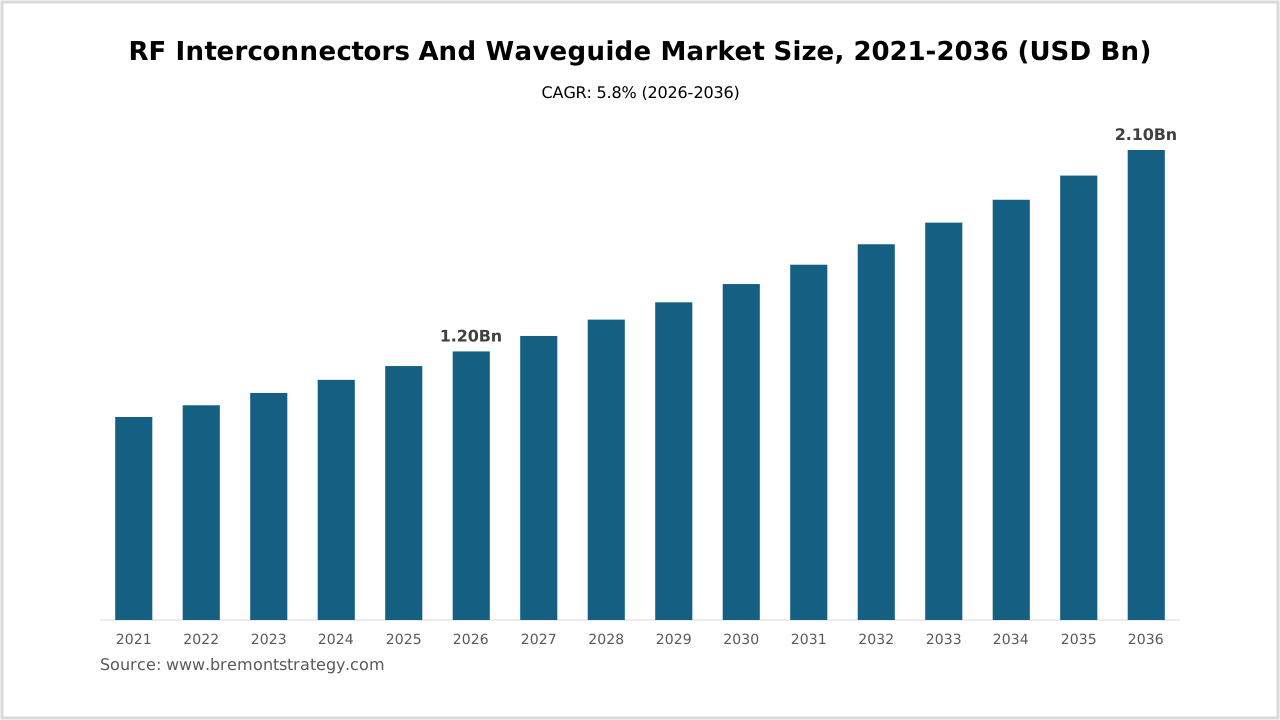
The RF Interconnectors And Waveguide market was valued at $1.2 Billion in 2026 and is projected to reach $2.1 Billion by 2036, growing at a CAGR of 5.8% during the forecast period 2026-2036. This growth is driven by increasing demand in telecommunications and aerospace sectors, where high-frequency data transmission is critical.
RF interconnectors and waveguides are essential components in RF systems, facilitating the transmission of radio frequency signals between devices. These components are distinct due to their ability to handle high-frequency signals with minimal loss, making them superior to conventional wired connections in specific applications.
Overall demand is driven by the expansion of 5G networks, increasing satellite communication needs, and the rise of IoT devices. These industry-level forces necessitate efficient and reliable RF signal transmission, which RF interconnectors and waveguides provide.
Technological advancements focus on miniaturization and enhancing frequency range capabilities. R&D efforts are directed towards developing components that can support higher data rates and more complex modulation schemes.
Competitive dynamics in this market revolve around price, technical performance, and support services. Vendors compete by offering high-performance products with robust technical support and extensive distribution networks, which are crucial for adoption.
RF Interconnectors And Waveguide Market Key Takeaways
- The RF Interconnectors And Waveguide market is expected to grow from $1.2 Billion in 2026 to $2.1 Billion by 2036, with a CAGR of 5.8%.
- The Connectors segment is projected to hold the largest market share, driven by its critical role in ensuring signal integrity.
- North America is anticipated to be the largest market, accounting for over 35% of the global share, due to its advanced telecommunications infrastructure.
- The rise of 5G technology is a significant demand driver, necessitating advanced RF interconnect solutions.
RF Interconnectors And Waveguide Market Key Drivers
| Drivers | Impact |
|---|---|
| 5G Deployment | Accelerates the need for high-performance RF components. |
| IoT Expansion | Increases demand for reliable RF connectivity solutions. |
| Satellite Communication | Drives the need for advanced waveguide technologies. |
| Aerospace Innovations | Requires robust RF systems for new aircraft designs. |
| Automotive Connectivity | Boosts demand for RF interconnectors in smart vehicles. |
5G Deployment
The rollout of 5G networks globally is a major driver for the RF interconnectors and waveguide market. As 5G requires higher frequency bands and greater data throughput, the need for efficient RF components that can handle these demands is critical. This deployment accelerates the adoption of advanced RF technologies.
IoT Expansion
The proliferation of IoT devices necessitates reliable RF connectivity solutions to ensure seamless communication between devices. As IoT applications grow, so does the demand for RF interconnectors that can support diverse and complex network environments.
Satellite Communication
With the increasing number of satellite launches for communication and earth observation, the demand for advanced waveguide technologies is rising. These components are crucial for maintaining signal integrity in satellite communication systems.
Aerospace Innovations
Innovations in the aerospace sector, such as the development of new aircraft and unmanned aerial vehicles, require robust RF systems. This drives the demand for high-performance RF interconnectors and waveguides capable of operating in extreme conditions.
Automotive Connectivity
The automotive industry's shift towards connected and autonomous vehicles boosts the demand for RF interconnectors. These components are essential for enabling vehicle-to-vehicle and vehicle-to-infrastructure communication, enhancing safety and efficiency.
RF Interconnectors And Waveguide Market Opportunities and Challenges
| Opportunity | Challenges |
|---|---|
| 5G Network Expansion | High R&D Costs |
| Emerging Markets | Regulatory Compliance |
| Technological Advancements | Supply Chain Disruptions |
The expansion of 5G networks presents significant opportunities for the RF interconnectors and waveguide market. As countries continue to invest in 5G infrastructure, the demand for high-performance RF components is expected to rise. Additionally, emerging markets offer growth potential as they modernize their telecommunications infrastructure. Technological advancements in RF components, such as miniaturization and enhanced frequency capabilities, also provide opportunities for innovation and market differentiation.
However, the market faces several challenges, including high R&D costs associated with developing advanced RF technologies. Regulatory compliance across different regions can also pose barriers to market entry. Furthermore, supply chain disruptions, exacerbated by global events, can impact the availability and cost of raw materials, affecting production timelines and pricing strategies.
RF Interconnectors And Waveguide Market Report Scope
| Attributes | Details |
|---|---|
| Report Title | RF Interconnectors And Waveguide Market Research Report 2036 |
| By component | Connectors, Adapters, Cables, Waveguides, Attenuators, Couplers |
| By deployment | Fixed, Portable, Rack-mounted, Embedded, Modular |
| By application | Telecommunications, Aerospace and Defense, Automotive, Medical, Industrial, Consumer Electronics |
| By industry | Telecom and IT, Aerospace, Defense, Healthcare, Automotive, Manufacturing |
| By region | North America, Europe, Asia Pacific, Latin America, Middle East & Africa |
| Countries Covered | North America (United States, Canada), Europe (Germany, France, UK, Italy, Spain, Rest of Europe), Asia Pacific (China, Japan, India, South Korea, Australia, Rest of Asia Pacific), Latin America (Brazil, Mexico, Rest of Latin America), Middle East & Africa (UAE, Saudi Arabia, South Africa, Rest of Middle East & Africa) |
| Base Year | 2026 |
| Historic Data | 2021-2025 |
| Forecast Period | 2026-2036 |
| Number of Pages | 280 |
| Number of Tables & Figures | 350 |
| Customization Available | Yes, the report can be customized as per your need. |
RF Interconnectors And Waveguide Market Segment Analysis
The RF Interconnectors And Waveguide market is segmented into various categories, including component, deployment, application, industry, and region. Each segment offers unique insights into market dynamics and growth opportunities.
By component Analysis
| Segment | Market Share | Growth Rate | Key Insight |
|---|---|---|---|
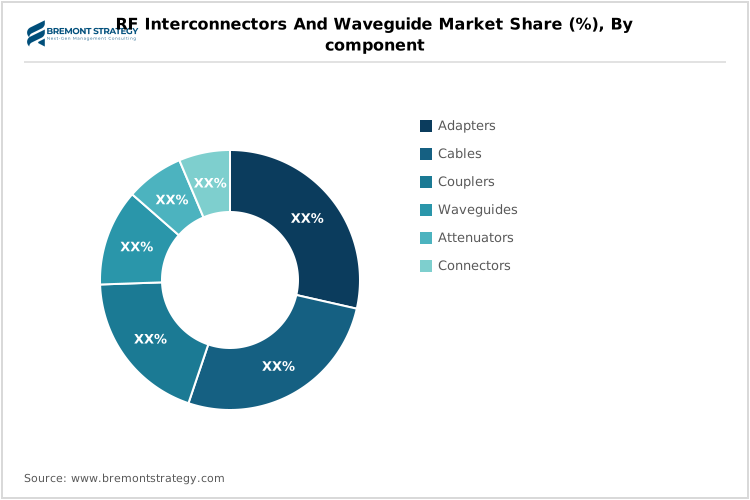
| Connectors | 30% | 6.0% | Essential for signal integrity |
| Adapters | 15% | 5.5% | Facilitates compatibility |
| Cables | 20% | 5.8% | Critical for data transmission |
| Waveguides | 18% | 6.2% | High-frequency applications |
| Attenuators | 10% | 5.0% | Manages signal strength |
| Couplers | 7% | 5.3% | Splits signal paths |
Connectors lead the component segment with a 30% market share, driven by their critical role in maintaining signal integrity across various applications. The demand for connectors is particularly high in telecommunications and aerospace sectors, where reliable signal transmission is paramount. Waveguides, with an 18% market share, are also significant due to their use in high-frequency applications, such as radar and satellite communications.
Adapters and cables are essential for ensuring compatibility and facilitating data transmission, respectively. Their demand is bolstered by the growing complexity of RF systems and the need for flexible connectivity solutions. Attenuators and couplers, while smaller in market share, play crucial roles in managing signal strength and splitting signal paths, respectively.
By deployment Analysis
| Segment | Market Share | Growth Rate | Key Insight |
|---|---|---|---|
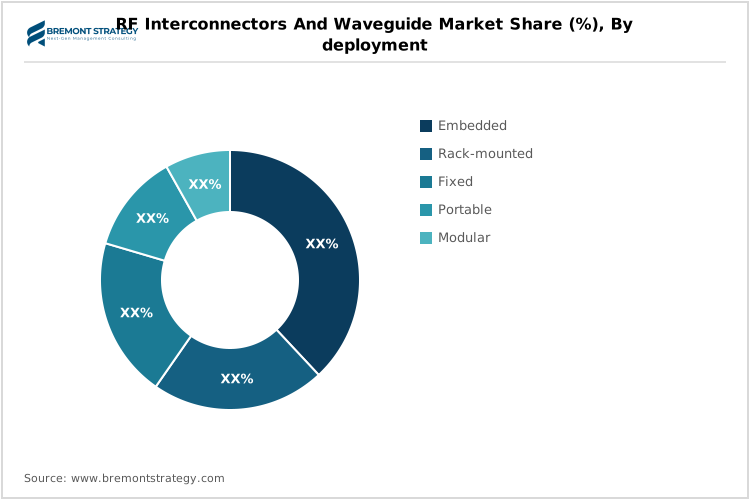
| Fixed | 25% | 5.5% | Stable infrastructure needs |
| Portable | 20% | 6.0% | Growing mobile applications |
| Rack-mounted | 18% | 5.7% | Data center expansion |
| Embedded | 22% | 6.2% | Integration in devices |
| Modular | 15% | 5.3% | Flexible configurations |
The embedded deployment segment is gaining traction, accounting for 22% of the market share due to its integration into various devices and systems. The demand for embedded solutions is driven by the increasing need for compact and efficient RF systems in consumer electronics and automotive applications. Portable deployments are also on the rise, supported by the proliferation of mobile applications and the need for flexible, on-the-go connectivity solutions.
Fixed and rack-mounted deployments remain significant, particularly in telecommunications and data center environments where stable infrastructure is essential. Modular solutions, while smaller in share, offer flexibility and customization, appealing to industries with diverse and evolving RF requirements.
By application Analysis
| Segment | Market Share | Growth Rate | Key Insight |
|---|---|---|---|
| Telecommunications | 35% | 6.5% | 5G network expansion |
| Aerospace and Defense | 25% | 5.8% | Advanced communication systems |
| Automotive | 15% | 6.0% | Connected vehicle growth |
| Medical | 10% | 5.5% | Telemedicine advancements |
| Industrial | 8% | 5.0% | Automation and control |
| Consumer Electronics | 7% | 5.3% | Smart devices proliferation |
Telecommunications dominate the application segment with a 35% market share, fueled by the expansion of 5G networks and the need for high-performance RF solutions. The aerospace and defense sector follows, driven by the demand for advanced communication systems in military and space applications. The automotive sector is also experiencing growth, supported by the rise of connected and autonomous vehicles requiring robust RF connectivity.
The medical application segment benefits from telemedicine advancements, where reliable RF communication is crucial for remote diagnostics and patient monitoring. Industrial applications, while smaller in share, are essential for automation and control systems that rely on RF technologies for efficient operation. Consumer electronics, though the smallest segment, continues to grow with the proliferation of smart devices.
By industry Analysis
| Segment | Market Share | Growth Rate | Key Insight |
|---|---|---|---|
| Telecom and IT | 40% | 6.5% | Infrastructure investments |
| Aerospace | 20% | 5.8% | Innovative aircraft designs |
| Defense | 15% | 6.0% | Military communication needs |
| Healthcare | 10% | 5.5% | Remote monitoring systems |
| Automotive | 8% | 6.2% | Vehicle-to-everything (V2X) |
| Manufacturing | 7% | 5.0% | Industrial IoT applications |
The Telecom and IT industry leads with a 40% market share, driven by significant infrastructure investments to support 5G and other advanced communication technologies. The aerospace industry follows, with demand for RF components in innovative aircraft designs and space exploration missions. The defense sector is also a key player, requiring robust RF systems for secure military communications.
Healthcare applications are expanding, particularly in remote monitoring systems that rely on RF technologies for efficient data transmission. The automotive industry is seeing growth in vehicle-to-everything (V2X) communication, enhancing safety and connectivity in smart vehicles. Manufacturing, though smaller in share, benefits from industrial IoT applications that require reliable RF solutions for automation and control.
By region Analysis
| Segment | Market Share | Growth Rate | Key Insight |
|---|---|---|---|
| North America | 35% | 5.5% | Advanced telecom infrastructure |
| Europe | 25% | 5.8% | Strong aerospace sector |
| Asia Pacific | 20% | 6.2% | Rapid industrialization |
| Latin America | 10% | 5.0% | Emerging telecom markets |
| Middle East & Africa | 10% | 5.3% | Infrastructure development |
North America leads the regional segment with a 35% market share, attributed to its advanced telecommunications infrastructure and early adoption of 5G technologies. The region's strong aerospace and defense sectors further drive demand for RF interconnectors and waveguides. Europe follows, with a robust aerospace industry and increasing investments in telecommunications infrastructure.
Asia Pacific is experiencing rapid growth, driven by industrialization and significant investments in telecommunications and automotive sectors. The region's demand for RF components is fueled by the expansion of 5G networks and the rise of smart manufacturing and IoT applications. Latin America, while smaller in share, presents opportunities in emerging telecom markets and infrastructure development.
RF Interconnectors And Waveguide Market Regional Outlook
| Regional Outlook | |
|---|---|
| Largest Market | North America |
| Fastest Growing Market | Asia Pacific |
| Emerging Countries | India, Brazil, South Africa |
| Future Outlook | Continued growth driven by 5G and IoT expansion. |
North America remains the largest market for RF interconnectors and waveguides, driven by its advanced telecommunications infrastructure and strong demand from aerospace and defense sectors. The region benefits from early adoption of 5G technologies and ongoing investments in high-performance RF systems.
Europe holds a significant share, supported by its robust aerospace industry and increasing investments in telecommunications infrastructure. The region's focus on innovation and technology development further drives demand for advanced RF components.
Asia Pacific is the fastest-growing market, fueled by rapid industrialization and significant investments in telecommunications and automotive sectors. The region's demand for RF components is driven by the expansion of 5G networks and the rise of smart manufacturing and IoT applications.
Latin America presents opportunities in emerging telecom markets and infrastructure development. The region's growth is supported by increasing investments in telecommunications and the modernization of industrial sectors.
The Middle East & Africa region is experiencing growth due to infrastructure development and increasing demand for advanced communication systems. The region's focus on modernization and technological advancement drives demand for RF interconnectors and waveguides.
RF Interconnectors And Waveguide Market Competitor Outlook
| Competitor Outlook | |
|---|---|
| Market Leader |
|
| Key Players |
|
| Key Competitive Factors |
|
RF Interconnectors And Waveguide Pricing Analysis
Pricing in the RF interconnectors and waveguide market is influenced by several factors, including formulation and specification, production scale, and regional variations. High-performance components with advanced specifications tend to command premium prices due to their superior capabilities and reliability. Additionally, economies of scale in production can lead to cost efficiencies, affecting pricing strategies. Regional variations in raw material costs and labor can also impact pricing, with markets in North America and Europe typically seeing higher prices than those in Asia Pacific.
Price sensitivity varies across different applications and industries, with some sectors prioritizing performance and reliability over cost. For instance, aerospace and defense industries often focus on value-driven buying behavior, where the emphasis is on obtaining components that meet stringent performance and safety standards. In contrast, consumer electronics may exhibit higher price sensitivity, with buyers seeking cost-effective solutions that balance performance and affordability.
RF Interconnectors And Waveguide Consumer Buying Behaviour / Preference Analysis
Key Purchase Criteria
| Buying Factor | Relative Importance | Reason |
|---|---|---|
| Performance | Very High | Ensures signal integrity |
| Durability/Reliability | High | Long-term usage |
| Certification/Compliance | Medium-High | Regulatory requirements |
| Total Cost | Medium | Budget constraints |
| Differentiating Capability | High | Competitive advantage |
Typical buyers in the RF interconnectors and waveguide market include procurement managers, RF engineers, and technical directors in industries such as telecommunications, aerospace, and defense. These professionals prioritize performance and reliability, ensuring that the components they select can maintain signal integrity and withstand demanding operational environments. Certification and compliance with industry standards are also critical, particularly in regulated sectors like aerospace and healthcare.
Purchase decisions are heavily influenced by the need for components that offer differentiating capabilities, providing a competitive advantage in terms of performance and innovation. While total cost is a consideration, especially in budget-constrained projects, the emphasis is often on obtaining high-quality, reliable solutions that meet specific technical requirements and deliver long-term value.
TABLE OF CONTENTS
1. Research Methodology
2. Market Structure
3. Executive Summary
4. RF Interconnectors And Waveguide Market Overview
- 4.1 Introduction
- Market Snapshot
- Assumptions, Inclusion & Exclusions
- Technological Advancements & Patent Analysis
- Case Studies
- Market Entry & Launch Strategies
- Macro-Economic Factors Impacting the Market Growth
- 4.2 RF Interconnectors And Waveguide Market Dynamics
- Market Drivers
- Market Restraints
- Market Opportunity
- 4.3 RF Interconnectors And Waveguide Market - Supply Chain Analysis
- Key Raw Material/Components Provider
- Key Manufacturers
- Key Distributors
- Key Consumers
- 4.4 Key Forces Shaping the RF Interconnectors And Waveguide Market
- Bargaining Power of Suppliers
- Bargaining Power of Buyers
- Threat of Substitution
- Threat of New Entrants
- Competitive Rivalry
- 4.1 Introduction
5. Global RF Interconnectors And Waveguide Market, By Component
- 5.1 Market Size, Value (USD Mn) & Volume (Units)
- Connectors
- Adapters
- Cables
- Waveguides
- Attenuators
- Couplers
- 5.2 Key Market Trends & Growth Opportunities
- 5.3 Market Share (%) Analysis, 2021-2036
- 5.4 Year-on-Year (YoY) Growth Rate
- 5.5 Market Attractiveness
- 5.6 Global Investment & Trade Risks
- 5.7 Pricing Analysis, 2021-2036
- 5.8 Operating Margin/Profits, 2021-2036
- 5.1 Market Size, Value (USD Mn) & Volume (Units)
6. Global RF Interconnectors And Waveguide Market, By Deployment Mode
- 6.1 Market Size, Value (USD Mn) & Volume (Units)
- Fixed
- Portable
- Rack-mounted
- Embedded
- Modular
- 6.2 Key Market Trends & Growth Opportunities
- 6.3 Market Share (%) Analysis, 2021-2036
- 6.4 Year-on-Year (YoY) Growth Rate
- 6.5 Market Attractiveness
- 6.6 Global Investment & Trade Risks
- 6.7 Pricing Analysis, 2021-2036
- 6.8 Operating Margin/Profits, 2021-2036
- 6.1 Market Size, Value (USD Mn) & Volume (Units)
7. Global RF Interconnectors And Waveguide Market, By Application
- 7.1 Market Size, Value (USD Mn) & Volume (Units)
- Telecommunications
- Aerospace and Defense
- Automotive
- Medical
- Industrial
- Consumer Electronics
- 7.2 Key Market Trends & Growth Opportunities
- 7.3 Market Share (%) Analysis, 2021-2036
- 7.4 Year-on-Year (YoY) Growth Rate
- 7.5 Market Attractiveness
- 7.6 Global Investment & Trade Risks
- 7.7 Pricing Analysis, 2021-2036
- 7.8 Operating Margin/Profits, 2021-2036
- 7.1 Market Size, Value (USD Mn) & Volume (Units)
8. Global RF Interconnectors And Waveguide Market, By Industry Vertical
- 8.1 Market Size, Value (USD Mn) & Volume (Units)
- Telecom and IT
- Aerospace
- Defense
- Healthcare
- Automotive
- Manufacturing
- 8.2 Key Market Trends & Growth Opportunities
- 8.3 Market Share (%) Analysis, 2021-2036
- 8.4 Year-on-Year (YoY) Growth Rate
- 8.5 Market Attractiveness
- 8.6 Global Investment & Trade Risks
- 8.7 Pricing Analysis, 2021-2036
- 8.8 Operating Margin/Profits, 2021-2036
- 8.1 Market Size, Value (USD Mn) & Volume (Units)
9. Global RF Interconnectors And Waveguide Market, By Region
- 9.1 Market Size, Value (USD Mn) & Volume (Units)
- North America
- Europe
- Asia Pacific
- Latin America
- Middle East & Africa
- 9.2 Key Market Trends & Growth Opportunities
- 9.3 Market Share (%) Analysis, 2021-2036
- 9.4 Year-on-Year (YoY) Growth Rate
- 9.5 Market Attractiveness
- 9.6 Global Investment & Trade Risks
- 9.7 Pricing Analysis, 2021-2036
- 9.8 Operating Margin/Profits, 2021-2036
- 9.1 Market Size, Value (USD Mn) & Volume (Units)
10. Global RF Interconnectors And Waveguide Market, By North America
- 10.1 Market Size, Value (USD Mn) & Volume (Units)
- US
- Canada
- 10.2 Key Market Trends & Growth Opportunities
- 10.3 Market Share (%) Analysis, 2021-2036
- 10.4 Year-on-Year (YoY) Growth Rate
- 10.5 Market Attractiveness
- 10.6 Global Investment & Trade Risks
- 10.7 Pricing Analysis, 2021-2036
- 10.8 Operating Margin/Profits, 2021-2036
- 10.1 Market Size, Value (USD Mn) & Volume (Units)
11. Global RF Interconnectors And Waveguide Market, By Europe
- 11.1 Market Size, Value (USD Mn) & Volume (Units)
- Germany
- France
- UK
- Spain
- Italy
- Switzerland
- Russia
- Poland
- Rest of Europe
- 11.2 Key Market Trends & Growth Opportunities
- 11.3 Market Share (%) Analysis, 2021-2036
- 11.4 Year-on-Year (YoY) Growth Rate
- 11.5 Market Attractiveness
- 11.6 Global Investment & Trade Risks
- 11.7 Pricing Analysis, 2021-2036
- 11.8 Operating Margin/Profits, 2021-2036
- 11.1 Market Size, Value (USD Mn) & Volume (Units)
12. Global RF Interconnectors And Waveguide Market, By Asia Pacific
- 12.1 Market Size, Value (USD Mn) & Volume (Units)
- China
- Japan
- South Korea
- India
- Australia
- South East Asia
- Rest of APAC
- 12.2 Key Market Trends & Growth Opportunities
- 12.3 Market Share (%) Analysis, 2021-2036
- 12.4 Year-on-Year (YoY) Growth Rate
- 12.5 Market Attractiveness
- 12.6 Global Investment & Trade Risks
- 12.7 Pricing Analysis, 2021-2036
- 12.8 Operating Margin/Profits, 2021-2036
- 12.1 Market Size, Value (USD Mn) & Volume (Units)
13. Global RF Interconnectors And Waveguide Market, By Latin America
- 13.1 Market Size, Value (USD Mn) & Volume (Units)
- Brazil
- Mexico
- Argentina
- Rest of LATAM
- 13.2 Key Market Trends & Growth Opportunities
- 13.3 Market Share (%) Analysis, 2021-2036
- 13.4 Year-on-Year (YoY) Growth Rate
- 13.5 Market Attractiveness
- 13.6 Global Investment & Trade Risks
- 13.7 Pricing Analysis, 2021-2036
- 13.8 Operating Margin/Profits, 2021-2036
- 13.1 Market Size, Value (USD Mn) & Volume (Units)
14. Global RF Interconnectors And Waveguide Market, By Middle East & Africa
- 14.1 Market Size, Value (USD Mn) & Volume (Units)
- Saudi Arabia
- UAE
- South Africa
- Rest of MEA
- 14.2 Key Market Trends & Growth Opportunities
- 14.3 Market Share (%) Analysis, 2021-2036
- 14.4 Year-on-Year (YoY) Growth Rate
- 14.5 Market Attractiveness
- 14.6 Global Investment & Trade Risks
- 14.7 Pricing Analysis, 2021-2036
- 14.8 Operating Margin/Profits, 2021-2036
- 14.1 Market Size, Value (USD Mn) & Volume (Units)
15. Competitive Analysis
- 15.1 Competition Landscape, Key Players
- Global Market Share (%) Analysis of Key Players in RF Interconnectors And Waveguide, in Value (USD Mn) & Volume (Units)
- Company Overview
- Company Financials
- News & Developments
- Strategic Initiatives
- 15.2 Company Profiles
- Amphenol Corporation
- TE Connectivity Ltd.
- HUBER+SUHNER AG
- Rosenberger Hochfrequenztechnik GmbH & Co. KG
- Pasternack Enterprises, Inc.
- Maury Microwave Corporation
- MegaPhase LLC
- Radiall SA
- Molex LLC
- Corning Incorporated
- Carlisle Interconnect Technologies
- Anritsu Corporation
- Junkosha Inc.
- W. L. Gore & Associates, Inc.
- Times Microwave Systems
- Smiths Interconnect
- API Technologies Corp.
- L3Harris Technologies, Inc.
- Cobham Limited
- Rohde & Schwarz GmbH & Co KG
- 15.1 Competition Landscape, Key Players
METHODOLOGY
To provide you with a comprehensive understanding of how we quantify your market opportunity, we utilize a multi-phased methodology designed to minimize risk and maximize strategic clarity. We begin the process by establishing a clear conceptual framework, often referred to as the TAM-SAM-SOM model. By starting with the Total Addressable Market, we look at the absolute global demand for your category. We then refine this into the Serviceable Addressable Market to account for your specific geographic and technological reach, and finally, we pinpoint the Serviceable Obtainable Market. This ensures that the final figures we present are not just theoretical "vanity metrics," but represent a realistic, capture-able revenue target for your business.
Our data collection process relies on a rigorous principle called triangulation, where we cross-reference multiple independent data streams to ensure accuracy. We initiate this with deep-dive secondary research, synthesizing high-value intelligence from audited financial filings, government trade databases, and specialized industry journals. This "desk research" phase provides a macro-economic baseline and identifies historical growth trajectories. However, because secondary data can sometimes lag behind real-time shifts, we supplement this with targeted primary research. This involves direct engagement with Key Opinion Leaders (KOLs) and structured quantitative surveys to capture the current pulse of the market and emerging buyer intent.
To ensure the integrity of our estimates, we employ a dual-modeling approach, calculating the market size from both the "Top-Down" and "Bottom-Up." The Top-Down analysis provides a valuable sanity check against broader economic trends, but we place the most weight on our Bottom-Up modeling. By taking granular data, such as the average transaction value and the actual number of potential customer touchpoints, and scaling them upward, we build a highly defensible model grounded in operational reality. This dual-verification method allows us to identify any discrepancies early, ensuring that the resulting data is robust enough to withstand the scrutiny of stakeholders or investors.
Finally, we recognize that a static market size figure is only a snapshot in time. To provide you with a roadmap for the future, we integrate trend analysis and Compound Annual Growth Rate (CAGR) forecasting into our final reporting. We analyze the underlying drivers, such as regulatory shifts, technological disruptions, or changing consumer behaviors, to predict how the market will evolve over the next three to five years. This ongoing tracking mechanism transforms a simple number into a dynamic strategic tool, allowing you to monitor your market share in real-time and pivot your resources as new opportunities emerge.
Frequently Asked Questions
What is the current size of the RF Interconnectors And Waveguide market?
The RF Interconnectors And Waveguide market size in the base year of 2026 is valued at $1.2 billion.
What is the projected market size by 2036?
By 2036, the RF Interconnectors And Waveguide market is projected to reach a size of $2.1 billion.
What is the market's CAGR during the forecast period?
The RF Interconnectors And Waveguide market is expected to grow at a compound annual growth rate (CAGR) of 5.8% from 2026 to 2036.
Which region is leading or fastest-growing in this market?
The Asia-Pacific region is anticipated to be the fastest-growing market for RF Interconnectors And Waveguide, driven by increasing technological advancements and demand from emerging economies.
Which segment holds the largest share in this market?
The telecommunications segment holds the largest share in the RF Interconnectors And Waveguide market, owing to the growing demand for high-speed data transmission.
Who are the key players in this market?
Key players in the RF Interconnectors And Waveguide market include companies such as TE Connectivity, Amphenol Corporation, and Molex, LLC.
What are the key growth drivers for this market?
The key growth drivers for the RF Interconnectors And Waveguide market include the increasing demand for wireless communication and the expansion of 5G networks globally.
Is the report customizable?
Yes, the RF Interconnectors And Waveguide market report can be customized to meet specific requirements and provide tailored insights.