Serology Testing
Serology Testing Market Research Report 2036
Serology Testing Market Report is Segmented By Product (Reagents and Consumables, Instruments, Software and Services), By Test Type (Enzyme-Linked Immunosorbent Assay (ELISA), Chemiluminescence Immunoassay (CLIA), Western Blot, Immunofluorescence Assay, Radioimmunoassay (RIA), Lateral Flow Immunoassay), By Application (Infectious Diseases, Autoimmune Diseases, Allergy Testing, Blood Screening and Transfusion Medicine, Oncology, Other Applications), By End User (Hospitals and Hospital-Based Laboratories, Clinical Laboratories, Diagnostic Centers, Blood Banks, Research Institutions, Point-of-Care Facilities), By Region (North America, Europe, Asia Pacific, Latin America, Middle East and Africa), and Geography (North America, Europe, Asia-Pacific, South America, and the Middle East and Africa). The Market Forecasts are Provided in Terms of Value (USD)
Serology Testing Market Outlook
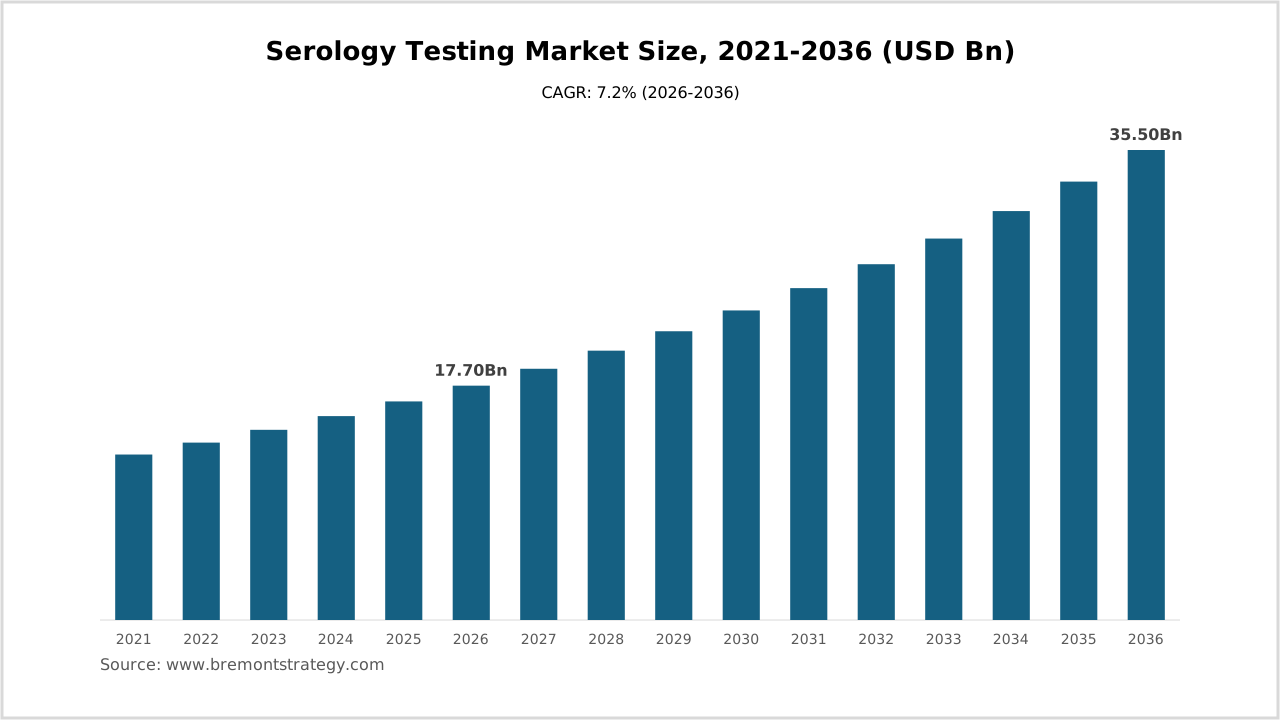
The Serology Testing market was valued at USD 17.7 Billion in 2026 and is projected to reach USD 35.5 Billion by 2036, growing at a CAGR of 7.2%% during the forecast period 2026-2036. This growth is driven by the increasing prevalence of infectious diseases, a rise in blood transfusions, and advancements in diagnostic technologies that enhance the accuracy and speed of serological tests.
Serology Testing is a diagnostic process that identifies antibodies in the blood and is widely used to detect infections, autoimmune disorders, and allergies. These tests include various methodologies such as ELISA, CLIA, and RIA. Serology testing differentiates itself from other diagnostic approaches through its ability to provide rapid results with high specificity and sensitivity.
The demand for serology testing is structurally driven by the expanding healthcare infrastructure, rising awareness about early diagnosis, and increasing healthcare expenditure. Moreover, regulatory mandates for blood screening and safety further bolster the adoption of serological tests.
Technological advancements such as automation, digitization, and the integration of AI in diagnostic processes are revolutionizing serology testing. Innovations in reagent and consumable development enhance test reliability, while software solutions improve data management and result interpretation.
Competitive dynamics in the Serology Testing market are shaped by factors like product innovation, pricing strategies, distribution networks, and brand reputation. Companies are focusing on enhancing product portfolios and expanding their market presence through strategic partnerships and acquisitions.
Additional context includes the increasing trend towards point-of-care testing, which provides rapid, on-site results, and the growing focus on personalized medicine, which necessitates more comprehensive diagnostic solutions.
Serology Testing Market Key Takeaways
- The Serology Testing market is expected to grow from USD 17.7 Billion in 2026 to USD 35.5 Billion by 2036, at a CAGR of 7.2%%.
- Increasing prevalence of infectious diseases and the need for blood screening in transfusion medicine are primary drivers of market growth.
- Technological advancements, such as AI integration and automation, are enhancing the efficiency and accuracy of serological tests.
- North America and Europe are key regions, benefiting from advanced healthcare infrastructures and supportive regulatory environments.
- Key companies like Abbott Laboratories and Siemens Healthineers AG are at the forefront of innovation and market expansion.
Serology Testing Market Key Drivers
| Drivers | Impact |
|---|---|
| Rising Infectious Diseases | Increases demand for early and accurate diagnostic solutions. |
| Technological Advancements | Enhances test accuracy and reduces turnaround time. |
| Regulatory Mandates | Drives the adoption of serological tests in blood screening. |
| Healthcare Infrastructure Development | Facilitates greater access to diagnostic services. |
| Growing Awareness | Enhances uptake of early diagnostic testing among populations. |
Rising Infectious Diseases
The increasing incidence of infectious diseases such as HIV, hepatitis, and COVID-19 has heightened the demand for accurate and timely serology testing. These tests are crucial for identifying antibodies, aiding in early diagnosis, and enabling effective disease management and prevention strategies.
Technological Advancements
Innovations in technology, including automation and AI integration in diagnostic tools, have significantly improved the accuracy, speed, and efficiency of serology tests. Such advancements allow for high-throughput processing and real-time data analysis, enhancing the overall testing process.
Regulatory Mandates
Stringent regulatory requirements for blood safety and diagnostic accuracy are propelling the adoption of serology tests. Governments and health organizations mandate comprehensive screening protocols to ensure the safety of blood transfusions, increasing reliance on serological diagnostics.
Healthcare Infrastructure Development
As healthcare systems continue to expand and improve globally, access to advanced diagnostic services is becoming more widespread. This development facilitates the adoption of serology testing as part of routine healthcare, especially in emerging economies.
Growing Awareness
Public awareness campaigns and educational initiatives about the importance of early diagnosis and disease prevention are driving the uptake of serological testing. This awareness is crucial for improving health outcomes and reducing the spread of infectious diseases.
Serology Testing Market Opportunities and Challenges
| Opportunity | Challenges |
|---|---|
| Point-of-Care Testing | Regulatory Compliance |
| Personalized Medicine | High Cost of Tests |
| Emerging Markets | Technical Complexity |
The market opportunities lie significantly in the expansion of point-of-care testing, which allows for immediate and efficient diagnosis outside traditional laboratory settings. The rise of personalized medicine also presents opportunities as it requires precise and efficient diagnostic solutions that serology testing can provide. Additionally, emerging markets offer growth potential due to improving healthcare infrastructures and increasing investments in healthcare services.
Challenges in the Serology Testing market include navigating regulatory compliance across different regions, which can be stringent and complex. The high cost of serology tests can also be a barrier, especially in price-sensitive markets. Furthermore, the technical complexity associated with serological assays necessitates skilled personnel and advanced equipment, which may limit adoption in under-resourced settings.
Serology Testing Market Report Scope
| Attributes | Details |
|---|---|
| Report Title: | Serology Testing Market Research Report 2036 |
| By Product | Reagents and Consumables, Instruments, Software and Services |
| By Test Type | Enzyme-Linked Immunosorbent Assay (ELISA), Chemiluminescence Immunoassay (CLIA), Western Blot, Immunofluorescence Assay, Radioimmunoassay (RIA), Lateral Flow Immunoassay |
| By Application | Infectious Diseases, Autoimmune Diseases, Allergy Testing, Blood Screening and Transfusion Medicine, Oncology, Other Applications |
| By End User | Hospitals and Hospital-Based Laboratories, Clinical Laboratories, Diagnostic Centers, Blood Banks, Research Institutions, Point-of-Care Facilities |
| By Region | North America, Europe, Asia Pacific, Latin America, Middle East and Africa |
| Regions Covered | North America, Europe, Asia Pacific, Latin America, Middle East & Africa |
| Countries Covered | United States, Canada, Germany, France, China, Japan, Brazil, South Africa, India, UAE |
| Base Year | 2026 |
| Historic Data | 2021-2025 |
| Forecast Period | 2026-2036 |
| Number of Pages | 280 |
| Number of Tables & Figures | 350 |
| Customization Available | Yes, the report can be customized as per your need. |
Serology Testing Market Segment Analysis
The Serology Testing market is segmented based on product, test type, application, end user, and region. Each segment plays a critical role in understanding market dynamics and trends. The market's diverse segmentation allows for targeted strategies that cater to specific needs and preferences.
By Product Analysis
| Segment | Market Share | Growth Rate | Key Insight |
|---|---|---|---|
| Reagents and Consumables | Not provided | Not provided | High demand due to frequent use in serology tests. |
| Instruments | Not provided | Not provided | Investment in advanced diagnostic equipment is growing. |
| Software and Services | Not provided | Not provided | Expanding role in data management and result interpretation. |
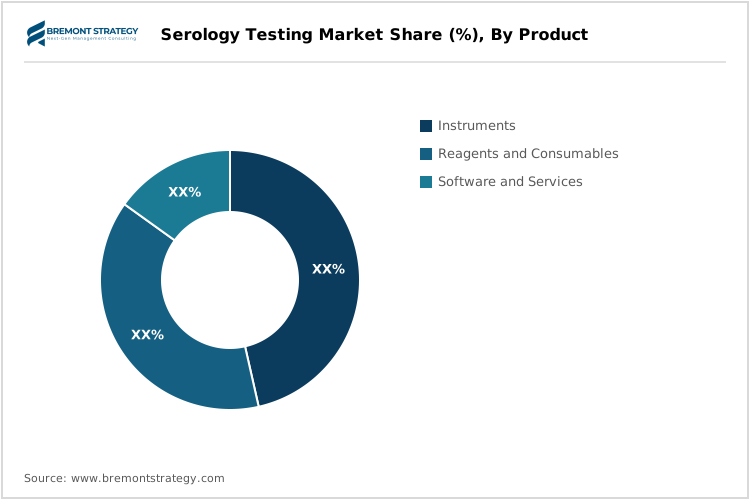
Reagents and consumables are a crucial part of serological testing, consistently in demand given their consumable nature and necessity for every test procedure. Instruments are witnessing heightened investment, particularly advanced diagnostic devices that promise greater accuracy and efficiency. Meanwhile, the software and services segment is gaining importance, providing essential support in terms of data analytics and management, which enhances the accuracy and efficiency of the diagnostic process.
By Test Type Analysis
| Segment | Market Share | Growth Rate | Key Insight |
|---|---|---|---|
| Enzyme-Linked Immunosorbent Assay (ELISA) | Not provided | Not provided | Widely used for its specificity and sensitivity. |
| Chemiluminescence Immunoassay (CLIA) | Not provided | Not provided | Growing preference for high throughput capabilities. |
| Western Blot | Not provided | Not provided | Used for confirmatory testing in various infections. |
| Immunofluorescence Assay | Not provided | Not provided | Common in autoimmune and allergy testing. |
| Radioimmunoassay (RIA) | Not provided | Not provided | Highly sensitive, though less frequently used due to radiation concerns. |
| Lateral Flow Immunoassay | Not provided | Not provided | Favoured for rapid point-of-care testing. |
ELISA remains a staple in serology testing due to its high specificity and sensitivity, essential for various diagnostic applications. CLIA is gaining traction owing to its high throughput capabilities, making it suitable for large-scale testing environments. Western Blot continues to hold significance for confirmatory tests, especially in infections like HIV. Immunofluorescence assays are popular in autoimmune and allergy diagnostics, thanks to their ability to visualize antibodies directly. Although RIA offers high sensitivity, its use is limited by concerns over radioactive contamination, while lateral flow immunoassays are increasingly utilized for their rapid point-of-care capabilities.
By Application Analysis
| Segment | Market Share | Growth Rate | Key Insight |
|---|---|---|---|
| Infectious Diseases | Not provided | Not provided | Dominant due to high prevalence and testing needs. |
| Autoimmune Diseases | Not provided | Not provided | Increasing incidence drives demand for specialized tests. |
| Allergy Testing | Not provided | Not provided | Growing awareness about allergies fosters market growth. |
| Blood Screening and Transfusion Medicine | Not provided | Not provided | Essential for ensuring blood safety, mandated by regulations. |
| Oncology | Not provided | Not provided | Expanding use in cancer diagnostics and monitoring. |
| Other Applications | Not provided | Not provided | Includes emerging areas in personalized medicine. |
Infectious diseases represent a major application segment due to the persistent and high demand for serological tests to manage and control outbreaks efficiently. The autoimmune diseases segment is witnessing growth, spurred by increasing awareness and incidence rates. Allergy testing gains momentum as awareness of allergens and their health impacts becomes more prevalent. Blood screening and transfusion medicine remain crucial, driven by regulatory mandates ensuring safety in blood banks and hospitals. Oncology applications are expanding, with serological tests playing an increasing role in cancer diagnosis and therapy monitoring. Other applications encompass a diverse range of emerging diagnostic needs, reflecting the evolving landscape of personalized medicine.
By End User Analysis
| Segment | Market Share | Growth Rate | Key Insight |
|---|---|---|---|
| Hospitals and Hospital-Based Laboratories | Not provided | Not provided | Main consumers of serology tests due to diverse patient needs. |
| Clinical Laboratories | Not provided | Not provided | Central role in routine and specialized serology testing. |
| Diagnostic Centers | Not provided | Not provided | Offer convenient, rapid testing services to patients. |
| Blood Banks | Not provided | Not provided | Critical for safe blood supply through mandatory screenings. |
| Research Institutions | Not provided | Not provided | Drive innovation and development in serology testing technologies. |
| Point-of-Care Facilities | Not provided | Not provided | Growing importance for immediate, on-site diagnostics. |
Hospitals and hospital-based laboratories are the primary end users, given the wide array of diagnostic needs they address, ranging from routine screenings to complex disease management. Clinical laboratories play a pivotal role, providing both routine and specialized serological testing, essential for diagnostic accuracy and patient management. Diagnostic centers are increasingly popular due to their ability to offer quick and accessible testing services, meeting patient demand for convenience. Blood banks are indispensable in maintaining a safe blood supply, with serology tests being crucial for compliance with safety regulations. Research institutions continue to propel the field forward, fostering technological advancements and novel applications in serology. Point-of-care facilities are gaining traction due to their capability to deliver immediate results, essential for timely clinical decisions.
By Region Analysis
| Segment | Market Share | Growth Rate | Key Insight |
|---|---|---|---|
| North America | Not provided | Not provided | Advanced healthcare infrastructure supports extensive testing. |
| Europe | Not provided | Not provided | Stringent regulations drive demand for accurate diagnostics. |
| Asia Pacific | Not provided | Not provided | Rapidly growing healthcare markets and infrastructure. |
| Latin America | Not provided | Not provided | Emerging markets with increasing healthcare investments. |
| Middle East and Africa | Not provided | Not provided | Improved healthcare access boosts demand for testing. |
North America stands out with its sophisticated healthcare infrastructure and high healthcare spending, ensuring widespread adoption of serology testing. Europe follows closely, with its stringent healthcare regulations necessitating reliable and accurate diagnostic solutions, driving the integration of serological tests into routine medical care. Asia-Pacific is rapidly emerging, characterized by expanding healthcare networks, increasing investments, and a rising prevalence of chronic and infectious diseases. Latin America offers substantial growth opportunities, especially as healthcare systems mature and investment in health services continues to rise. In the Middle East and Africa, improving healthcare access and increasing awareness about disease prevention are key factors fueling market expansion.
Serology Testing Market Regional Outlook
| Regional Outlook | |
|---|---|
| Largest Market | Not provided |
| Fastest Growing Market | Not provided |
| Emerging Countries | India, Brazil, South Africa |
| Future Outlook | Expansion in emerging markets and rapid technological advancements to drive growth. |
North America remains vital in the serology testing market due to its advanced healthcare infrastructure and proactive healthcare policies that encourage the adoption of cutting-edge diagnostic technologies. In Europe, the emphasis on comprehensive healthcare and rigorous testing standards continues to fuel demand for serological diagnostics, supported by well-established health services and research institutions.
Asia-Pacific is poised for significant growth, driven by rapidly expanding healthcare infrastructure, increasing prevalence of infectious diseases, and rising healthcare expenditure. The region's countries, particularly India and China, present lucrative opportunities due to their large populations and ongoing healthcare reforms.
In Latin America, the market is growing as healthcare systems evolve and access to medical services improves. Governments and private stakeholders are investing in healthcare infrastructure, which is enhancing the reach and effectiveness of serological testing.
The Middle East and Africa face unique healthcare challenges but are seeing improvements thanks to international aid, government initiatives, and private investments. These efforts are increasing the availability of diagnostic services, including serology testing, across the region.
Serology Testing Market Competitor Outlook
| Competitor Outlook | |
|---|---|
| Market Leader | Not provided |
| Key Players |
|
| Key Competitive Factors |
|
Serology Testing Pricing Analysis
The pricing structure in the serology testing market is influenced by several factors, including the cost of raw materials, manufacturing, and the complexity of the technology involved. High-quality reagents and consumables are crucial components, often dictating the cost structure due to their recurring use. Manufacturing costs are affected by the need for advanced equipment and skilled labor, while technology costs are driven by ongoing R&D investments to enhance test accuracy and efficiency.
Supply chain dynamics play a critical role, impacting pricing through distribution costs and logistics. Customization of products and services can add to cost, as can compliance with stringent regulatory standards which require extensive testing and certification. Buyer price sensitivity varies, with larger institutions more focused on long-term reliability and total cost of ownership, while smaller facilities may prioritize initial purchase price.
Serology Testing Consumer Buying Behaviour / Preference Analysis
Key Purchase Criteria
| Buying Factor | Relative Importance | Reason |
|---|---|---|
| Accuracy | High | Critical for reliable diagnosis and treatment decisions. |
| Cost | Medium | Balancing quality with budget constraints is essential. |
| Turnaround Time | High | Rapid results are crucial for timely clinical management. |
| Ease of Use | Medium | Simplifies integration into existing workflows. |
| Support and Service | Medium | Technical support ensures effective operation and maintenance. |
Typical buyers of serology testing products include hospitals, clinical laboratories, diagnostic centers, and research institutions. Procurement behavior is often driven by the need for accuracy and reliability, with technical evaluations focusing on the test's sensitivity and specificity. Price sensitivity varies, with larger institutions considering total cost of ownership, while smaller centers might prioritize initial cost. Quality expectations are high, with demands for compliance with regulatory standards and certifications.
Supplier relationships are important, with buyers looking for partners who offer strong support and service networks. Customization requirements may include specific software features or compatibility with existing systems. After-sales services like training and technical support are valued, ensuring smooth operation and maintenance of diagnostic equipment.
TABLE OF CONTENTS
1. Research Methodology
2. Market Structure
3. Executive Summary
4. Serology Testing Market Overview
- 4.1 Introduction
- Market Snapshot
- Assumptions, Inclusion & Exclusions
- Technological Advancements & Patent Analysis
- Case Studies
- Market Entry & Launch Strategies
- Macro-Economic Factors Impacting the Market Growth
- 4.2 Serology Testing Market Dynamics
- Market Drivers
- Market Restraints
- Market Opportunity
- 4.3 Serology Testing Market - Supply Chain Analysis
- Key Raw Material/Components Provider
- Key Manufacturers
- Key Distributors
- Key Consumers
- 4.4 Key Forces Shaping the Serology Testing Market
- Bargaining Power of Suppliers
- Bargaining Power of Buyers
- Threat of Substitution
- Threat of New Entrants
- Competitive Rivalry
- 4.1 Introduction
5. Global Serology Testing Market, By Product
- 5.1 Market Size, Value (USD Mn) & Volume (Units)
- Reagents and Consumables
- Instruments
- Software and Services
- 5.2 Key Market Trends & Growth Opportunities
- 5.3 Market Share (%) Analysis, 2021-2036
- 5.4 Year-on-Year (YoY) Growth Rate
- 5.5 Market Attractiveness
- 5.6 Global Investment & Trade Risks
- 5.7 Pricing Analysis, 2021-2036
- 5.8 Operating Margin/Profits, 2021-2036
- 5.1 Market Size, Value (USD Mn) & Volume (Units)
6. Global Serology Testing Market, By Test Type
- 6.1 Market Size, Value (USD Mn) & Volume (Units)
- Enzyme-Linked Immunosorbent Assay (ELISA)
- Chemiluminescence Immunoassay (CLIA)
- Western Blot
- Immunofluorescence Assay
- Radioimmunoassay (RIA)
- Lateral Flow Immunoassay
- 6.2 Key Market Trends & Growth Opportunities
- 6.3 Market Share (%) Analysis, 2021-2036
- 6.4 Year-on-Year (YoY) Growth Rate
- 6.5 Market Attractiveness
- 6.6 Global Investment & Trade Risks
- 6.7 Pricing Analysis, 2021-2036
- 6.8 Operating Margin/Profits, 2021-2036
- 6.1 Market Size, Value (USD Mn) & Volume (Units)
7. Global Serology Testing Market, By Application
- 7.1 Market Size, Value (USD Mn) & Volume (Units)
- Infectious Diseases
- Autoimmune Diseases
- Allergy Testing
- Blood Screening and Transfusion Medicine
- Oncology
- Other Applications
- 7.2 Key Market Trends & Growth Opportunities
- 7.3 Market Share (%) Analysis, 2021-2036
- 7.4 Year-on-Year (YoY) Growth Rate
- 7.5 Market Attractiveness
- 7.6 Global Investment & Trade Risks
- 7.7 Pricing Analysis, 2021-2036
- 7.8 Operating Margin/Profits, 2021-2036
- 7.1 Market Size, Value (USD Mn) & Volume (Units)
8. Global Serology Testing Market, By End User
- 8.1 Market Size, Value (USD Mn) & Volume (Units)
- Hospitals and Hospital-Based Laboratories
- Clinical Laboratories
- Diagnostic Centers
- Blood Banks
- Research Institutions
- Point-of-Care Facilities
- 8.2 Key Market Trends & Growth Opportunities
- 8.3 Market Share (%) Analysis, 2021-2036
- 8.4 Year-on-Year (YoY) Growth Rate
- 8.5 Market Attractiveness
- 8.6 Global Investment & Trade Risks
- 8.7 Pricing Analysis, 2021-2036
- 8.8 Operating Margin/Profits, 2021-2036
- 8.1 Market Size, Value (USD Mn) & Volume (Units)
9. Global Serology Testing Market, By Region
- 9.1 Market Size, Value (USD Mn) & Volume (Units)
- North America
- Europe
- Asia Pacific
- Latin America
- Middle East & Africa
- 9.2 Key Market Trends & Growth Opportunities
- 9.3 Market Share (%) Analysis, 2021-2036
- 9.4 Year-on-Year (YoY) Growth Rate
- 9.5 Market Attractiveness
- 9.6 Global Investment & Trade Risks
- 9.7 Pricing Analysis, 2021-2036
- 9.8 Operating Margin/Profits, 2021-2036
- 9.1 Market Size, Value (USD Mn) & Volume (Units)
10. Global Serology Testing Market, By North America
- 10.1 Market Size, Value (USD Mn) & Volume (Units)
- US
- Canada
- 10.2 Key Market Trends & Growth Opportunities
- 10.3 Market Share (%) Analysis, 2021-2036
- 10.4 Year-on-Year (YoY) Growth Rate
- 10.5 Market Attractiveness
- 10.6 Global Investment & Trade Risks
- 10.7 Pricing Analysis, 2021-2036
- 10.8 Operating Margin/Profits, 2021-2036
- 10.1 Market Size, Value (USD Mn) & Volume (Units)
11. Global Serology Testing Market, By Europe
- 11.1 Market Size, Value (USD Mn) & Volume (Units)
- Germany
- France
- UK
- Spain
- Italy
- Switzerland
- Russia
- Poland
- Rest of Europe
- 11.2 Key Market Trends & Growth Opportunities
- 11.3 Market Share (%) Analysis, 2021-2036
- 11.4 Year-on-Year (YoY) Growth Rate
- 11.5 Market Attractiveness
- 11.6 Global Investment & Trade Risks
- 11.7 Pricing Analysis, 2021-2036
- 11.8 Operating Margin/Profits, 2021-2036
- 11.1 Market Size, Value (USD Mn) & Volume (Units)
12. Global Serology Testing Market, By Asia Pacific
- 12.1 Market Size, Value (USD Mn) & Volume (Units)
- China
- Japan
- South Korea
- India
- Australia
- South East Asia
- Rest of APAC
- 12.2 Key Market Trends & Growth Opportunities
- 12.3 Market Share (%) Analysis, 2021-2036
- 12.4 Year-on-Year (YoY) Growth Rate
- 12.5 Market Attractiveness
- 12.6 Global Investment & Trade Risks
- 12.7 Pricing Analysis, 2021-2036
- 12.8 Operating Margin/Profits, 2021-2036
- 12.1 Market Size, Value (USD Mn) & Volume (Units)
13. Global Serology Testing Market, By Latin America
- 13.1 Market Size, Value (USD Mn) & Volume (Units)
- Brazil
- Mexico
- Argentina
- Rest of LATAM
- 13.2 Key Market Trends & Growth Opportunities
- 13.3 Market Share (%) Analysis, 2021-2036
- 13.4 Year-on-Year (YoY) Growth Rate
- 13.5 Market Attractiveness
- 13.6 Global Investment & Trade Risks
- 13.7 Pricing Analysis, 2021-2036
- 13.8 Operating Margin/Profits, 2021-2036
- 13.1 Market Size, Value (USD Mn) & Volume (Units)
14. Global Serology Testing Market, By Middle East & Africa
- 14.1 Market Size, Value (USD Mn) & Volume (Units)
- Saudi Arabia
- UAE
- South Africa
- Rest of MEA
- 14.2 Key Market Trends & Growth Opportunities
- 14.3 Market Share (%) Analysis, 2021-2036
- 14.4 Year-on-Year (YoY) Growth Rate
- 14.5 Market Attractiveness
- 14.6 Global Investment & Trade Risks
- 14.7 Pricing Analysis, 2021-2036
- 14.8 Operating Margin/Profits, 2021-2036
- 14.1 Market Size, Value (USD Mn) & Volume (Units)
15. Competitive Analysis
- 15.1 Competition Landscape, Key Players
- Global Market Share (%) Analysis of Key Players in Serology Testing, in Value (USD Mn) & Volume (Units)
- Company Overview
- Company Financials
- News & Developments
- Strategic Initiatives
- 15.2 Company Profiles
- Abbott Laboratories
- F. Hoffmann-La Roche Ltd.
- Siemens Healthineers AG
- Thermo Fisher Scientific Inc.
- Danaher Corporation
- bioMérieux SA
- DiaSorin S.p.A.
- Hologic Inc.
- QuidelOrtho Corporation
- Becton Dickinson and Company
- 15.1 Competition Landscape, Key Players
METHODOLOGY
To provide you with a comprehensive understanding of how we quantify your market opportunity, we utilize a multi-phased methodology designed to minimize risk and maximize strategic clarity. We begin the process by establishing a clear conceptual framework, often referred to as the TAM-SAM-SOM model. By starting with the Total Addressable Market, we look at the absolute global demand for your category. We then refine this into the Serviceable Addressable Market to account for your specific geographic and technological reach, and finally, we pinpoint the Serviceable Obtainable Market. This ensures that the final figures we present are not just theoretical "vanity metrics," but represent a realistic, capture-able revenue target for your business.
Our data collection process relies on a rigorous principle called triangulation, where we cross-reference multiple independent data streams to ensure accuracy. We initiate this with deep-dive secondary research, synthesizing high-value intelligence from audited financial filings, government trade databases, and specialized industry journals. This "desk research" phase provides a macro-economic baseline and identifies historical growth trajectories. However, because secondary data can sometimes lag behind real-time shifts, we supplement this with targeted primary research. This involves direct engagement with Key Opinion Leaders (KOLs) and structured quantitative surveys to capture the current pulse of the market and emerging buyer intent.
To ensure the integrity of our estimates, we employ a dual-modeling approach, calculating the market size from both the "Top-Down" and "Bottom-Up." The Top-Down analysis provides a valuable sanity check against broader economic trends, but we place the most weight on our Bottom-Up modeling. By taking granular data, such as the average transaction value and the actual number of potential customer touchpoints, and scaling them upward, we build a highly defensible model grounded in operational reality. This dual-verification method allows us to identify any discrepancies early, ensuring that the resulting data is robust enough to withstand the scrutiny of stakeholders or investors.
Finally, we recognize that a static market size figure is only a snapshot in time. To provide you with a roadmap for the future, we integrate trend analysis and Compound Annual Growth Rate (CAGR) forecasting into our final reporting. We analyze the underlying drivers, such as regulatory shifts, technological disruptions, or changing consumer behaviors, to predict how the market will evolve over the next three to five years. This ongoing tracking mechanism transforms a simple number into a dynamic strategic tool, allowing you to monitor your market share in real-time and pivot your resources as new opportunities emerge.
Frequently Asked Questions
What is the current market size of the Serology Testing market?
The market size was valued at USD 17.7 Billion in the base year 2026.
What is the projected market size by 2036?
The Serology Testing market is projected to reach USD 35.5 Billion by 2036.
What is the expected CAGR for the Serology Testing market?
The market is expected to grow at a CAGR of 7.2%% during the forecast period 2026-2036.
Which region is the leading region in the Serology Testing market?
Not provided in the supplied market data.
Which is the leading segment in the Serology Testing market?
Not provided in the supplied market data.
Who are the key companies operating in the Serology Testing market?
Key companies include Abbott Laboratories, F. Hoffmann-La Roche Ltd., Siemens Healthineers AG, Thermo Fisher Scientific Inc., and others.
What are the key growth drivers for this market?
Key growth drivers include rising infectious diseases, technological advancements, and regulatory mandates.
Is customization available for this report?
Yes, the report can be customized as per your need.