Silica Nanocomposite Polymers
Silica Nanocomposite Polymers Market Research Report 2036
Silica Nanocomposite Polymers Market Segments - by Component (Matrix Polymers, Silica Nanoparticles, Additives, Modifiers, Stabilizers), Deployment (In-Situ Polymerization, Solution Blending, Melt Blending, Sol-Gel Process, Electrospinning), Application (Automotive Parts, Electronics and Semiconductors, Packaging, Construction Materials, Medical Devices, Aerospace Components), Industry (Automotive, Electronics, Construction, Healthcare, Aerospace, Packaging), and Region (North America, Europe, Asia Pacific, Latin America, Middle East & Africa) - The Market Forecasts are Provided in Terms of Value (USD)
Silica Nanocomposite Polymers Market Outlook
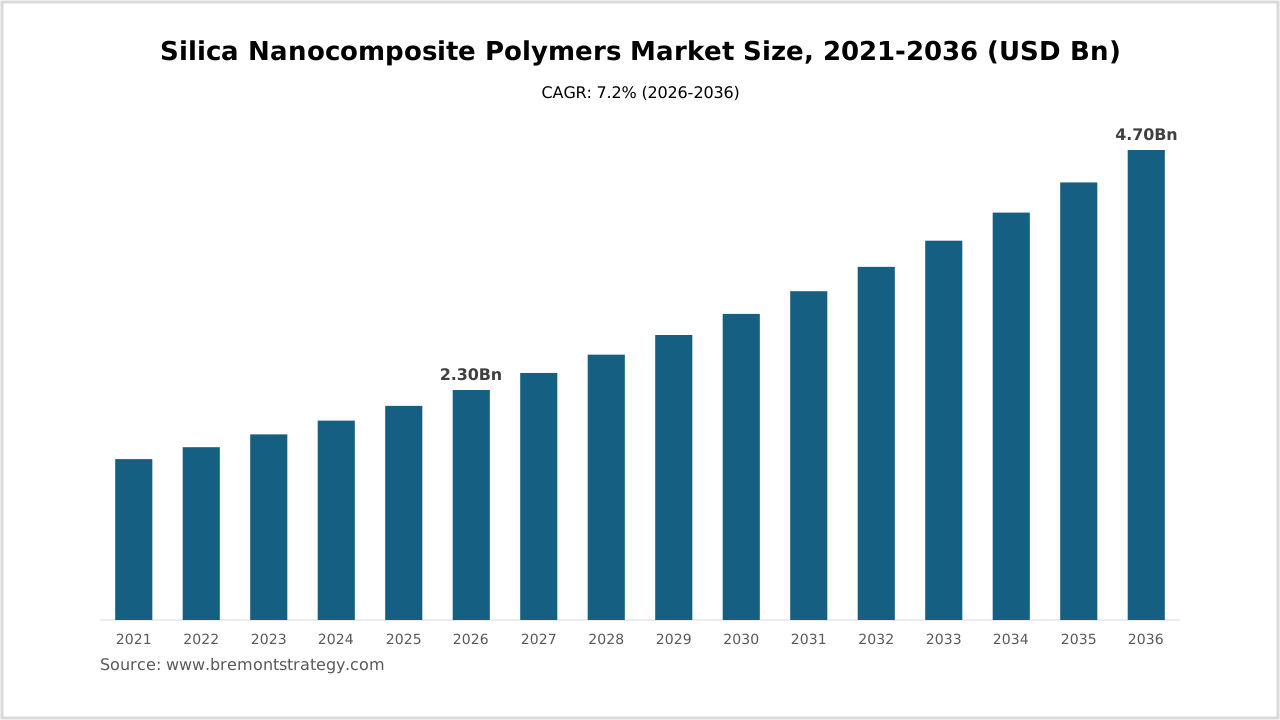
The Silica Nanocomposite Polymers market was valued at $2.3 Billion in 2026 and is projected to reach $4.7 Billion by 2036, growing at a CAGR of 7.2% during the forecast period 2026-2036. This growth is driven by increasing demand across various industries such as automotive, electronics, and healthcare, where the unique properties of silica nanocomposites enhance performance and durability.
Silica nanocomposite polymers are advanced materials that integrate silica nanoparticles into polymer matrices, creating composites with superior mechanical, thermal, and barrier properties. These materials are distinct from conventional polymers due to their enhanced strength, reduced weight, and improved thermal stability, making them ideal for high-performance applications.
The overall demand for silica nanocomposite polymers is primarily driven by the need for lightweight and high-strength materials in automotive and aerospace industries. Additionally, the growing electronics sector demands advanced materials for better thermal management and miniaturization of components.
Technological advancements in the production processes such as in-situ polymerization and sol-gel processes are paving the way for more efficient and cost-effective manufacturing of silica nanocomposites. Research and development are focused on improving the dispersion of nanoparticles within the polymer matrix to further enhance material properties.
Competitive dynamics in the market are shaped by factors such as pricing strategies, technical performance, and distribution networks. Companies that offer superior technical support and have a strong distribution network are better positioned to capture market share. Adoption is heavily influenced by the ability of vendors to meet specific application requirements and provide value-added services.
Additionally, environmental regulations and sustainability concerns are pushing manufacturers to develop eco-friendly nanocomposite solutions, which could open new opportunities in the market.
Silica Nanocomposite Polymers Market Key Takeaways
- The Silica Nanocomposite Polymers market is expected to grow from $2.3 Billion in 2026 to $4.7 Billion by 2036, at a CAGR of 7.2%.
- The "Matrix Polymers" segment is anticipated to hold the largest market share, driven by its widespread application in various industries.
- Asia Pacific is projected to be the fastest-growing region, with significant contributions from China and India.
- The automotive industry is a major demand driver, utilizing silica nanocomposites for lightweight and durable components.
- Technological advancements in manufacturing processes like sol-gel and electrospinning are enhancing product performance and expanding application areas.
Silica Nanocomposite Polymers Market Key Drivers
| Drivers | Impact |
|---|---|
| Automotive Demand | Increased use in lightweight, high-strength automotive components. |
| Electronics Miniaturization | Need for advanced materials in compact, efficient electronic devices. |
| Environmental Regulations | Push for sustainable, eco-friendly materials in manufacturing. |
| Technological Advancements | Innovations in manufacturing processes enhancing product capabilities. |
| Healthcare Applications | Growing use in medical devices for improved performance and safety. |
Automotive Demand
The demand for silica nanocomposite polymers in the automotive industry is driven by the need for materials that offer high strength-to-weight ratios. These polymers are used in the production of lightweight components that contribute to fuel efficiency and reduced emissions. As automotive manufacturers strive to meet stringent environmental standards, the integration of silica nanocomposites becomes increasingly critical.
Electronics Miniaturization
In the electronics sector, the trend towards miniaturization requires materials that can provide excellent thermal management and electrical insulation. Silica nanocomposite polymers are ideal for these applications due to their superior thermal stability and dielectric properties, enabling the production of smaller, more efficient electronic devices.
Environmental Regulations
Environmental regulations are compelling manufacturers to adopt sustainable practices, including the use of eco-friendly materials. Silica nanocomposite polymers, being recyclable and non-toxic, align well with these regulatory demands, driving their adoption across various industries.
Technological Advancements
Advancements in manufacturing technologies such as sol-gel and electrospinning processes are enhancing the dispersion of silica nanoparticles within polymer matrices. This results in improved mechanical and thermal properties, expanding the application scope of silica nanocomposite polymers.
Healthcare Applications
The healthcare industry is increasingly utilizing silica nanocomposite polymers in medical devices due to their biocompatibility and enhanced mechanical properties. These materials are used in implants, prosthetics, and other medical applications where performance and safety are paramount.
Silica Nanocomposite Polymers Market Opportunities and Challenges
| Opportunity | Challenges |
|---|---|
| Advanced Manufacturing | High Production Costs |
| Emerging Markets | Regulatory Compliance |
| Eco-Friendly Products | Limited Raw Material Availability |
Opportunities in the silica nanocomposite polymers market are primarily driven by advancements in manufacturing technologies that allow for more efficient production processes. Emerging markets, particularly in Asia Pacific, offer significant growth potential as industrialization and technological adoption increase. Additionally, the development of eco-friendly products presents an opportunity for manufacturers to differentiate themselves in a market increasingly focused on sustainability.
However, the market faces challenges such as high production costs associated with advanced manufacturing processes, which can limit profitability. Regulatory compliance is another significant hurdle, as manufacturers must navigate complex international standards. Furthermore, the availability of raw materials can be a constraint, impacting the supply chain and production capabilities.
Silica Nanocomposite Polymers Market Report Scope
| Attributes | Details |
|---|---|
| Report Title | Silica Nanocomposite Polymers Market Research Report 2036 |
| By Component | Matrix Polymers, Silica Nanoparticles, Additives, Modifiers, Stabilizers |
| By Deployment | In-Situ Polymerization, Solution Blending, Melt Blending, Sol-Gel Process, Electrospinning |
| By Application | Automotive Parts, Electronics and Semiconductors, Packaging, Construction Materials, Medical Devices, Aerospace Components |
| By Industry | Automotive, Electronics, Construction, Healthcare, Aerospace, Packaging |
| By region | North America, Europe, Asia Pacific, Latin America, Middle East & Africa |
| Countries Covered | North America (United States, Canada), Europe (Germany, France, UK, Italy, Spain, Rest of Europe), Asia Pacific (China, Japan, India, South Korea, Australia, Rest of Asia Pacific), Latin America (Brazil, Mexico, Rest of Latin America), Middle East & Africa (Saudi Arabia, UAE, South Africa, Rest of MEA) |
| Base Year | 2026 |
| Historic Data | 2021-2025 |
| Forecast Period | 2026-2036 |
| Number of Pages | 280 |
| Number of Tables & Figures | 350 |
| Customization Available | Yes, the report can be customized as per your need. |
Silica Nanocomposite Polymers Market Segment Analysis
The Silica Nanocomposite Polymers market is segmented into various categories, including components, deployment methods, applications, industries, and regions. Each segment plays a vital role in shaping the overall market dynamics and growth trajectory.
By Component Analysis
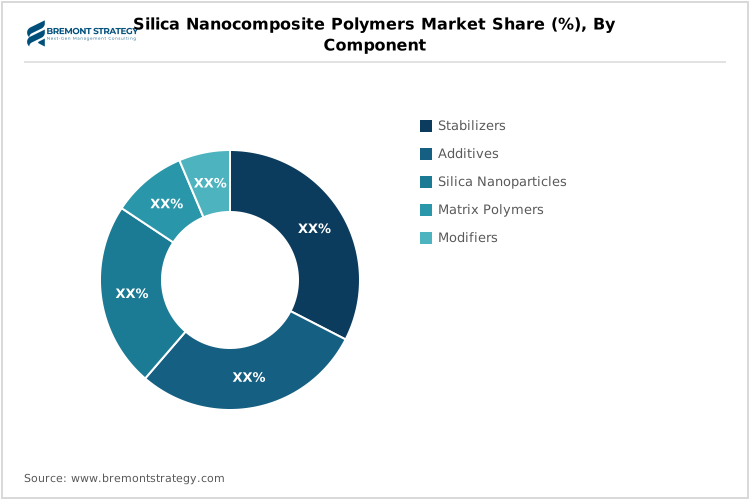
The "Matrix Polymers" segment dominates the component category due to its critical role in forming the base of nanocomposites. These polymers provide the structural framework necessary for embedding silica nanoparticles, enhancing the material's overall properties. The demand for matrix polymers is driven by their versatility and compatibility with various applications, from automotive to electronics.
"Silica Nanoparticles" are essential for imparting unique properties to the composites, such as improved mechanical strength and thermal stability. The growing focus on advanced material science is boosting the demand for high-quality silica nanoparticles, which are crucial for achieving desired performance characteristics in end-use applications.
"Additives" and "Modifiers" play supportive roles in refining the properties of nanocomposites, offering enhancements like UV resistance and improved processability. These components are increasingly used to tailor materials for specific applications, ensuring optimal performance and longevity.
By Deployment Analysis
"In-Situ Polymerization" is a leading deployment method due to its ability to integrate nanoparticles directly into the polymer matrix during synthesis, ensuring even distribution and strong interfacial bonding. This method is favored in high-performance applications where material integrity is paramount.
"Solution Blending" and "Melt Blending" are popular for their cost-effectiveness and scalability, making them suitable for large-scale production. These methods are widely adopted in industries such as packaging and construction, where cost efficiency is crucial.
The "Sol-Gel Process" offers precise control over the material's microstructure, making it ideal for applications requiring high thermal and chemical stability. This method is gaining traction in the electronics and aerospace sectors, where such properties are essential.
By Application Analysis
The "Automotive Parts" application segment is a major driver of market growth, leveraging the lightweight and high-strength properties of silica nanocomposites to enhance vehicle performance and fuel efficiency. The automotive industry's push towards sustainability and reduced emissions further fuels this demand.
"Electronics and Semiconductors" benefit from the thermal and electrical properties of silica nanocomposites, which are critical for miniaturization and improved device performance. The rapid advancement in consumer electronics and IoT devices is a significant demand driver in this segment.
"Packaging" and "Construction Materials" segments utilize silica nanocomposites for their barrier properties, enhancing product shelf life and structural integrity. The growing need for sustainable packaging solutions and durable construction materials is bolstering demand in these areas.
By Industry Analysis
The "Automotive" industry is the largest consumer of silica nanocomposite polymers, driven by the need for lightweight, durable materials that contribute to vehicle efficiency and safety. The industry's focus on innovation and sustainability continues to drive demand for advanced materials.
The "Electronics" industry leverages the unique properties of silica nanocomposites to improve device performance and reliability. As the demand for smaller, more efficient devices grows, so does the need for high-performance materials.
The "Healthcare" industry is increasingly adopting silica nanocomposites in medical devices, where biocompatibility and enhanced mechanical properties are critical. This trend is driven by the growing demand for advanced medical technologies and devices.
By region Analysis
North America is a significant market for silica nanocomposite polymers, driven by strong demand from the automotive and aerospace industries. The region's focus on technological innovation and sustainability supports the adoption of advanced materials.
Europe is characterized by its stringent environmental regulations and focus on sustainability, driving the demand for eco-friendly materials. The region's automotive and electronics industries are key consumers of silica nanocomposites.
Asia Pacific is the fastest-growing region, with rapid industrialization and technological adoption in countries like China and India. The region's burgeoning automotive and electronics sectors are major contributors to market growth.
Latin America presents emerging opportunities for silica nanocomposite polymers, driven by growing industrialization and infrastructure development. The region's focus on sustainable growth supports the adoption of advanced materials.
The Middle East & Africa region is gradually adopting silica nanocomposite polymers, with demand driven by the construction and automotive industries. The region's focus on economic diversification and infrastructure development supports market growth.
Silica Nanocomposite Polymers Market Regional Outlook
| Regional Outlook | |
|---|---|
| Largest Market | North America |
| Fastest Growing Market | Asia Pacific |
| Emerging Countries | China, India, Brazil |
| Future Outlook | Continued growth driven by technological advancements and sustainability trends. |
North America remains a dominant market for silica nanocomposite polymers due to its advanced automotive and aerospace industries. The region's focus on innovation and sustainability drives the adoption of high-performance materials, with significant investments in R&D and manufacturing capabilities.
Europe's market is characterized by stringent environmental regulations and a strong emphasis on sustainability. The region's automotive and electronics sectors are key consumers of silica nanocomposites, leveraging their properties to meet regulatory standards and enhance product performance.
Asia Pacific is the fastest-growing market, fueled by rapid industrialization and technological adoption in countries such as China and India. The region's expanding automotive and electronics industries are major contributors to market growth, with increasing investments in advanced manufacturing technologies.
Latin America offers emerging opportunities for silica nanocomposite polymers, driven by industrialization and infrastructure development. The region's focus on sustainable growth and economic diversification supports the adoption of advanced materials in various industries.
The Middle East & Africa region is gradually adopting silica nanocomposite polymers, with demand driven by the construction and automotive industries. The region's focus on economic diversification and infrastructure development supports market growth, with increasing investments in advanced materials.
Silica Nanocomposite Polymers Market Competitor Outlook
| Competitor Outlook | |
|---|---|
| Market Leader |
|
| Key Players |
|
| Key Competitive Factors |
|
Silica Nanocomposite Polymers Pricing Analysis
Pricing in the silica nanocomposite polymers market is influenced by several factors, including the formulation and specification of the polymers, production scale, and regional market dynamics. High-quality silica nanoparticles and advanced manufacturing processes can increase costs, while economies of scale and regional production capabilities can reduce them. Geographic location also plays a role, with variations in labor and material costs impacting pricing.
Price sensitivity in this market varies, with some buyers prioritizing cost over performance, while others focus on the value provided by high-performance materials. In industries such as automotive and electronics, where performance and reliability are critical, buyers are more likely to invest in premium products. Conversely, in cost-sensitive sectors, price competitiveness can be a decisive factor in purchasing decisions.
Silica Nanocomposite Polymers Consumer Buying Behaviour / Preference Analysis
Key Purchase Criteria
| Buying Factor | Relative Importance | Reason |
|---|---|---|
| Performance | Very High | Critical for application success |
| Durability/Reliability | High | Ensures long-term use |
| Certification/Compliance | Medium-High | Regulatory requirements |
| Total Cost | Medium | Budget constraints |
| Differentiating Capability | High | Competitive advantage |
Typical buyers in the silica nanocomposite polymers market include procurement managers, R&D specialists, and product engineers from industries such as automotive, electronics, and healthcare. These professionals prioritize performance and durability, as these factors are crucial for the success and longevity of their products. Compliance with industry standards and certifications is also important, particularly in regulated sectors.
Purchase decisions are heavily influenced by the ability of the materials to meet specific application requirements and offer a competitive advantage. While cost is a consideration, buyers in high-performance sectors are often willing to invest in premium materials that deliver superior results. The decision-making process involves evaluating the balance between cost and value, with a focus on long-term benefits and return on investment.
TABLE OF CONTENTS
1. Research Methodology
2. Market Structure
3. Executive Summary
4. Silica Nanocomposite Polymers Market Overview
- 4.1 Introduction
- Market Snapshot
- Assumptions, Inclusion & Exclusions
- Technological Advancements & Patent Analysis
- Case Studies
- Market Entry & Launch Strategies
- Macro-Economic Factors Impacting the Market Growth
- 4.2 Silica Nanocomposite Polymers Market Dynamics
- Market Drivers
- Market Restraints
- Market Opportunity
- 4.3 Silica Nanocomposite Polymers Market - Supply Chain Analysis
- Key Raw Material/Components Provider
- Key Manufacturers
- Key Distributors
- Key Consumers
- 4.4 Key Forces Shaping the Silica Nanocomposite Polymers Market
- Bargaining Power of Suppliers
- Bargaining Power of Buyers
- Threat of Substitution
- Threat of New Entrants
- Competitive Rivalry
- 4.1 Introduction
5. Global Silica Nanocomposite Polymers Market, By Component
- 5.1 Market Size, Value (USD Mn) & Volume (Units)
- Matrix Polymers
- Silica Nanoparticles
- Additives
- Modifiers
- Stabilizers
- 5.2 Key Market Trends & Growth Opportunities
- 5.3 Market Share (%) Analysis, 2021-2036
- 5.4 Year-on-Year (YoY) Growth Rate
- 5.5 Market Attractiveness
- 5.6 Global Investment & Trade Risks
- 5.7 Pricing Analysis, 2021-2036
- 5.8 Operating Margin/Profits, 2021-2036
- 5.1 Market Size, Value (USD Mn) & Volume (Units)
6. Global Silica Nanocomposite Polymers Market, By Deployment
- 6.1 Market Size, Value (USD Mn) & Volume (Units)
- In-Situ Polymerization
- Solution Blending
- Melt Blending
- Sol-Gel Process
- Electrospinning
- 6.2 Key Market Trends & Growth Opportunities
- 6.3 Market Share (%) Analysis, 2021-2036
- 6.4 Year-on-Year (YoY) Growth Rate
- 6.5 Market Attractiveness
- 6.6 Global Investment & Trade Risks
- 6.7 Pricing Analysis, 2021-2036
- 6.8 Operating Margin/Profits, 2021-2036
- 6.1 Market Size, Value (USD Mn) & Volume (Units)
7. Global Silica Nanocomposite Polymers Market, By Application
- 7.1 Market Size, Value (USD Mn) & Volume (Units)
- Automotive Parts
- Electronics and Semiconductors
- Packaging
- Construction Materials
- Medical Devices
- Aerospace Components
- 7.2 Key Market Trends & Growth Opportunities
- 7.3 Market Share (%) Analysis, 2021-2036
- 7.4 Year-on-Year (YoY) Growth Rate
- 7.5 Market Attractiveness
- 7.6 Global Investment & Trade Risks
- 7.7 Pricing Analysis, 2021-2036
- 7.8 Operating Margin/Profits, 2021-2036
- 7.1 Market Size, Value (USD Mn) & Volume (Units)
8. Global Silica Nanocomposite Polymers Market, By Industry
- 8.1 Market Size, Value (USD Mn) & Volume (Units)
- Automotive
- Electronics
- Construction
- Healthcare
- Aerospace
- Packaging
- 8.2 Key Market Trends & Growth Opportunities
- 8.3 Market Share (%) Analysis, 2021-2036
- 8.4 Year-on-Year (YoY) Growth Rate
- 8.5 Market Attractiveness
- 8.6 Global Investment & Trade Risks
- 8.7 Pricing Analysis, 2021-2036
- 8.8 Operating Margin/Profits, 2021-2036
- 8.1 Market Size, Value (USD Mn) & Volume (Units)
9. Global Silica Nanocomposite Polymers Market, By Region
- 9.1 Market Size, Value (USD Mn) & Volume (Units)
- North America
- Europe
- Asia Pacific
- Latin America
- Middle East & Africa
- 9.2 Key Market Trends & Growth Opportunities
- 9.3 Market Share (%) Analysis, 2021-2036
- 9.4 Year-on-Year (YoY) Growth Rate
- 9.5 Market Attractiveness
- 9.6 Global Investment & Trade Risks
- 9.7 Pricing Analysis, 2021-2036
- 9.8 Operating Margin/Profits, 2021-2036
- 9.1 Market Size, Value (USD Mn) & Volume (Units)
10. Global Silica Nanocomposite Polymers Market, By North America
- 10.1 Market Size, Value (USD Mn) & Volume (Units)
- US
- Canada
- 10.2 Key Market Trends & Growth Opportunities
- 10.3 Market Share (%) Analysis, 2021-2036
- 10.4 Year-on-Year (YoY) Growth Rate
- 10.5 Market Attractiveness
- 10.6 Global Investment & Trade Risks
- 10.7 Pricing Analysis, 2021-2036
- 10.8 Operating Margin/Profits, 2021-2036
- 10.1 Market Size, Value (USD Mn) & Volume (Units)
11. Global Silica Nanocomposite Polymers Market, By Europe
- 11.1 Market Size, Value (USD Mn) & Volume (Units)
- Germany
- France
- UK
- Spain
- Italy
- Switzerland
- Russia
- Poland
- Rest of Europe
- 11.2 Key Market Trends & Growth Opportunities
- 11.3 Market Share (%) Analysis, 2021-2036
- 11.4 Year-on-Year (YoY) Growth Rate
- 11.5 Market Attractiveness
- 11.6 Global Investment & Trade Risks
- 11.7 Pricing Analysis, 2021-2036
- 11.8 Operating Margin/Profits, 2021-2036
- 11.1 Market Size, Value (USD Mn) & Volume (Units)
12. Global Silica Nanocomposite Polymers Market, By Asia Pacific
- 12.1 Market Size, Value (USD Mn) & Volume (Units)
- China
- Japan
- South Korea
- India
- Australia
- South East Asia
- Rest of APAC
- 12.2 Key Market Trends & Growth Opportunities
- 12.3 Market Share (%) Analysis, 2021-2036
- 12.4 Year-on-Year (YoY) Growth Rate
- 12.5 Market Attractiveness
- 12.6 Global Investment & Trade Risks
- 12.7 Pricing Analysis, 2021-2036
- 12.8 Operating Margin/Profits, 2021-2036
- 12.1 Market Size, Value (USD Mn) & Volume (Units)
13. Global Silica Nanocomposite Polymers Market, By Latin America
- 13.1 Market Size, Value (USD Mn) & Volume (Units)
- Brazil
- Mexico
- Argentina
- Rest of LATAM
- 13.2 Key Market Trends & Growth Opportunities
- 13.3 Market Share (%) Analysis, 2021-2036
- 13.4 Year-on-Year (YoY) Growth Rate
- 13.5 Market Attractiveness
- 13.6 Global Investment & Trade Risks
- 13.7 Pricing Analysis, 2021-2036
- 13.8 Operating Margin/Profits, 2021-2036
- 13.1 Market Size, Value (USD Mn) & Volume (Units)
14. Global Silica Nanocomposite Polymers Market, By Middle East & Africa
- 14.1 Market Size, Value (USD Mn) & Volume (Units)
- Saudi Arabia
- UAE
- South Africa
- Rest of MEA
- 14.2 Key Market Trends & Growth Opportunities
- 14.3 Market Share (%) Analysis, 2021-2036
- 14.4 Year-on-Year (YoY) Growth Rate
- 14.5 Market Attractiveness
- 14.6 Global Investment & Trade Risks
- 14.7 Pricing Analysis, 2021-2036
- 14.8 Operating Margin/Profits, 2021-2036
- 14.1 Market Size, Value (USD Mn) & Volume (Units)
15. Competitive Analysis
- 15.1 Competition Landscape, Key Players
- Global Market Share (%) Analysis of Key Players in Silica Nanocomposite Polymers, in Value (USD Mn) & Volume (Units)
- Company Overview
- Company Financials
- News & Developments
- Strategic Initiatives
- 15.2 Company Profiles
- BASF SE
- Evonik Industries AG
- Cabot Corporation
- 3M Company
- Dow Inc.
- Wacker Chemie AG
- Arkema Group
- Huntsman Corporation
- Momentive Performance Materials Inc.
- PPG Industries, Inc.
- Akzo Nobel N.V.
- Solvay S.A.
- Clariant AG
- SABIC
- Toray Industries, Inc.
- Mitsubishi Chemical Corporation
- LG Chem Ltd.
- DuPont de Nemours, Inc.
- Henkel AG & Co. KGaA
- Nippon Paint Holdings Co., Ltd.
- 15.1 Competition Landscape, Key Players
METHODOLOGY
To provide you with a comprehensive understanding of how we quantify your market opportunity, we utilize a multi-phased methodology designed to minimize risk and maximize strategic clarity. We begin the process by establishing a clear conceptual framework, often referred to as the TAM-SAM-SOM model. By starting with the Total Addressable Market, we look at the absolute global demand for your category. We then refine this into the Serviceable Addressable Market to account for your specific geographic and technological reach, and finally, we pinpoint the Serviceable Obtainable Market. This ensures that the final figures we present are not just theoretical "vanity metrics," but represent a realistic, capture-able revenue target for your business.
Our data collection process relies on a rigorous principle called triangulation, where we cross-reference multiple independent data streams to ensure accuracy. We initiate this with deep-dive secondary research, synthesizing high-value intelligence from audited financial filings, government trade databases, and specialized industry journals. This "desk research" phase provides a macro-economic baseline and identifies historical growth trajectories. However, because secondary data can sometimes lag behind real-time shifts, we supplement this with targeted primary research. This involves direct engagement with Key Opinion Leaders (KOLs) and structured quantitative surveys to capture the current pulse of the market and emerging buyer intent.
To ensure the integrity of our estimates, we employ a dual-modeling approach, calculating the market size from both the "Top-Down" and "Bottom-Up." The Top-Down analysis provides a valuable sanity check against broader economic trends, but we place the most weight on our Bottom-Up modeling. By taking granular data, such as the average transaction value and the actual number of potential customer touchpoints, and scaling them upward, we build a highly defensible model grounded in operational reality. This dual-verification method allows us to identify any discrepancies early, ensuring that the resulting data is robust enough to withstand the scrutiny of stakeholders or investors.
Finally, we recognize that a static market size figure is only a snapshot in time. To provide you with a roadmap for the future, we integrate trend analysis and Compound Annual Growth Rate (CAGR) forecasting into our final reporting. We analyze the underlying drivers, such as regulatory shifts, technological disruptions, or changing consumer behaviors, to predict how the market will evolve over the next three to five years. This ongoing tracking mechanism transforms a simple number into a dynamic strategic tool, allowing you to monitor your market share in real-time and pivot your resources as new opportunities emerge.
Frequently Asked Questions
What is the current size of the Silica Nanocomposite Polymers market?
The base year for the Silica Nanocomposite Polymers market is 2026, with a market size of $2.3 billion.
What is the projected market size by 2036?
By 2036, the Silica Nanocomposite Polymers market is expected to reach a size of $4.7 billion.
What is the market's CAGR during the forecast period?
The market is projected to grow at a compound annual growth rate (CAGR) of 7.2% from 2026 to 2036.
Which region leads in this market?
The Asia-Pacific region is currently the leader in the Silica Nanocomposite Polymers market, driven by rapid industrialization and technological advancements.
Which segment holds the largest share in the market?
The automotive segment holds the largest share in the Silica Nanocomposite Polymers market due to the increasing demand for lightweight and durable materials.
Who are the key players in this market?
Key players in the Silica Nanocomposite Polymers market include companies such as BASF SE, Cabot Corporation, and Dow Chemical Company.
What are the key growth drivers for this market?
Key growth drivers include the rising demand for advanced materials in electronics and automotive industries, and the increasing focus on sustainable and high-performance materials.
Is the report customizable?
Yes, the report can be customized according to specific requirements to better meet individual client needs.