Label applicators
Label applicators Market Research Report 2036
Label Applicators Market Segments - by Component (Hardware, Software, Services, Consumables, Accessories), Deployment (Automatic, Semi-Automatic, Manual), Application (Primary Packaging, Secondary Packaging, Tertiary Packaging, Product Labeling, Brand Labeling), Industry (Food & Beverage, Pharmaceuticals, Consumer Goods, Logistics & Transportation, Retail, Automotive), and Region (North America, Europe, Asia Pacific, Latin America, Middle East & Africa) - The Market Forecasts are Provided in Terms of Value (USD)
Label applicators Market Outlook
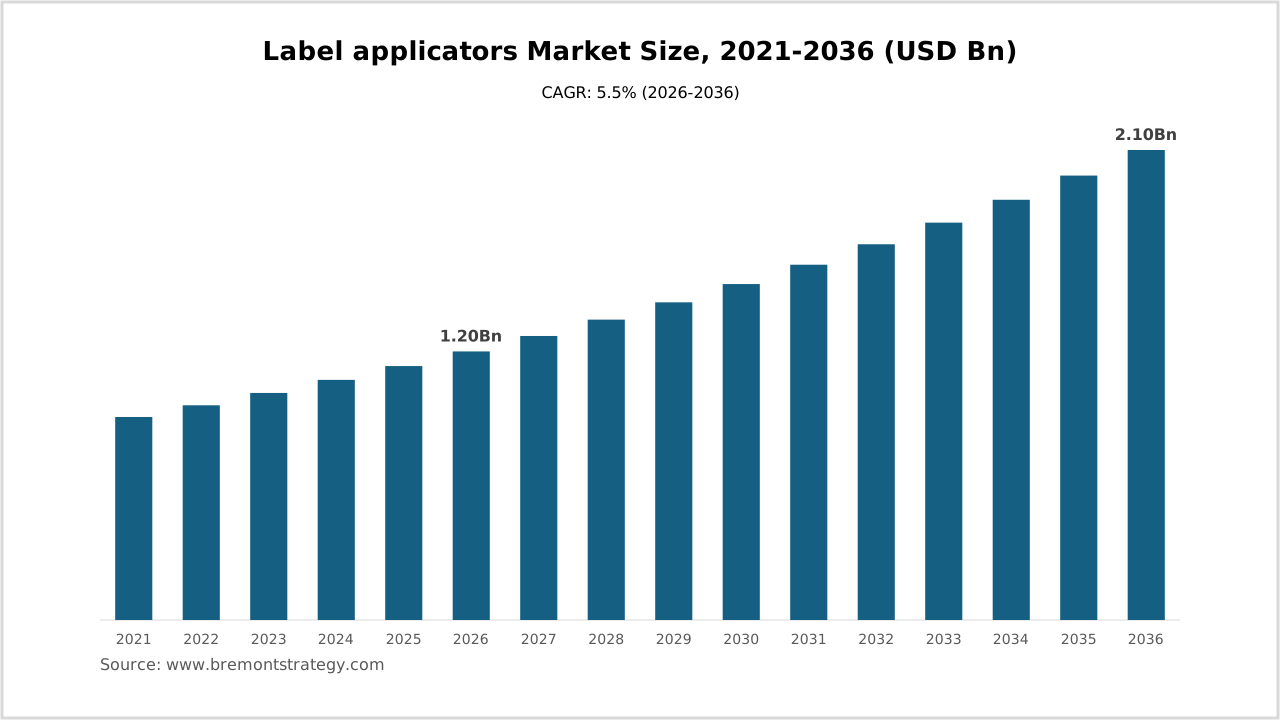
The Label applicators market was valued at $1.2 billion in 2026 and is projected to reach $2.1 billion by 2036, growing at a CAGR of 5.5% during the forecast period 2026-2036. This significant growth is driven by increasing demand across various industries such as food & beverage, pharmaceuticals, and logistics. Technological advancements in labeling technologies and the integration of automation are further propelling market expansion. As companies focus on enhancing product identification and brand visibility, the demand for efficient labeling solutions is anticipated to grow. With the rising adoption of e-commerce, the need for labeling in packaging and logistics is booming, providing a lucrative growth opportunity for manufacturers and suppliers in the sector. The market landscape is highly competitive with several key players actively focusing on innovation and strategic partnerships to gain a competitive edge.
Key Takeaways
- The market size was $1.2 billion in 2026 and is expected to reach $2.1 billion by 2036.
- The market is projected to grow at a CAGR of 5.5% from 2026 to 2036.
- North America is expected to dominate the market due to technological advancements.
- Increasing demand in the food & beverage industry is a major growth driver.
- Integration of automation and IoT in label applicators is enhancing efficiency.
- Top companies include Avery Dennison, ProMach, and Domino Printing Sciences.
- Asia-Pacific is anticipated to be the fastest-growing region during the forecast period.
- Challenges include high initial costs and complexities in system integration.
Label applicators Market Outlook 2026-2036
The label applicators market is poised for robust growth over the forecast period, reflecting the rising demand for efficient and automated labeling solutions across diverse industries. Companies are increasingly adopting label applicators to enhance their operational efficiencies, reduce human error, and comply with stringent regulatory standards regarding labeling. The market is witnessing a surge in demand from sectors such as pharmaceuticals, which require precise and reliable labeling for safety and compliance. Moreover, the growing trend of personalized packaging and customization in product labeling is further fueling market growth, as manufacturers seek to differentiate their products and enhance consumer engagement.
Additionally, the integration of advanced technologies such as IoT and machine learning in label applicators is transforming the market landscape. These technologies enable real-time monitoring and data analytics, improving overall production efficiency and reducing downtime. With the rise of e-commerce and the need for supply chain optimization, the demand for effective labeling solutions in logistics and transportation is increasing. The market is also being driven by the need for sustainable and environmentally friendly labeling solutions, as companies focus on reducing their carbon footprint and adhering to environmental regulations. As a result, innovations in biodegradable and recyclable labeling materials are gaining traction, opening new avenues for market expansion.
Label applicators Market Regional Outlook 2026-2036
North America is anticipated to lead the label applicators market during the forecast period, attributed to the region's advanced technological infrastructure and the presence of major market players. The demand for labeling solutions in the region is driven by stringent regulatory standards and the need for accurate and efficient product identification in industries such as pharmaceuticals and food & beverage. The growing adoption of automation and smart labeling technologies is further propelling market growth in North America.
In Europe, the market for label applicators is expected to witness considerable growth, owing to the increasing focus on sustainable packaging and labeling solutions. European companies are investing in innovative technologies to meet the rising consumer demand for eco-friendly products. The implementation of strict labeling regulations and the need for compliance across various industries are driving the adoption of advanced labeling solutions in the region.
Asia-Pacific is projected to be the fastest-growing region, driven by rapid industrialization and urbanization in countries like China and India. The expanding food & beverage and consumer goods sectors are significantly contributing to the demand for label applicators. Moreover, the growing e-commerce industry in the region is leading to increased requirements for efficient packaging and labeling solutions, making Asia-Pacific a lucrative market for label applicator manufacturers.
Key Growth Drivers of the Label applicators Market
Technological Advancements in Labeling Solutions
The ongoing technological advancements in labeling solutions are a major driver of market growth. The incorporation of automation, IoT, and machine learning in label applicators enhances efficiency, accuracy, and productivity. These advancements enable real-time monitoring and data analytics, optimizing the labeling process and reducing operational costs. As industries strive to improve their operational efficiencies, the demand for technologically advanced label applicators is expected to rise significantly.
Growing Demand in the Food & Beverage Industry
The food & beverage industry is one of the largest consumers of label applicators, driven by the need for accurate and efficient labeling solutions to meet regulatory standards and enhance product visibility. With the rising consumer demand for transparency and detailed product information, companies are investing in advanced labeling technologies. This trend is expected to continue, providing significant growth opportunities for the label applicators market.
Rising E-commerce and Logistics Needs
The exponential growth of e-commerce and the resultant need for efficient logistics and supply chain management are driving the demand for label applicators. These solutions are essential for ensuring accurate product identification, tracking, and inventory management. As e-commerce continues to expand globally, the need for effective labeling solutions in packaging and transportation is anticipated to grow, contributing to market expansion.
Increasing Focus on Sustainability
With growing environmental concerns, companies are focusing on sustainable labeling solutions to reduce their carbon footprint. The demand for biodegradable and recyclable labeling materials is on the rise, as businesses aim to adhere to environmental regulations and meet consumer expectations for eco-friendly products. This shift towards sustainability is driving innovation in the label applicators market, providing new growth avenues for market players.
Label applicators Market Segment Analysis
By Component
The component segment of the label applicators market comprises hardware, software, services, consumables, and accessories. Each component plays a crucial role in the effective functioning of label applicators, with hardware being the most significant contributor to market revenue.
Hardware components, including printers and applicators, are essential for the physical application of labels, while software solutions enable seamless integration and management of labeling processes. The demand for advanced software solutions is increasing as companies seek to automate their operations and improve efficiency.
Services such as installation, maintenance, and support are also critical, ensuring the smooth operation of label applicators and minimizing downtime. As the market grows, the demand for these services is expected to rise, providing opportunities for service providers.
Consumables and accessories, including labels and ribbons, are indispensable for the continuous operation of label applicators. The demand for high-quality consumables is driven by the need for superior print quality and durability, contributing to market growth.
By Deployment
The deployment segment is categorized into automatic, semi-automatic, and manual label applicators, each catering to different operational needs and scales. Automatic label applicators are witnessing significant demand due to their ability to enhance productivity and reduce human error.
These applicators are ideal for high-volume operations, offering efficiency and precision in label application. The adoption of automatic label applicators is rising, particularly in industries like pharmaceuticals and food & beverage, where accuracy and speed are paramount.
Semi-automatic label applicators offer a balance between automation and manual intervention, making them suitable for medium-scale operations. These applicators provide flexibility and are preferred by companies looking to optimize their processes without a complete automation overhaul.
Manual label applicators, though limited in application, are still in use for small-scale operations and custom labeling needs. They are cost-effective solutions for businesses with minimal labeling requirements, maintaining a niche market presence.
By Application
The application segment of the label applicators market includes primary packaging, secondary packaging, tertiary packaging, product labeling, and brand labeling. Each application serves a specific purpose in the packaging and branding process.
Primary packaging labeling focuses on applying labels directly to product containers, ensuring product information and branding are clearly visible to consumers. This segment is a significant contributor to market revenue, driven by the need for consumer engagement and regulatory compliance.
Secondary packaging labeling involves labeling on the outer packaging, primarily for logistical purposes and brand reinforcement. The demand for secondary packaging labeling is increasing with the growth of e-commerce and the need for efficient supply chain management.
Tertiary packaging labeling focuses on bulk packaging for transportation and storage, ensuring easy identification and inventory management. This segment is gaining traction as companies seek to optimize their logistics operations and streamline warehouse management.
By Industry
The label applicators market serves various industries, including food & beverage, pharmaceuticals, consumer goods, logistics & transportation, retail, and automotive. Each industry has unique labeling requirements, contributing to the diverse demand for label applicators.
The food & beverage industry is a major consumer of label applicators, driven by the need for compliance with labeling regulations and consumer demand for detailed product information. The growing focus on food safety and traceability is further boosting demand in this industry.
In the pharmaceuticals industry, accurate and reliable labeling is crucial for safety and compliance, making label applicators indispensable. The industry's stringent regulations and the need for precise labeling are fueling market growth in this sector.
The consumer goods and retail industries are also significant contributors to market revenue, as companies focus on enhancing product visibility and branding through effective labeling solutions. The rise of e-commerce is further driving demand in these sectors.
By Region
The regional segment of the label applicators market is divided into North America, Europe, Asia-Pacific, Latin America, and the Middle East & Africa. Each region presents unique growth opportunities and challenges for market players.
North America dominates the market, driven by technological advancements and the presence of key market players. The region's stringent regulatory standards and focus on automation are propelling demand for advanced labeling solutions.
Europe is witnessing steady growth, fueled by the increasing focus on sustainability and compliance with labeling regulations. The demand for eco-friendly labeling solutions is driving innovation in the region.
Asia-Pacific is the fastest-growing region, with rapid industrialization and urbanization leading to increased demand for label applicators. The region's expanding food & beverage and consumer goods sectors are significant contributors to market growth.
Label applicators Segment Comparison
| Segment | Market Share | Growth Rate | Key Insight |
|---|---|---|---|
| Hardware | 40% | 5.6% | High demand for automation |
| Software | 20% | 6.1% | Integration with IoT |
| Services | 15% | 5.0% | Growth in maintenance needs |
| Consumables | 10% | 4.8% | Rising sustainability focus |
| Accessories | 15% | 4.5% | Demand for customization |
| Automatic Deployment | 45% | 6.0% | Preferred for high-volume operations |
| Semi-Automatic Deployment | 30% | 5.2% | Balancing cost and efficiency |
| Manual Deployment | 25% | 3.8% | Cost-effective for small-scale |
| North America | 35% | 5.3% | Technological leader |
| Asia-Pacific | 25% | 6.5% | Fastest-growing region |
Label applicators Market Opportunities and Threats 2026-2036
The label applicators market is poised for significant opportunities as industries increasingly adopt automation and smart technologies. The integration of IoT and AI in labeling solutions offers enhanced efficiency, real-time monitoring, and data-driven decision-making, creating lucrative growth prospects for market players. As companies seek to optimize their operations and improve product traceability, the demand for advanced label applicators is expected to surge.
Another promising opportunity lies in the growing focus on sustainability and eco-friendly labeling solutions. With increasing consumer awareness and regulatory pressure, companies are investing in sustainable packaging and labeling materials, driving innovation and opening new avenues for market growth. The adoption of biodegradable and recyclable labels is gaining traction, providing a competitive edge for environmentally-conscious businesses.
However, the market faces threats from high initial costs and the complexity of integrating advanced labeling solutions into existing systems. Small and medium-sized enterprises may find it challenging to invest in and implement these technologies, posing a barrier to market entry. Additionally, the evolving regulatory landscape and the need for continuous compliance can impact market dynamics, requiring companies to stay adaptable and proactive.
Competition among key players is intense, with companies focusing on product innovation, strategic partnerships, and mergers and acquisitions to strengthen their market position. While this competitiveness drives market innovation, it also poses a threat to smaller players who may struggle to keep pace with larger, more established competitors. To succeed, companies must focus on differentiation, customer-centric solutions, and sustainable practices.
Label applicators Market Competitor Outlook 2026-2036
The label applicators market is characterized by intense competition, with several key players vying for market dominance. Companies such as Avery Dennison Corporation, ProMach, Inc., and Domino Printing Sciences plc are at the forefront, known for their innovative solutions and strong market presence. These industry leaders are investing heavily in research and development to introduce advanced labeling technologies that cater to evolving industry needs. Their focus on automation, integration with IoT, and sustainable solutions positions them favorably in the market.
Strategic collaborations and partnerships are key strategies employed by market players to expand their reach and enhance their competitive edge. Companies are forming alliances with technology providers to integrate cutting-edge solutions into their product offerings, ensuring seamless functionality and enhanced customer experience. Mergers and acquisitions are also prevalent, enabling companies to diversify their product portfolios and penetrate new markets.
The competitive landscape is further shaped by the presence of regional players who offer customized solutions tailored to local market demands. These companies often leverage their understanding of regional regulatory requirements and consumer preferences to capture market share. However, the rapidly evolving technological landscape poses a challenge to both established and emerging players, necessitating continuous innovation and adaptability to maintain a strong market position.
Label applicators Market Latest Industry Developments
- Avery Dennison launched a new line of eco-friendly label materials to meet rising sustainability demands.
- ProMach introduced its next-generation automated labeling system, enhancing operational efficiency for manufacturers.
- Domino Printing Sciences announced a strategic partnership with a leading IoT provider to integrate smart labeling solutions.
- Videojet Technologies unveiled its latest inkjet printer designed for high-speed labeling applications.
- SATO Holdings expanded its product portfolio with the launch of a new series of RFID label applicators.
- Herma GmbH developed a new labeling technology that significantly reduces label waste.
- Krones AG introduced an advanced labeling machine with enhanced precision and flexibility.
- Fuji Seal International invested in a new research facility to accelerate innovation in sustainable labeling solutions.
- MULTIVAC Group announced the opening of a new manufacturing plant to meet growing demand in Asia-Pacific.
- Matthews International Corporation acquired a technology startup to enhance its digital labeling capabilities.
- Accraply launched a new modular label applicator system that offers customization for diverse industry needs.
- EPI Labelers introduced a compact labeling solution designed for small-scale packaging operations.
- CTM Labeling Systems partnered with a leading packaging company to provide integrated labeling solutions.
- ID Technology announced a major upgrade to its existing product line, focusing on automation and efficiency.
- ALTech UK Ltd. developed a new software platform to streamline label design and management processes.
- Markem-Imaje Corporation unveiled its latest sustainable label products, emphasizing environmental responsibility.
TABLE OF CONTENTS
1. Research Methodology
2. Market Structure
3. Executive Summary
4. Label applicators Market Overview
- 4.1 Introduction
- Market Snapshot
- Assumptions, Inclusion & Exclusions
- Technological Advancements & Patent Analysis
- Case Studies
- Market Entry & Launch Strategies
- Macro-Economic Factors Impacting the Market Growth
- 4.2 Label applicators Market Dynamics
- Market Drivers
- Market Restraints
- Market Opportunity
- 4.3 Label applicators Market - Supply Chain Analysis
- Key Raw Material/Components Provider
- Key Manufacturers
- Key Distributors
- Key Consumers
- 4.4 Key Forces Shaping the Label applicators Market
- Bargaining Power of Suppliers
- Bargaining Power of Buyers
- Threat of Substitution
- Threat of New Entrants
- Competitive Rivalry
- 4.1 Introduction
5. Global Label applicators Market, By Component
- 5.1 Market Size, Value (USD Mn) & Volume (Units)
- Hardware
- Software
- Services
- Consumables
- Accessories
- 5.2 Key Market Trends & Growth Opportunities
- 5.3 Market Share (%) Analysis, 2021-2036
- 5.4 Year-on-Year (YoY) Growth Rate
- 5.5 Market Attractiveness
- 5.6 Global Investment & Trade Risks
- 5.7 Pricing Analysis, 2021-2036
- 5.8 Operating Margin/Profits, 2021-2036
- 5.1 Market Size, Value (USD Mn) & Volume (Units)
6. Global Label applicators Market, By Deployment Mode
- 6.1 Market Size, Value (USD Mn) & Volume (Units)
- Automatic
- Semi-Automatic
- Manual
- 6.2 Key Market Trends & Growth Opportunities
- 6.3 Market Share (%) Analysis, 2021-2036
- 6.4 Year-on-Year (YoY) Growth Rate
- 6.5 Market Attractiveness
- 6.6 Global Investment & Trade Risks
- 6.7 Pricing Analysis, 2021-2036
- 6.8 Operating Margin/Profits, 2021-2036
- 6.1 Market Size, Value (USD Mn) & Volume (Units)
7. Global Label applicators Market, By Application
- 7.1 Market Size, Value (USD Mn) & Volume (Units)
- Primary Packaging
- Secondary Packaging
- Tertiary Packaging
- Product Labeling
- Brand Labeling
- 7.2 Key Market Trends & Growth Opportunities
- 7.3 Market Share (%) Analysis, 2021-2036
- 7.4 Year-on-Year (YoY) Growth Rate
- 7.5 Market Attractiveness
- 7.6 Global Investment & Trade Risks
- 7.7 Pricing Analysis, 2021-2036
- 7.8 Operating Margin/Profits, 2021-2036
- 7.1 Market Size, Value (USD Mn) & Volume (Units)
8. Global Label applicators Market, By Industry Vertical
- 8.1 Market Size, Value (USD Mn) & Volume (Units)
- Food & Beverage
- Pharmaceuticals
- Consumer Goods
- Logistics & Transportation
- Retail
- Automotive
- 8.2 Key Market Trends & Growth Opportunities
- 8.3 Market Share (%) Analysis, 2021-2036
- 8.4 Year-on-Year (YoY) Growth Rate
- 8.5 Market Attractiveness
- 8.6 Global Investment & Trade Risks
- 8.7 Pricing Analysis, 2021-2036
- 8.8 Operating Margin/Profits, 2021-2036
- 8.1 Market Size, Value (USD Mn) & Volume (Units)
9. Global Label applicators Market, By Region
- 9.1 Market Size, Value (USD Mn) & Volume (Units)
- North America
- Europe
- Asia Pacific
- Latin America
- Middle East & Africa
- 9.2 Key Market Trends & Growth Opportunities
- 9.3 Market Share (%) Analysis, 2021-2036
- 9.4 Year-on-Year (YoY) Growth Rate
- 9.5 Market Attractiveness
- 9.6 Global Investment & Trade Risks
- 9.7 Pricing Analysis, 2021-2036
- 9.8 Operating Margin/Profits, 2021-2036
- 9.1 Market Size, Value (USD Mn) & Volume (Units)
10. Global Label applicators Market, By North America
- 10.1 Market Size, Value (USD Mn) & Volume (Units)
- US
- Canada
- 10.2 Key Market Trends & Growth Opportunities
- 10.3 Market Share (%) Analysis, 2021-2036
- 10.4 Year-on-Year (YoY) Growth Rate
- 10.5 Market Attractiveness
- 10.6 Global Investment & Trade Risks
- 10.7 Pricing Analysis, 2021-2036
- 10.8 Operating Margin/Profits, 2021-2036
- 10.1 Market Size, Value (USD Mn) & Volume (Units)
11. Global Label applicators Market, By Europe
- 11.1 Market Size, Value (USD Mn) & Volume (Units)
- Germany
- France
- UK
- Spain
- Italy
- Switzerland
- Russia
- Poland
- Rest of Europe
- 11.2 Key Market Trends & Growth Opportunities
- 11.3 Market Share (%) Analysis, 2021-2036
- 11.4 Year-on-Year (YoY) Growth Rate
- 11.5 Market Attractiveness
- 11.6 Global Investment & Trade Risks
- 11.7 Pricing Analysis, 2021-2036
- 11.8 Operating Margin/Profits, 2021-2036
- 11.1 Market Size, Value (USD Mn) & Volume (Units)
12. Global Label applicators Market, By Asia Pacific
- 12.1 Market Size, Value (USD Mn) & Volume (Units)
- China
- Japan
- South Korea
- India
- Australia
- South East Asia
- Rest of APAC
- 12.2 Key Market Trends & Growth Opportunities
- 12.3 Market Share (%) Analysis, 2021-2036
- 12.4 Year-on-Year (YoY) Growth Rate
- 12.5 Market Attractiveness
- 12.6 Global Investment & Trade Risks
- 12.7 Pricing Analysis, 2021-2036
- 12.8 Operating Margin/Profits, 2021-2036
- 12.1 Market Size, Value (USD Mn) & Volume (Units)
13. Global Label applicators Market, By Latin America
- 13.1 Market Size, Value (USD Mn) & Volume (Units)
- Brazil
- Mexico
- Argentina
- Rest of LATAM
- 13.2 Key Market Trends & Growth Opportunities
- 13.3 Market Share (%) Analysis, 2021-2036
- 13.4 Year-on-Year (YoY) Growth Rate
- 13.5 Market Attractiveness
- 13.6 Global Investment & Trade Risks
- 13.7 Pricing Analysis, 2021-2036
- 13.8 Operating Margin/Profits, 2021-2036
- 13.1 Market Size, Value (USD Mn) & Volume (Units)
14. Global Label applicators Market, By Middle East & Africa
- 14.1 Market Size, Value (USD Mn) & Volume (Units)
- Saudi Arabia
- UAE
- South Africa
- Rest of MEA
- 14.2 Key Market Trends & Growth Opportunities
- 14.3 Market Share (%) Analysis, 2021-2036
- 14.4 Year-on-Year (YoY) Growth Rate
- 14.5 Market Attractiveness
- 14.6 Global Investment & Trade Risks
- 14.7 Pricing Analysis, 2021-2036
- 14.8 Operating Margin/Profits, 2021-2036
- 14.1 Market Size, Value (USD Mn) & Volume (Units)
15. Competitive Analysis
- 15.1 Competition Landscape, Key Players
- Global Market Share (%) Analysis of Key Players in Label applicators, in Value (USD Mn) & Volume (Units)
- Company Overview
- Company Financials
- News & Developments
- Strategic Initiatives
- 15.2 Company Profiles
- Avery Dennison Corporation
- Weber Packaging Solutions, Inc.
- Label-Aire, Inc.
- ProMach, Inc.
- Quadrel Labeling Systems
- Domino Printing Sciences plc
- Videojet Technologies, Inc.
- SATO Holdings Corporation
- Herma GmbH
- Krones AG
- Fuji Seal International, Inc.
- MULTIVAC Group
- Matthews International Corporation
- Accraply, Inc.
- EPI Labelers
- CTM Labeling Systems
- ID Technology, LLC
- ALTech UK Ltd.
- Markem-Imaje Corporation
- Logopak Systeme GmbH & Co. KG
- 15.1 Competition Landscape, Key Players
METHODOLOGY
To provide you with a comprehensive understanding of how we quantify your market opportunity, we utilize a multi-phased methodology designed to minimize risk and maximize strategic clarity. We begin the process by establishing a clear conceptual framework, often referred to as the TAM-SAM-SOM model. By starting with the Total Addressable Market, we look at the absolute global demand for your category. We then refine this into the Serviceable Addressable Market to account for your specific geographic and technological reach, and finally, we pinpoint the Serviceable Obtainable Market. This ensures that the final figures we present are not just theoretical "vanity metrics," but represent a realistic, capture-able revenue target for your business.
Our data collection process relies on a rigorous principle called triangulation, where we cross-reference multiple independent data streams to ensure accuracy. We initiate this with deep-dive secondary research, synthesizing high-value intelligence from audited financial filings, government trade databases, and specialized industry journals. This "desk research" phase provides a macro-economic baseline and identifies historical growth trajectories. However, because secondary data can sometimes lag behind real-time shifts, we supplement this with targeted primary research. This involves direct engagement with Key Opinion Leaders (KOLs) and structured quantitative surveys to capture the current pulse of the market and emerging buyer intent.
To ensure the integrity of our estimates, we employ a dual-modeling approach, calculating the market size from both the "Top-Down" and "Bottom-Up." The Top-Down analysis provides a valuable sanity check against broader economic trends, but we place the most weight on our Bottom-Up modeling. By taking granular data, such as the average transaction value and the actual number of potential customer touchpoints, and scaling them upward, we build a highly defensible model grounded in operational reality. This dual-verification method allows us to identify any discrepancies early, ensuring that the resulting data is robust enough to withstand the scrutiny of stakeholders or investors.
Finally, we recognize that a static market size figure is only a snapshot in time. To provide you with a roadmap for the future, we integrate trend analysis and Compound Annual Growth Rate (CAGR) forecasting into our final reporting. We analyze the underlying drivers, such as regulatory shifts, technological disruptions, or changing consumer behaviors, to predict how the market will evolve over the next three to five years. This ongoing tracking mechanism transforms a simple number into a dynamic strategic tool, allowing you to monitor your market share in real-time and pivot your resources as new opportunities emerge.